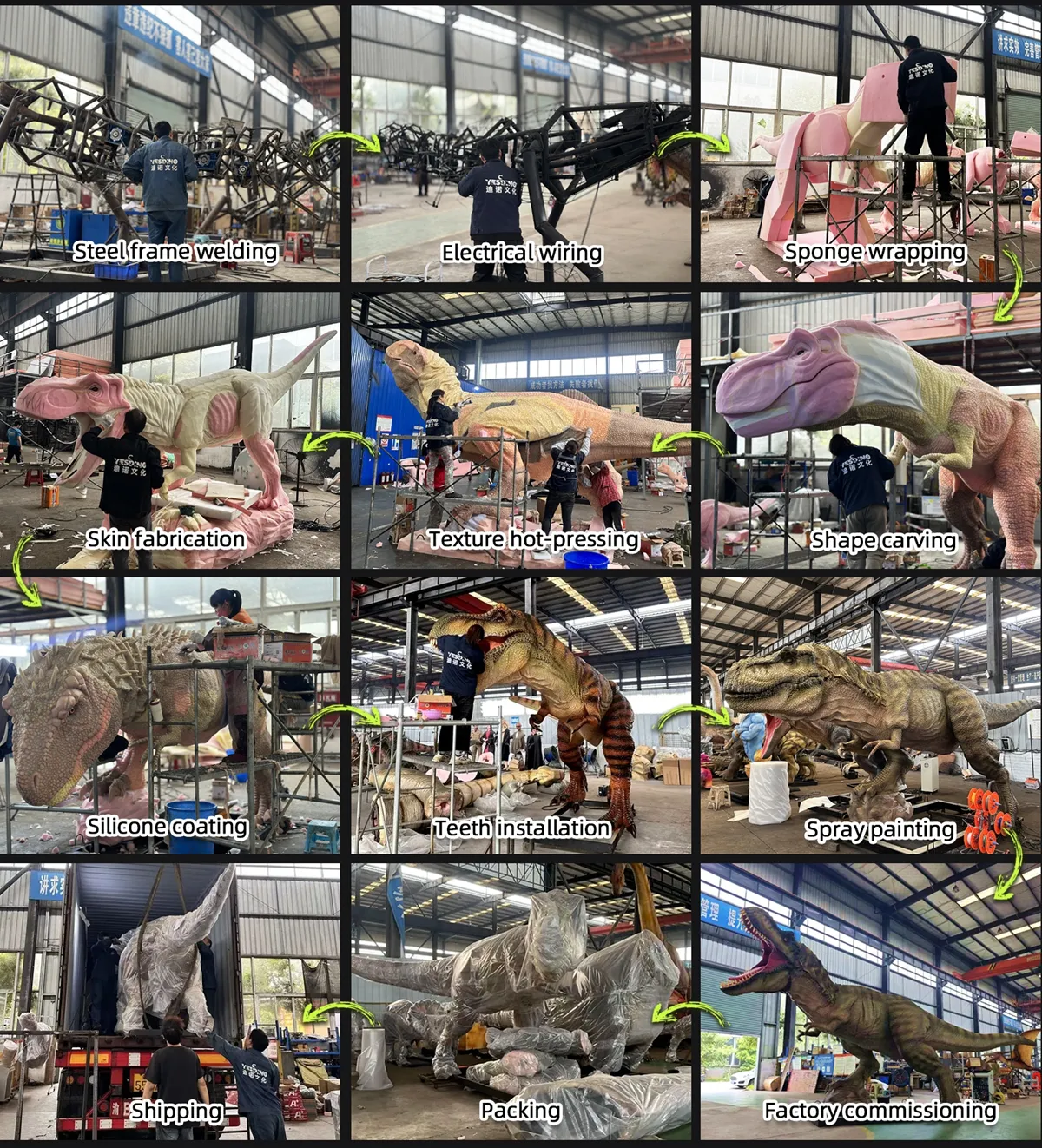
Production Process
In a science gallery the cricket is usually heard before it is seen. A visitor turns a corner, catches a chirp from a dim corner and walks over to find out what is making it. That order of events is worth designing around, which is why the sound here is the main effect rather than an accessory.
SKU YAI-007: 2 m long, 1.4 m tall, with other sizes built to order.
Why two metres
Two metres is where a cricket stops being a model and becomes an exhibit. At that length the wing veins, the antenna base and the leg spines are legible from a metre away, which is where a child stands while an adult reads the label.
Scale does not buy volume. A larger body needs a larger speaker and a larger cabinet inside it, and past a point the extra size adds to the crate without adding to the sound. If your gallery wants something that reads from the far side of the room, the honest answer is a different animal, not a bigger cricket.
Placement in a science gallery
Education centres, natural history halls and insect zoos suit this build. At 1.4 m it sits below an adult's eyeline and directly in front of a child, which is the right place in a room where the audience is eight years old.
Sound decides the position more than sight does. Near a hard wall the chirp bounces back at visitors from behind the exhibit, which reads as confusing. Under a soft ceiling or beside an air handler the sound disappears into room noise. The spot that works is usually a corner with one reflective surface and some distance from the plant room.
Sound first, then wings
The chirp comes from the wing stroke: the wings lift, scrape and close, and the sound is the result. Play the audio a beat late and the illusion collapses, because visitors watch the wings while they listen. Cue and wing cycle are tuned together on site, not separately.
Wing lift, abdomen pulse, a slow antenna sway and a small body rock make up the set. The abdomen is the quiet hero: a cricket at rest pulses slightly, and that movement is what separates a still model from an animal waiting.
Volume gets set with the room empty, then again with a school group in it. Children absorb high frequencies, so a level that sounded right at commissioning can read as thin on a busy Tuesday.
Antennae and the shell
The antennae are the fragile part of this animal. Long, thin and light is exactly the shape that takes the first knock in a crate, in a doorway, or from a visitor reaching over a barrier. They travel in their own tube and go on last during installation.
That is a maintenance decision as much as a shipping one. On an exhibit that travels or gets touched, antennae are consumable, so they are built as replaceable units with a connector at the base rather than as part of the head moulding. A spares set travels with the animal.
The body is Q235 steel, rust treated, with high-density foam carved to shape and a 5–7 mm silicone skin. Colour is layered translucent silicone, which lets the shell carry depth instead of a flat coat. A chitin finish is mostly about the light in the room, and matte reads better than gloss under gallery spots.
Getting it in
At 2 m the animal travels in one piece with the antennae boxed separately, so the crate is long rather than heavy. The narrowest door on the route and the turn at the top of the stairs are the two measurements worth taking first.
It stands on a plinth or a low platform with the base fixed down, into a screed floor indoors or onto a ballast plate on a mezzanine. Leave a service gap at the rear, about the depth of a person's shoulders, because the panels are at the back and the animal faces a wall.
Before you order
Send the room plan, the ceiling height, where the nearest socket is, and a phone recording of the room at busy time. That last one is unusual and useful: it tells us what the speaker is competing with.
One case where this is the wrong animal. A hall with continuous noise from other exhibits, hard floors and no soft surfaces: the chirp sits in a range that room noise eats, and the exhibit becomes a silent model with a moving wing. In that room a louder species fits better than more speaker.
Enquiry
Tell us the room, the age range of the audience, and whether the animal stays put or travels with a school programme. Power is configured at 110 V or 220 V, the electronics carry a two-year warranty, and the working range of −25 °C to 45 °C covers an unheated store room as well as a gallery. Freight, duties, certificates and installation sit outside the product price.
Where to go next
Two things come up in almost every enquiry on this build: how the size compares with the alternatives, and what it takes to get it on site. The park layout and theming strategies sets out the options side by side, and the size guide covering 3 m to 12 m builds covers pads, access and assembly. Budget planning sits in the spare parts and repair kit list.
For ideas on placing it, see exhibit planning walkthrough. The rest of the range is on animatronic insects, and if this one is the wrong size for the slot, 3m animatronic centipede for insect exhibits is the closest alternative.
Product Accessories

Packaging and Container Loading