Production Process
A three-metre centipede sits low. At 1.4 m it reads at hip height, and the part visitors stop for is the leg wave travelling the length of the body, half a metre from their hands. Raising it onto a tall plinth loses the flatness that makes a centipede look like one.
SKU YAI-012: 3 m long, 1.4 m at the highest segment.
Why three metres, and not five
A longer body needs longer legs to hold the proportions, and longer legs run a slower cycle. The wave reads as correct on a centipede because the legs are short and the offset between sections is tight. At five metres the legs grow with the body, the cycle drags, and what visitors see is a mechanism stepping.
What you give up is presence at distance. From the far end of a hall this is a low shape on a plinth, and people have to walk over before it does anything. On a deep gallery, a taller animal carries the room better.
Where it sits in a hall
Height is rarely the constraint at 1.4 m. Floor area is: three metres of animal, a standoff for the barrier, and the space a school group takes when it stops. Insect halls, natural history galleries and dark walk-throughs all work.
Outdoors it suits a hard standing with drainage and less so gravel, where the legs sit in the splash zone and the low panels collect grit. Low animals also live or die on lighting: one spot from above flattens the segmentation into a single dark band, while two lights at a shallow angle along the flank make the shell read.
Dozens of small movements
A centipede is the opposite of a T. rex in motion terms: no dominant joint to hide behind. The effect is dozens of small movements packed into a small volume, and the parameter that decides whether it looks alive is the phase offset between sections.
Set that offset evenly and the legs read as a conveyor, every section firing in turn. Add too much variation and it reads as a fault. What works is an uneven offset across a few sections, so the wave breaks and re-forms the way it does when an animal changes pace.
The mandibles get the reactions, but they are the last thing to tune. Legs first, face second.
Packed into a small volume
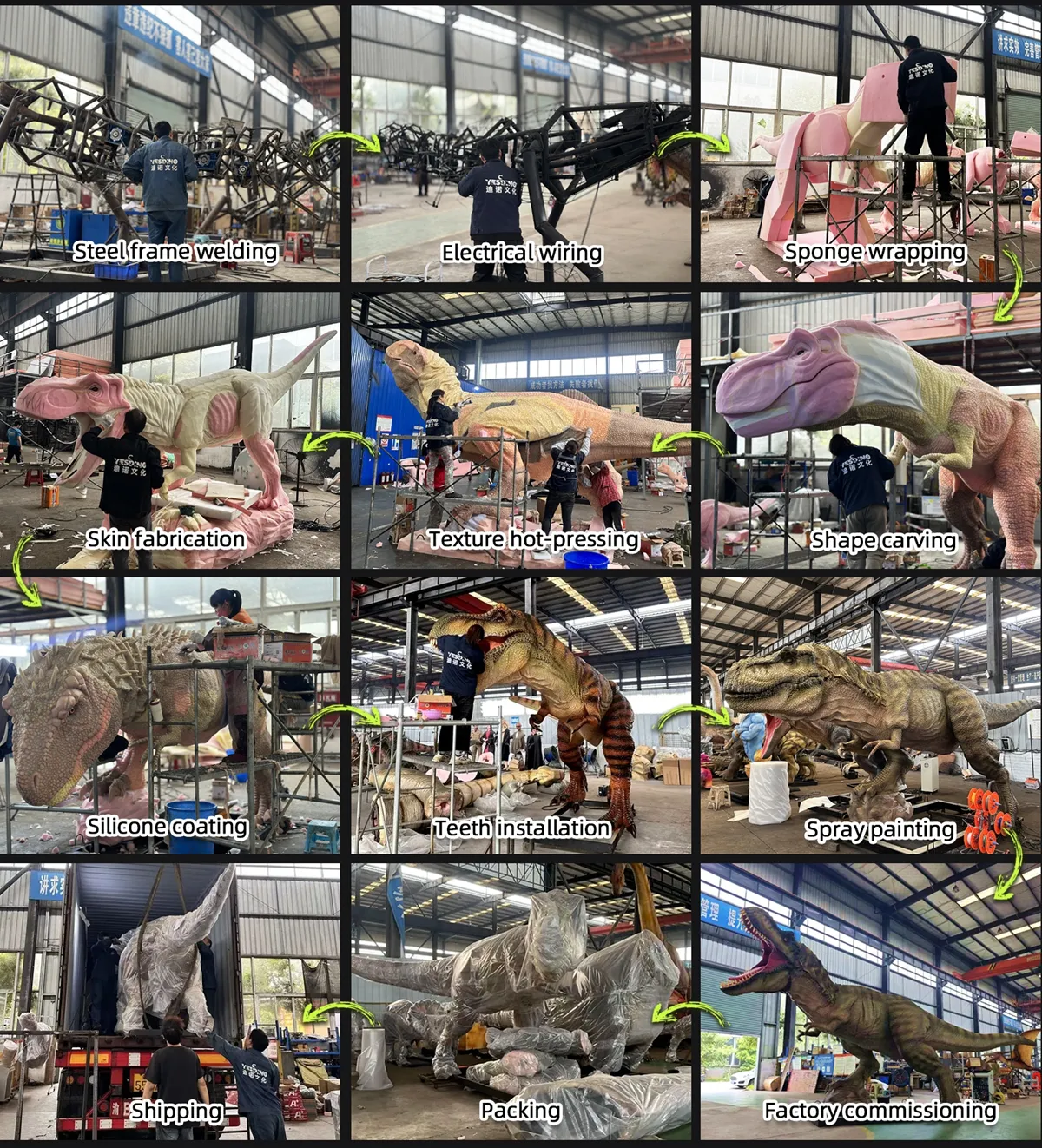
Structure is Q235 steel with rust treatment, high-density foam carved to the body volume, and a 5–7 mm silicone skin. Colour goes on as layered translucent silicone, so the tone sits in the surface rather than on top of it.
Insects are the hardest category we build, and the reason is density. A body 1.4 m tall holding dozens of small actuators leaves little room for a hand, the loom runs beside the mechanics instead of through them, and heat collects inside a closed shell. Sections are ventilated and the drive boards sit where air moves.
Service panels go on the underside of alternating sections. A panel on every section would put a seam on the surface the lights graze, and weaken the shell where the legs load it.
Shipping and setting it down
The body splits at segment joints and each leg pair travels on its section. The widest rigid part of the crate decides which door you can use, so the split is planned against the route rather than the drawing.
On site it stands on a low plinth or a levelled floor. Fixings into concrete are the simple case; on a stage deck or raised floor the base takes a ballast plate instead, which is heavier to move and leaves the floor intact.
Commissioning runs about half a day: leg cycle, phase offset, mat or proximity trigger, then a full timed loop with the barrier up. Settings are recorded and left with you.
Before you order
Send the floor plan with the viewing side marked, the ceiling height, where power lands, and whether the animal lives indoors or out. A photo from the visitor approach tells us more than a dimension list.
Two cases where this size is the wrong buy. A walk-through where visitors brush past, because knees and hands meet legs all day and a silicone shell is not a handrail. And a hall with fast traffic in a straight line, where a three-metre animal across the route becomes an obstacle rather than a stop.
Enquiry
Tell us the length of the wall or plinth it would sit against, and how close visitors get. If the hall has a theme, name it, because skin tone and lighting are set at build. Power is configured at 110 V or 220 V for the destination, electronics carry a two-year warranty, and freight, duties, certificates and installation are quoted apart from the animal.
Where to go next
Worth reading before you commit: the pneumatic versus hydraulic comparison for how the sizes compare, the cost breakdown with the seven price factors for what the ground has to carry, and the wiring concealment notes for where the money actually goes.
For ideas on placing it, see exhibit planning walkthrough. The rest of the range is on animatronic insects, and if this one is the wrong size for the slot, animatronic cricket for science exhibitions is the closest alternative.
Product Accessories

Packaging and Container Loading