


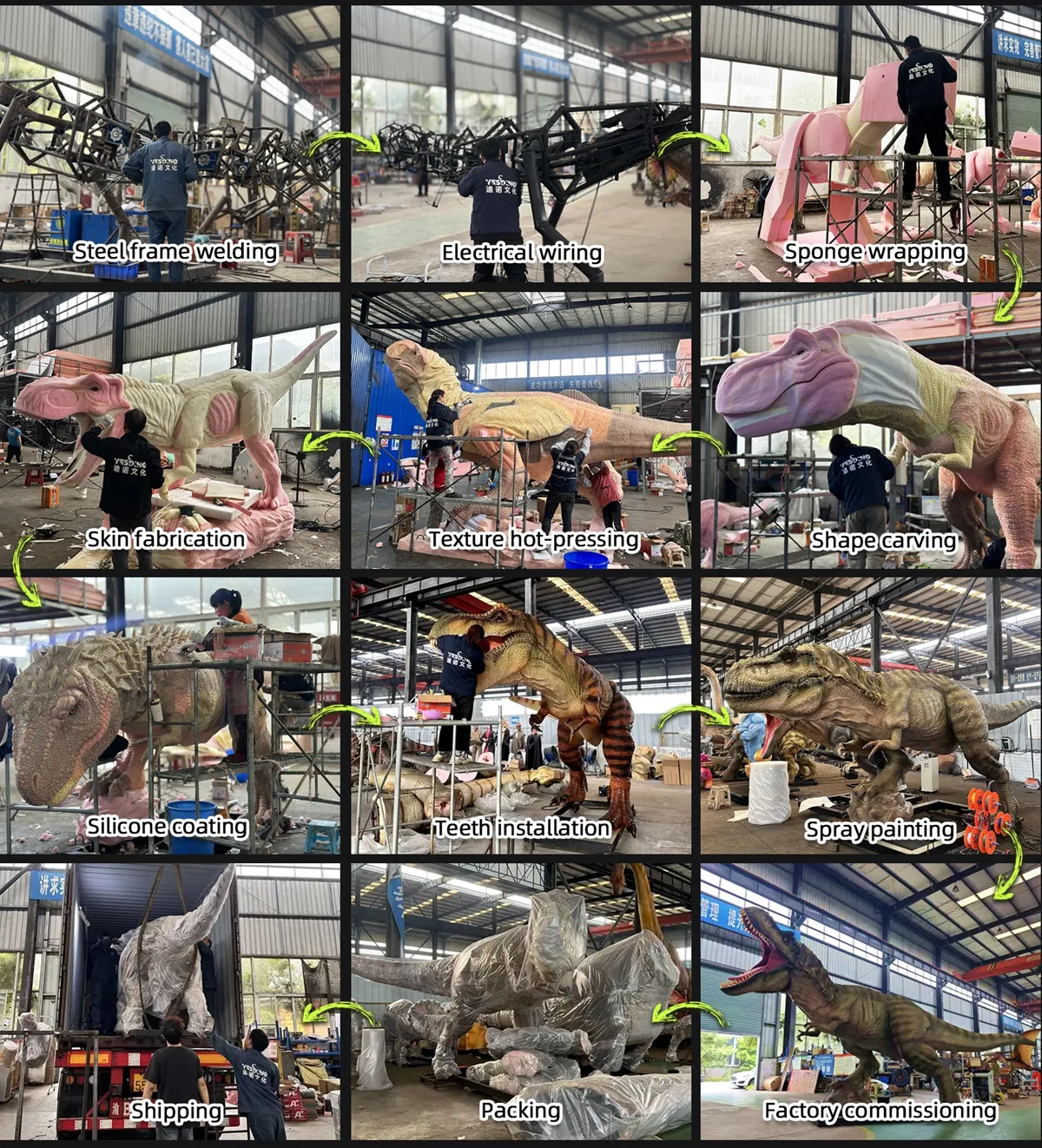
Production Process
A park with a 900 m trail, four animals and one ticket window. The predator at the entrance has to look like it costs more than the fence it stands behind, and it has to go up without a crane on a Tuesday. This build was made for that park.
Five metres long, 0.8 m across the body, 2 m at the head. Short enough to stand at a path junction, tall enough that the skull sits above a barrier at chest height on an adult.
Why 5 m is the entry-level predator
At 5 m you get the whole animal — heavy skull, jaw, the small two-fingered hands under the chest, a tail long enough to counterweight the front. Nothing is cropped or implied. What you do not get is a silhouette visible from the car park, and if that is the brief, this is the wrong size.
The economics are the point. One container, one crew, one day, no crane, no concrete footing. That combination is what makes a single predator affordable for a park that is still adding animals one season at a time.
Where it sits on the trail
Best position is on the outside of a bend, 2.5 m back from the path edge, facing the direction visitors arrive from. At that distance the head is above the barrier line and the animal fills the gap between two trees without standing in the walkway.
Two placement notes from trail work. Put it where the ground is level: a 5 m frame on a slope sits with one foot loaded and the tail low, and it looks wrong before anyone can say why. And keep 1.5 m of clear ground behind the tail — the sway needs it, and so does the person who has to reach the panel.
What moves at a gate
Neck turn, head tilt, jaw, blink, chest breathing, tail sway. The jaw carries the animal at an entrance, because that is what people photograph, and it is also the movement that gets set too wide. A heavy skull opening 30 degrees reads as a roar; 60 degrees reads as a puppet.
The trigger goes on the path side at 1.3 m, aimed 1.5 m upstream of the animal, with about 0.6 seconds between detection and the first movement — long enough that the animal seems to notice, short enough that a walking visitor is still in front of it. Aim it up the path rather than across it: a sensor set across a path fires at everyone who turns back for a second look.
Frame, skin and a wet season
Q235 steel frame, rust treated, foam carved for volume, silicone skin 5 to 7 mm, colour in translucent layers. Outdoor build runs from −25°C to 45°C, 110 V or 220 V configured to the destination, and the core electronics carry a two-year warranty.
Water is the thing that decides how an outdoor predator ages. It runs down the spine and collects where the tail meets the body, so that joint gets a seal and a drain path rather than a bead of silicone alone. Feet standing in wet grass wick moisture upward; a gravel pad under each foot costs little and adds years.
One container, one crew
The animal breaks into head and neck, torso, and tail, and at 0.8 m body width the sections load inside a standard 20 ft container with the base frame along one wall. Loading order matters: head crate first, tail last, so it comes out head last at the site and the torso is on the ground first.
On site, three people and a pallet truck. Four ground screws at 900 mm into soil, or four M10 anchors into a slab if the position is paved. The cabinet sits inside the torso behind a panel on the left flank, and the programme is set during commissioning and left on file, so a replacement technician can match it later.
Before you order
Send the trail plan with the position marked, a photo from the visitor approach, the ground surface and the distance to the nearest power. Tell us the barrier height and how close people get, and whether the animal is the first thing visitors see or the fourth.
Three cases where another size serves you better. Past 12 m of viewing distance, a 5 m animal loses the detail you pay for and an 8 m build earns its freight. A herd of four along one straight reads as repeated props; vary the sizes. On a site that floods, raise the pad — a frame in standing water is a monthly maintenance item.
Enquiry
Send the position on a plan, two photos of the approach, and the voltage at the site. Tell us the barrier distance and whether the animal faces the gate or the trail. We will send the footprint, the anchor layout and the container loading list, so the day it arrives is a day of assembly rather than a day of decisions.
Where to go next
Two things come up in almost every enquiry on this build: how the size compares with the alternatives, and what it takes to get it on site. The size guide covering 3 m to 12 m builds sets out the length options side by side, and the rental cost breakdown covers pads, access and assembly. Budget planning sits in the pneumatic versus hydraulic comparison.
For ideas on placing it, see what shipping a large animal involves. The rest of the range is on animatronic dinosaurs, and if this one is the wrong size for the slot, animatronic dilophosaurus for theme parks is the closest alternative.
Product Accessories

Packaging and Container Loading



