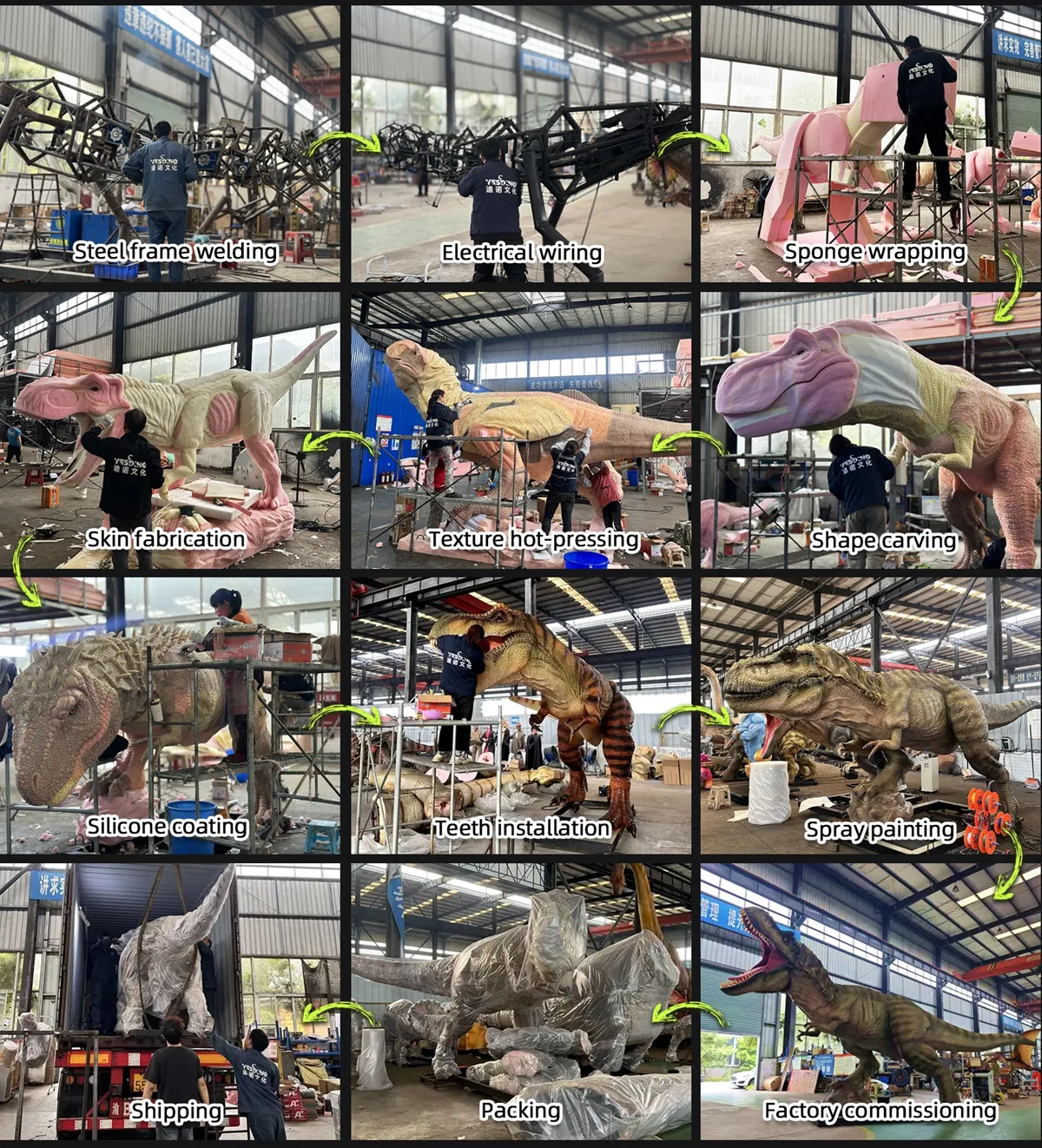
Production Process
At a photo point, the thing that decides whether the picture works is head height. Children get lifted, adults crouch, somebody ends up half out of frame. A skull at 2.2 m removes most of that fidgeting, because a standing adult is already in the right place.
This build is 5 m long, 0.8 m across the body, and 2.2 m at the top of the skull — long enough to fill a phone frame at three metres, shallow enough to sit on a plinth.
The half metre that makes the photograph
A five-metre animal at 1.6 m of head height is a diorama. At 2.2 m the skull sits above an adult's crown and the jaw line falls across the shoulder. People stand at the flank, turn slightly, and the head lands in the upper third of the frame.
The trade is proportion. A short body under a head held that high looks leggy from the side, so this variant is posed with the neck angled down and forward; the front three-quarter reads heavy in front, and straight side-on is the weaker angle. At 5 m, someone standing 3 m from the shoulder gets the whole animal and themselves in a phone frame.
Queue geometry around a photo
A photo stop holds a group for forty to sixty seconds, longer than a walk-past animal and shorter than a show. Budget 3 m of standing room off the path edge, on the lit side, so the queue forms beside the animal rather than in front of it.
The plinth wants to be about 1.2 m wide for a 0.8 m body: 200 mm of margin each side is enough to kneel on and keeps feet off the skin. Barriers sit 0.9 m out from the flank, so someone can stand shoulder to jaw without touching the animal. Angle the animal at about 45 degrees to the approach, and visitors step off the path, take the shot, and rejoin.
What moves, and what holds still
Head turn, neck pitch, jaw, blink, tail sway and a body lean. The neck earns its programming time here: a slow pitch up and hold gives a photographer time to press the shutter. We set a hold of about four seconds at the top of the rise.
The jaw stays quiet during the hold. A snap mid-photo produces the open-mouth picture everybody has, and it also moves the head off the mark. Two-fingered hands and the short forelimbs do almost nothing; on this build they are there for the close-up, not the loop.
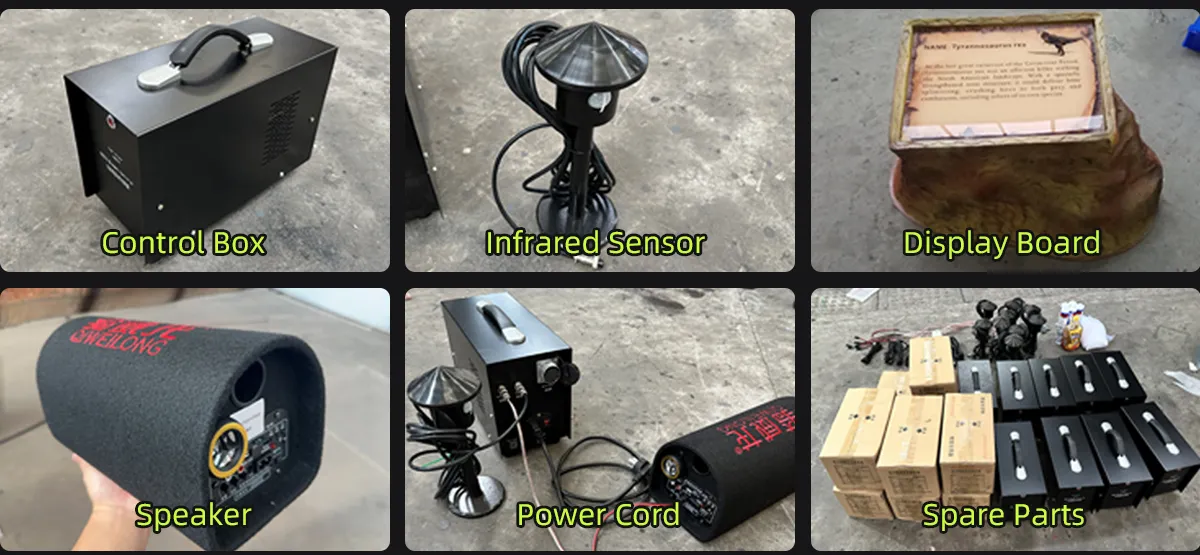
Triggering is a mat, not a beam: 900 by 600 mm, set 1.5 m in front of the flank, so the animal reacts when someone steps onto the mark. Delay 2 s, which puts the head lift at the moment the phone comes up.
Skin, colour and camera light
Q235 steel frame, rust-treated, high-density foam carved to shape, 5–7 mm silicone skin, colour in translucent sprayed layers. The head and jaw edge get the thickest build, because that is where hands and selfie sticks arrive. The skull is heavy in the mould, so the neck actuator is sized for it.
Lamp colour temperature is worth a conversation. Under 3000K warm light the skin photographs orange and skin tones go red beside it; 4000K neutral keeps both plausible. Working range is −25°C to 45°C, 110 V or 220 V configured at build.
Getting it onto the plinth
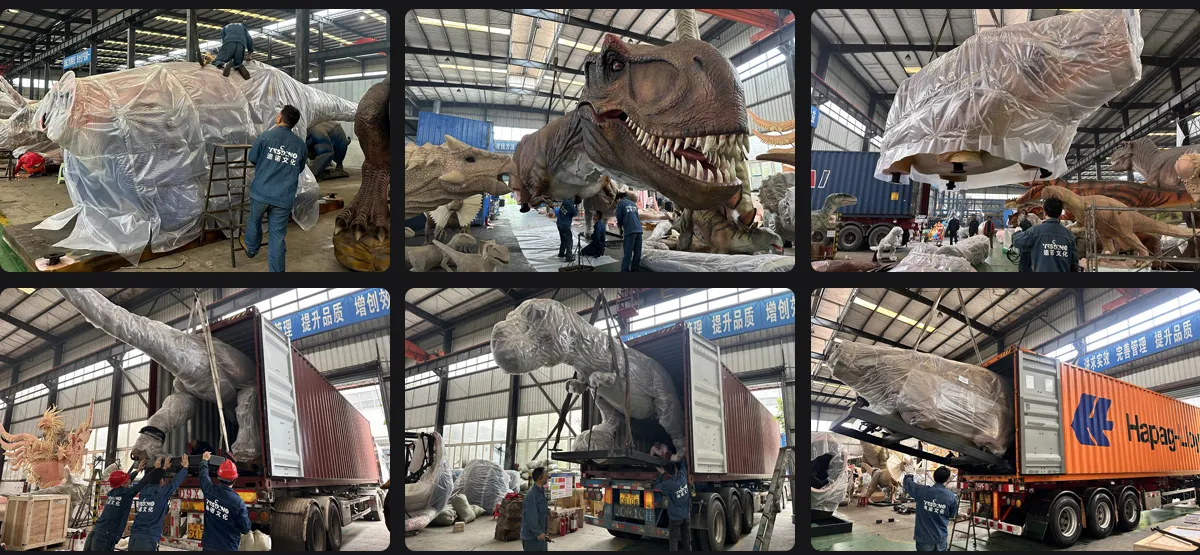
Two sections and a base frame, about 1,100 kg crated, on one pallet plus a long crate for the tail. A 0.8 m body goes through a 1 m gate; the crate does not, so measure the route at the crate. A telehandler lifts it onto a 400 mm plinth in under an hour.
The cabinet sits at the rear of the base frame with the door on the side away from the camera position, and 600 mm of clearance. Photographers do not move for a service hatch, and a hatch under the shooting side gets propped open all day.
Before you order
Send a photograph from where the visitor will stand, at eye height, with something in it for scale. Add the path width, the plinth detail and the light direction at the busiest hour, plus the lens and distance if a ride camera is involved.
One case against this size: a trail where the animal is meant to read as a silhouette from thirty metres. The height that helps a photo makes it thin at distance, and a longer build does that job better. A photo stop without a marked standing spot also collects people in the middle of the path.
Enquiry
Send the standing position, the light direction and the path width. We can set the hold length and the mat position to the shot you want rather than to a default loop, and posture and colour are made to order.
Where to go next
If you are still comparing options, start with the cost breakdown with the seven price factors — it lines up the builds by length and reach. Site work is covered in the spare parts and repair kit list, and the size guide covering 3 m to 12 m builds lists the factors that move the price.
For ideas on placing it, see layout strategies for themed trails. The rest of the range is on animatronic dinosaurs, and if this one is the wrong size for the slot, animatronic triceratops for events is the closest alternative.
Product Accessories
Packaging and Container Loading