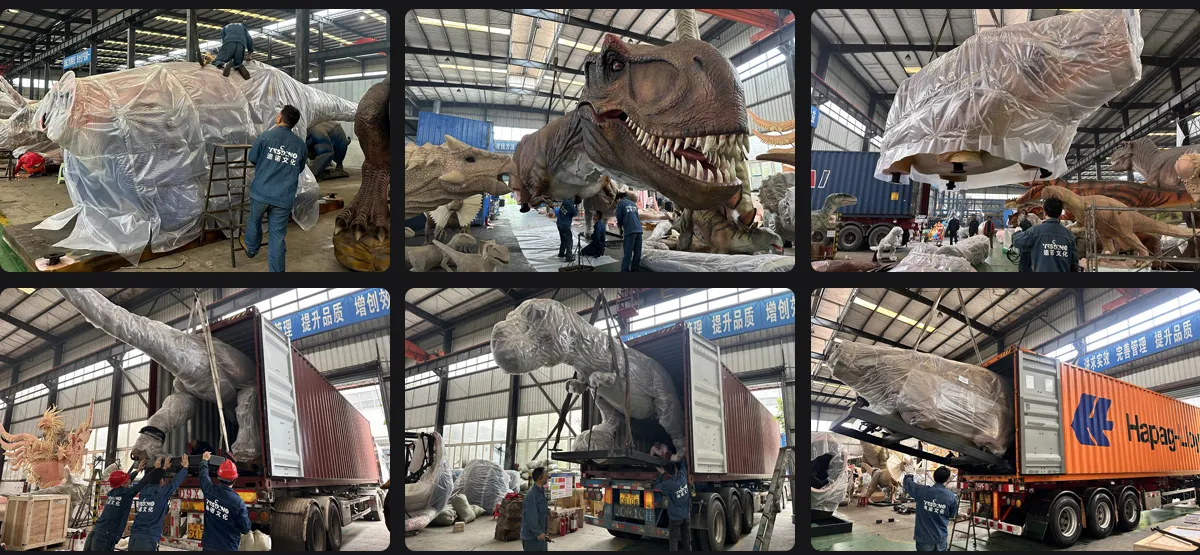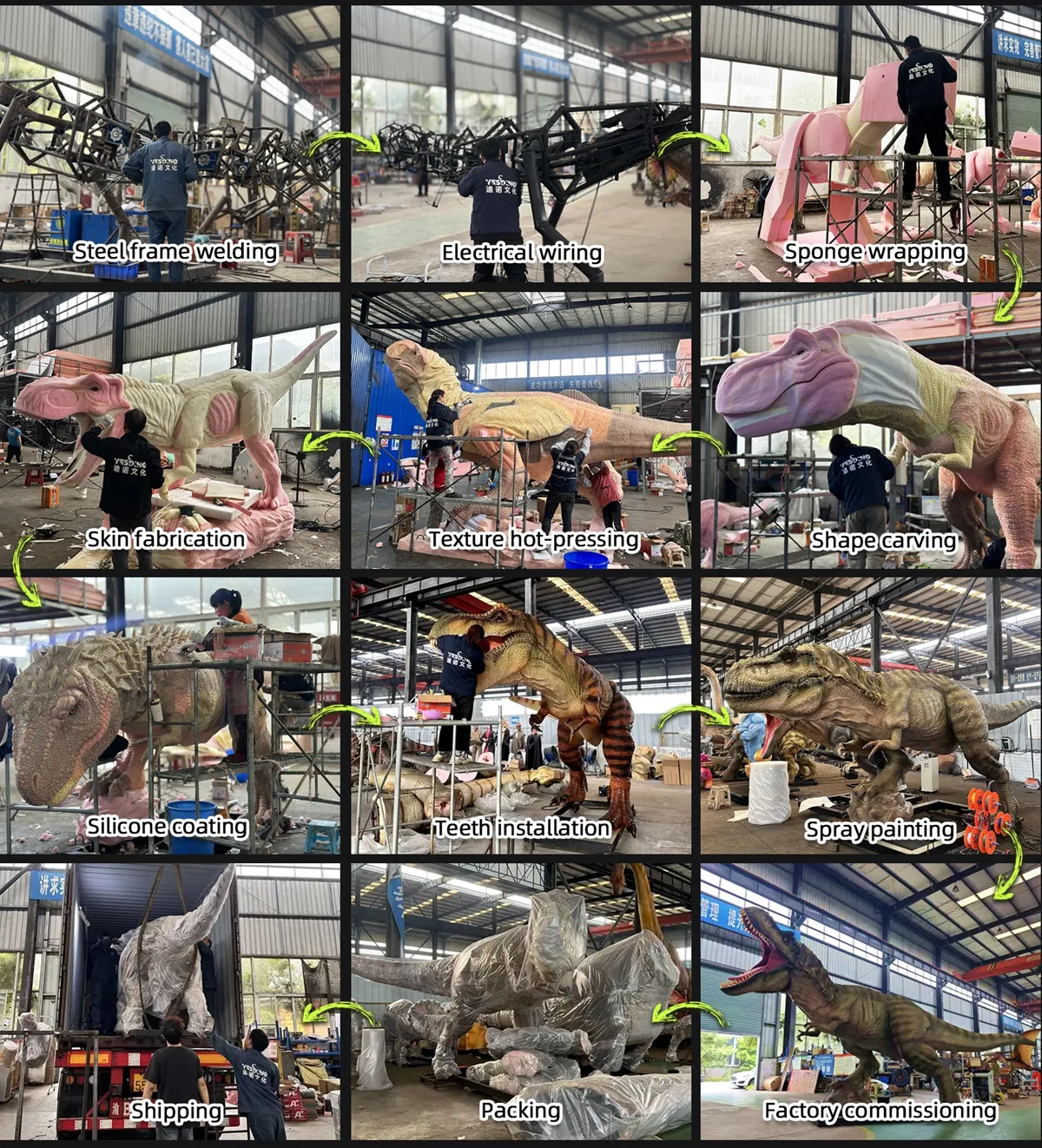
Production Process
Stegosaurus is the easiest dinosaur to identify from a bad photograph. Plates on the back, spikes on the tail, head down — nobody has ever confused it with anything else. That silhouette is also the reason it works as a landscape piece: it reads from the far side of a car park, in silhouette, at dusk.
SKU YKL-072: six metres long, two metres to the top of the tallest plate, 0.8 m across the body. A compact adult — the largest known specimens reached about nine metres — sized so it sits comfortably on a trail without eating the path.
Seventeen plates, mounted to stay put
The plates on a real animal sat in two alternating rows along the back, largest over the hips, tapering towards the neck and tail. On a model they are the parts that fail first if they are built as decoration bolted to a skin.
We build them as plates on their own mounts tied into the spine frame, with the skin carried around the base of each one rather than stretched over it. Two reasons: the plate keeps its edge under wind and handling, and the joint stays closed when the body flexes. A plate mounted on the surface opens a crack at the base within a season, and once water gets behind it the repair is a reskin, not a touch-up.
| Part | How it's built | What it means on site |
|---|---|---|
| Back plates | Separate mouldings on spine-mounted steel brackets | A damaged plate can be replaced on its own |
| Tail spikes | Four spikes on the last tail section, tied to the tail frame | They travel with the tail sweep instead of being static |
| Body skin | Foam volume, silicone 5–7 mm, layered translucent colour | Local touch-up rather than a panel repaint |
The tail is the interactive part
Four spikes on the end of a swinging tail is the reason this animal draws a reaction that a Brachiosaurus never gets. On the model the tail runs on its own drive with end-of-travel protection, and the spikes are mounted to the tail frame so they move as one piece rather than wobbling independently.
Set the sweep so the tip stops short of the barrier line. Visitors lean; a tail that reaches the barrier will eventually meet somebody's shoulder, and the conversation afterwards is not about the exhibit.
A small head, correctly
Stegosaurus had a skull roughly the size of a dog's, carried low, with a beak and small leaf-shaped teeth. Models that give it a broad, heroic head look wrong to anyone who has seen the skeleton, and the low browsing posture follows from the same anatomy — the animal fed close to the ground, not up in the canopy.
The old story about a second brain in the hips is worth mentioning only to bury it: the enlargement in the spinal canal was a glycogen body, and there is no evidence it did any thinking. If your exhibit carries interpretive panels, this is a good one to include — visitors ask about it more often than you would expect.
Five movement groups
Head left and right, neck up and down, jaw open and close with a synchronised roar, blinking eyes, and the tail sweep. There is no forearm group because there is nothing useful to move — the forelimbs are short and carried low, and animating them adds a hinge without adding character.
On a low-headed animal the neck group matters more than the head group. Bringing the head up to visitor height and letting it drop back to grazing is the movement that makes the model feel like it is doing something, rather than posing.
Colour, and why plates are not always grey
Nobody knows the plate colour, which means it is a design decision rather than a reconstruction. Two schemes sell best: a muted olive body with warm oxide plates, which photographs well against green planting, and a dark grey body with pale plates, which reads as museum reconstruction and suits stone or concrete settings.
Pattern and level of wear are specified per order — mud staining low on the legs, faded patches across the plate faces, a duller finish on the tail. Send a photo of the location and we'll suggest a scheme that holds up in that light rather than shipping the default.
Specification and delivery
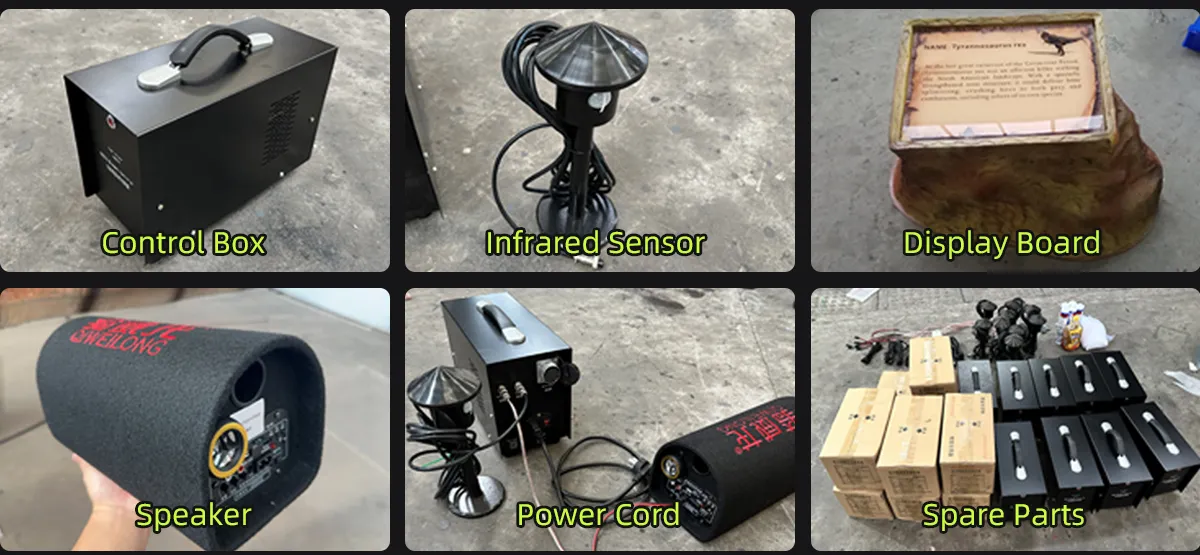
Welded Q235 steel frame with anti-rust treatment, high-density foam volume, silicone five to seven millimetres, 110 V or 220 V set at build, working range −25 °C to 45 °C. The animal ships in sections with a base frame, control cabinet, sound system, wiring diagram and calibration sheet. Freight, duties, certificates and installation are quoted separately and are not part of the product price.
Send the site photo, the viewing distance and the ground surface. If the exhibit goes on grass or gravel rather than a pad, say so early — it changes the base design, and it is much cheaper to decide before the frame is welded than after.
Where to go next
If you are still comparing options, start with the cost breakdown with the seven price factors — it lines up the builds by length and reach. Site work is covered in the spare parts and repair kit list, and the size guide covering 3 m to 12 m builds lists the factors that move the price.
For ideas on placing it, see what shipping a large animal involves. The rest of the range is on animatronic dinosaurs, and if this one is the wrong size for the slot, 5m animatronic t-rex for dinosaur parks is the closest alternative.
Product Accessories
Packaging and Container Loading