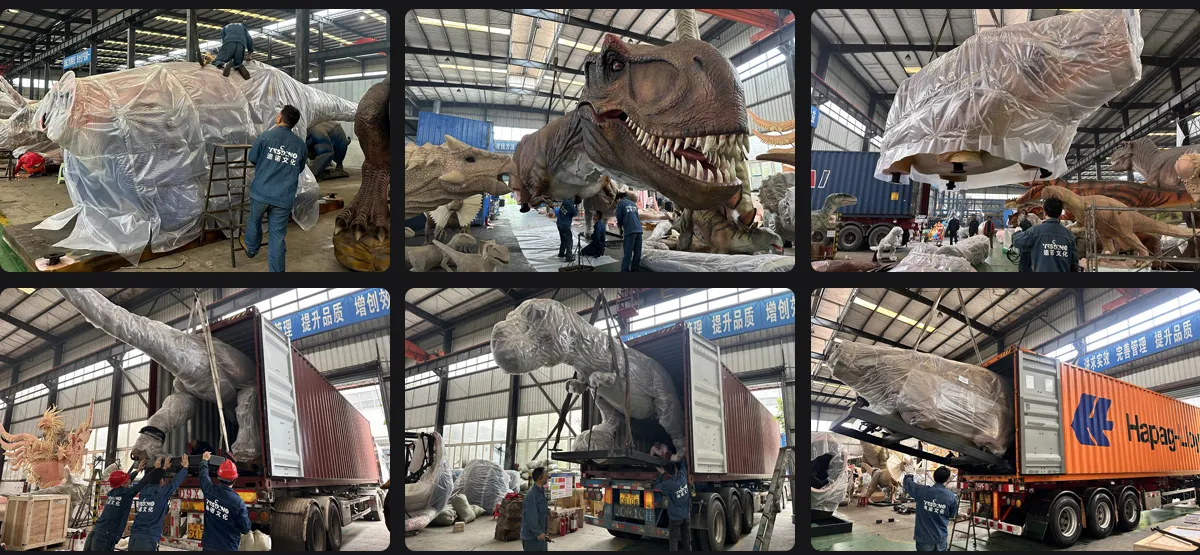


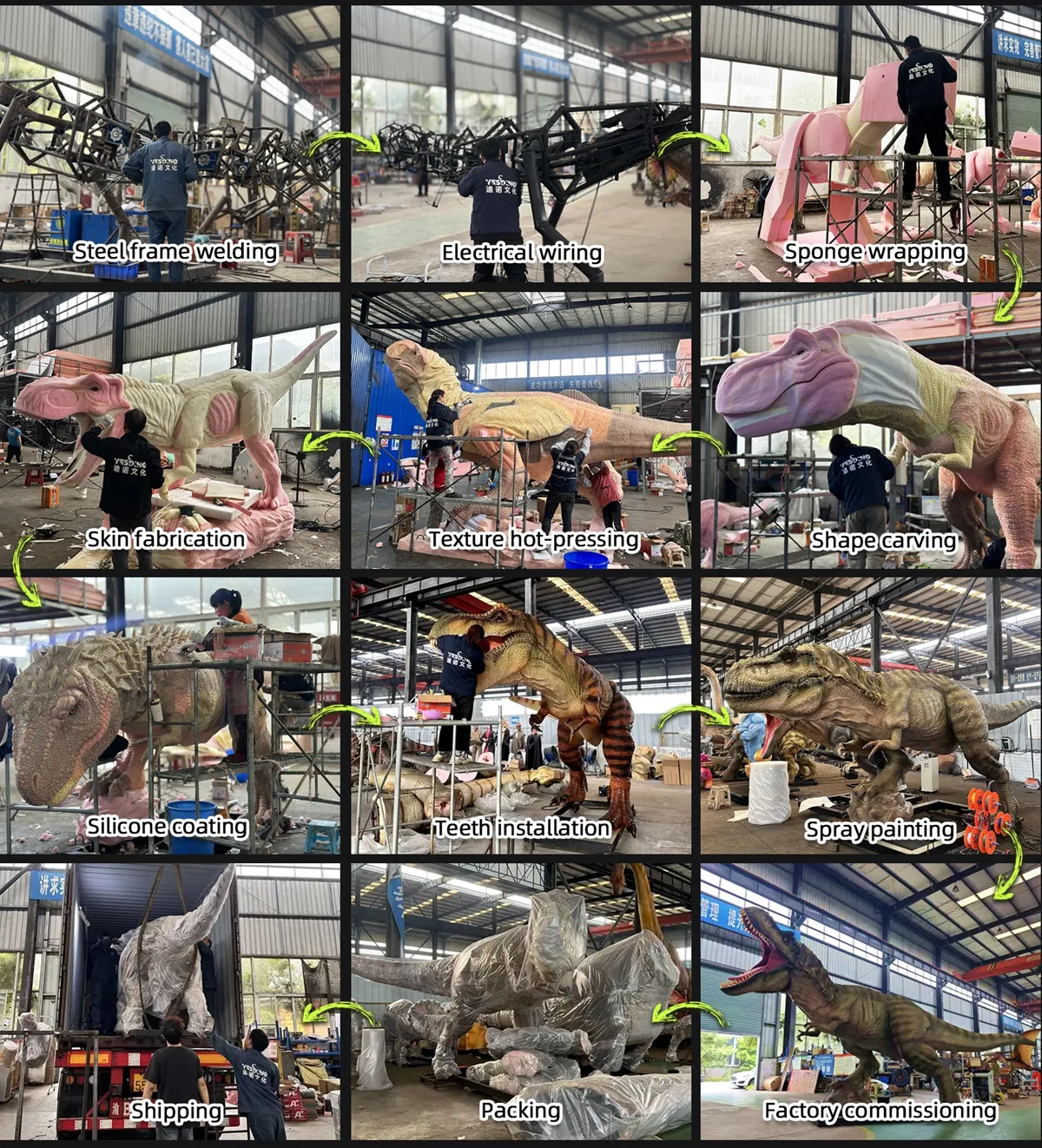
Production Process
Watch seven-year-olds meet a raptor and the geometry is obvious: at 1.5 m the head is level with their faces, and the animal has to be close enough to touch through a fence. That is a different product from the film-scale build standing two metres up.
Three metres long, 0.65 m across the body, 1.5 m at the top of the head.
Half the height changes the job
A tall raptor is a silhouette animal: it works at ten metres, over a barrier, in a photograph taken from below. At 1.5 m this one works at one to three metres, where a visitor can see the claw, the teeth line and the way the head tracks them. Put it behind a wide barrier with a long approach and it shrinks into a bird.
What you give up is presence at distance. A three-metre animal cannot anchor a plaza or fill a gateway. What you gain is interaction: it can sit on a low plinth inside a play trail, at the end of a rope tunnel, or on a raised deck where children come up to its eyeline without a fence between them.
Trail stops and low plinths
At 0.65 m wide the body sits comfortably on a plinth 900 mm square, which is small enough to place inside a play area without blocking a route. A 1.5 m path in front of it gives a comfortable viewing distance for a family and still lets a pushchair pass behind.
Rope barriers at 600 mm put the chest at a child's shoulder height, so the head shows over the rope without an adult lifting anyone. On a raised deck, keep 900 mm between the edge and the head's travel; the neck reaches further forward than people expect.
The claw, the tail, the hands
The sickle claw on the second toe is the detail children look for, so it gets its own small lift during the lean-forward part of the cycle, and the other toes stay planted. Three-fingered hands work as short grasping movements rather than big reaches; at this scale a wide arm gesture reads as a cartoon.
The tail is stiff, which sets a limit on sway: it moves as one piece from the hips, a few degrees each way, and that stiffness is what makes the animal look balanced when it turns. Head turn is the fastest axis in the set, jaw follows it, and blinking runs on its own timer.
Built for hands and weather
Q235 steel frame with rust treatment, high-density foam carved to volume, silicone skin at 5–7 mm, colour sprayed in translucent layers. On a children's trail the wear comes from hands and from bags set down against the flank, and the skin takes both: a scuff is tinted back rather than repainted.
Two settings are worth adjusting on a family site. Sound runs lower than on a park build, because a close scream at head height is a different experience from one twenty metres away. Lighting matters too: at 3500K the skin looks warm and the eyes catch a highlight; at 5000K the animal photographs colder and the mouth interior goes grey.
Two people and a doorway
The build ships as body, head-and-neck and tail, base plate separate. The widest crate is close to 0.65 m, so a standard 0.8 m door is enough. Two people lift the sections, and the whole assembly is a morning's work rather than a crane day.
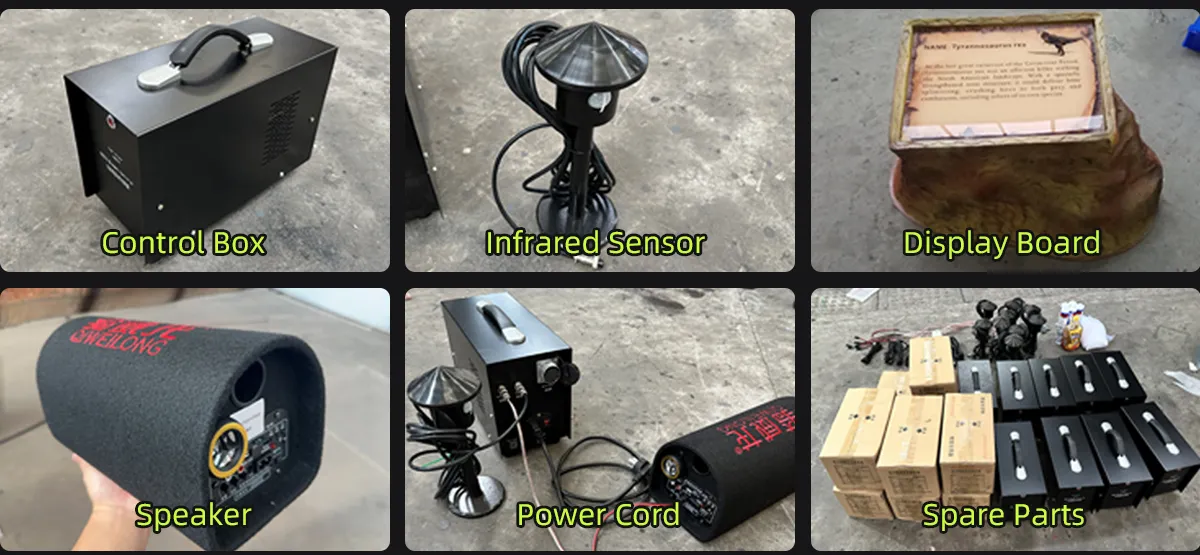
Order: base plate anchored to the plinth or paving, body on, neck and head onto the shoulder coupling, tail last, skin closed at the joints. The cabinet sits under the body behind a lockable panel, and the panel faces away from the rope line so a technician is not opening it over children's heads. On paving, four anchors into the slab; on a deck, a spreader plate under the base.
Before you order
Send the plinth or deck dimensions, the barrier layout, the walking route past the animal and the surface it stands on. Tell us the age band you expect most, since that decides the head height relative to the barrier and how loud the sound is set.
Where a 1.5 m animal is the wrong fit. A site where visitors approach from fifteen metres or more, because a 1.5 m animal needs proximity to work. And an unsupervised contact zone where adults reach over a low barrier, since the head travel at adult chest height invites exactly that; a taller build with a set-back fence is the easier arrangement.
Enquiry
Send a photo of the plinth or the deck, the barrier plan, and the age range you expect on site. Tell us whether the animal runs all day or on a timed cycle.
The animal price excludes freight, duties, certificates and installation. A barrier layout sketch can come with the quote if the display is still being drawn.
Where to go next
Two things come up in almost every enquiry on this build: how the size compares with the alternatives, and what it takes to get it on site. The cost breakdown with the seven price factors sets out the length options side by side, and the spare parts and repair kit list covers pads, access and assembly. Budget planning sits in the size guide covering 3 m to 12 m builds.
For ideas on placing it, see layout strategies for themed trails. The rest of the range is on animatronic dinosaurs, and if this one is the wrong size for the slot, animatronic baryonyx for jurassic theme parks is the closest alternative.
Product Accessories
Packaging and Container Loading