Production Process
The request usually arrives after a tenant change: a corner on level two has gone empty, the centre wants something in it before the weekend, and nobody knows what will lease the space next. The animal is furniture with a face, and it has to move again when the lease is signed.
This one is 5 m long, 0.8 m across the body, 2 m tall. Small enough to stand on a mall floor without a barrier, big enough to hold a corner on its own.
Five metres of decoration, not an exhibit
An exhibit is lit and staffed. A decoration is walked past forty times a day by the same people and has to stay interesting without anyone explaining it. That pushes the design towards silhouette and posture rather than detail: at 2 m tall, head carried low and forward, the animal reads from twenty metres away, which is the distance that matters in a corridor.
The trade-off is the close look. At 5 m long you get a convincing head, a strong neck and a heavy body, and the tail is proportionally shorter than a full-size animal would carry. Visitors who crouch by the tail can see where the last section joins, at 1.4 m where floor lighting falls off.
The escalator view
The escalator is the free viewing platform in every centre, and it looks down at roughly thirty degrees. A 2 m animal placed four to six metres off the escalator base shows its whole back and skull in one frame, which is why the slot matters more than the finish. Set it directly underneath and you get a view of the spine and nothing else.
People also see the animal from behind on the way down, so the tail gets as much attention as the face, posed with a slight curve that stops the rear view reading as a straight tube.
Movement that survives a lean
Five movements run here: jaw, neck turn, head tilt, tail sway and blink. A slow idle cycle holds it between triggers, and the head turn stays slow — a snap at head height startles small children and pulls attention from the shops behind.
The neck is the group to set carefully: visitors stand at skull height, so a swing that travels too far pushes the nose into arm's reach. We stop the turn about 0.4 m short of the widest point, and the sensor sits under the base plinth at 900 mm facing the walking direction, with a 0.6 s delay so it answers someone who has stopped rather than a passing trolley.
Skin under hand pressure
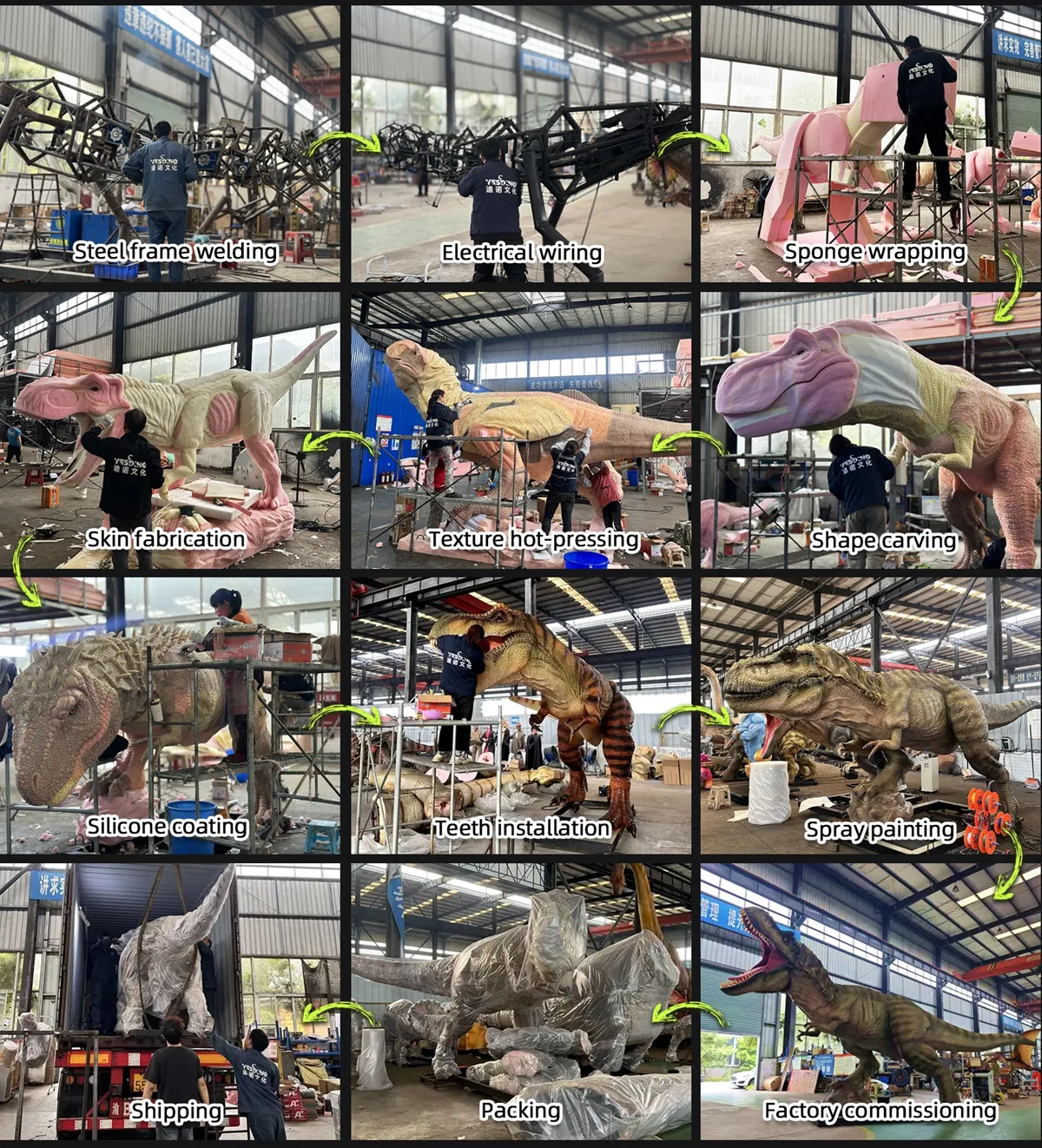
Silicone at 5–7 mm over carved foam, colour sprayed in translucent layers. The thickness is the part that matters on a mall floor: people lean on a dinosaur the way they lean on a car in a showroom, and a thin skin behind a handprint stays deformed. Under it, a tube frame of ribs every 300 mm carries that load back to the steel base.
The finish is a matte sealer rather than a gloss. Gloss looks better in a photograph and worse in a corridor, because every downlight lands on the hide as a hot spot. A 3500 K lamp gives the silicone a warm cast; a 4000 K lamp pulls it grey, so if the centre is switching lamps, approve colour on site afterwards.
A reset in one night
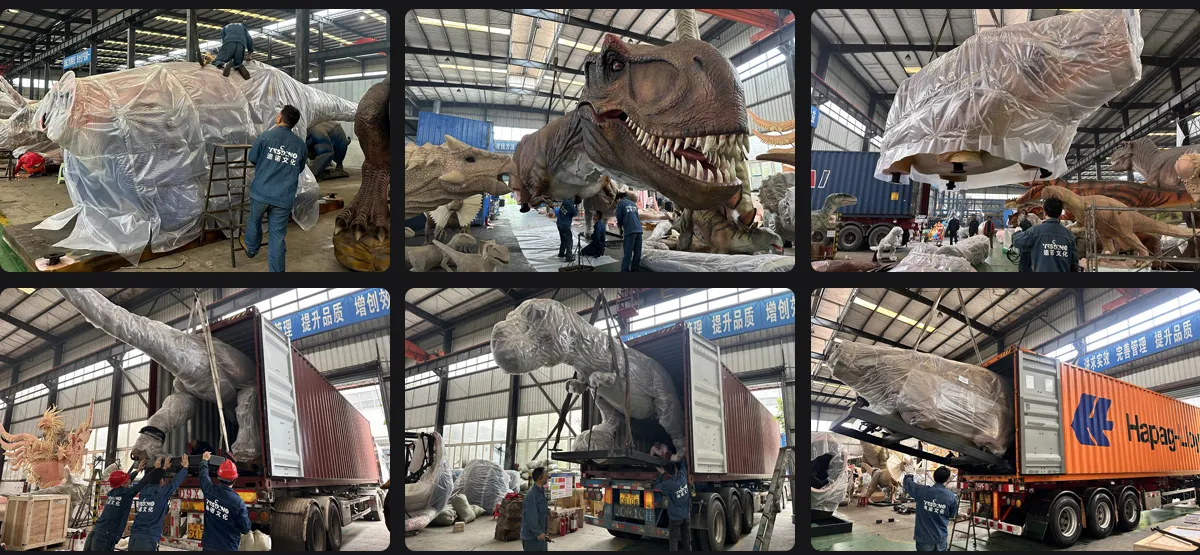
It comes apart into head, body, tail, two legs and a base frame, with the cabinet as a separate box. Sections are keyed, so the head lands one way on the neck collar. Two people with a pallet truck move the whole thing in about two hours.
Anchoring is deliberately light: the base is ballasted on rubber-faced feet, with four M10 anchors where the centre allows drilling. The cabinet faces the back corridor, not the shopper side, and wants 600 mm of door swing. Where a floor is tiled over a membrane, ballast alone is often the simpler choice.
Before the floor plan is signed
Send the plan with the escalator marked, the ceiling height, the service lift dimensions and the voltage at the nearest socket. A photo from the escalator at eye level shows what the animal will be seen against, which no plan does.
Two cases where a five-metre decoration is the wrong buy. A centre with a 12 m atrium and a busy event programme will want a larger animal, since a 2 m piece disappears in that volume. A slot on a main fire escape route adds footprint constraints that a decoration budget rarely covers.
Enquiry
Tell us the slot, the lease length and whether the animal has to move again. Short leases change the anchoring recommendation, and designing for a move is easier than improvising one. Freight, duties, certificates and installation sit outside the product price.
Where to go next
If you are still comparing options, start with the wiring concealment notes — it lines up the builds by length and reach. Site work is covered in the park layout and theming strategies, and the cost breakdown with the seven price factors lists the factors that move the price.
For ideas on placing it, see layout strategies for themed trails. The rest of the range is on animatronic dinosaurs, and if this one is the wrong size for the slot, animatronic dilophosaurus for exhibition halls is the closest alternative.
Product Accessories
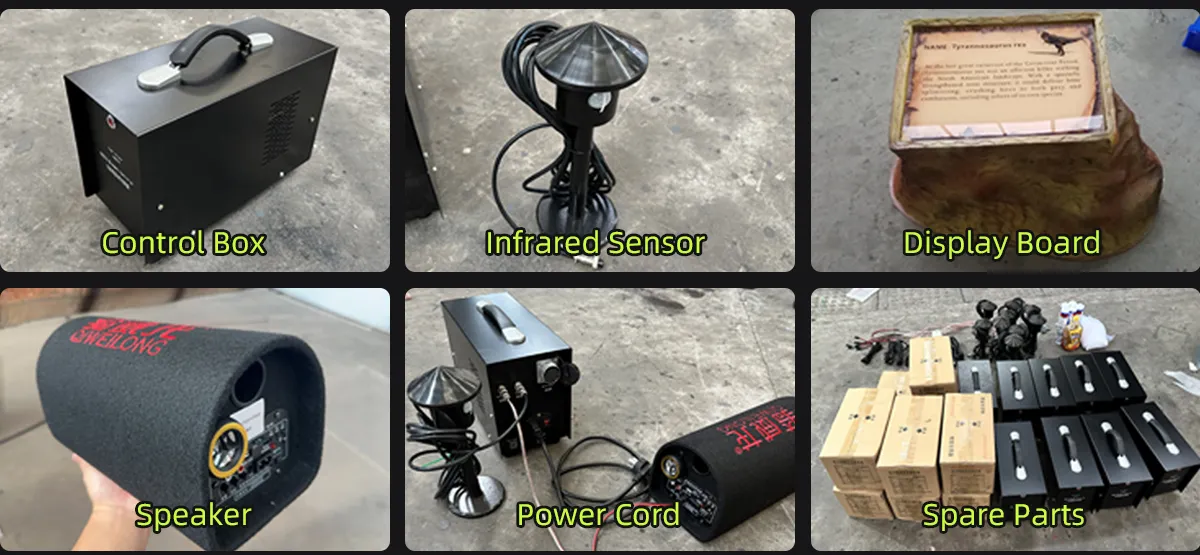
Packaging and Container Loading