


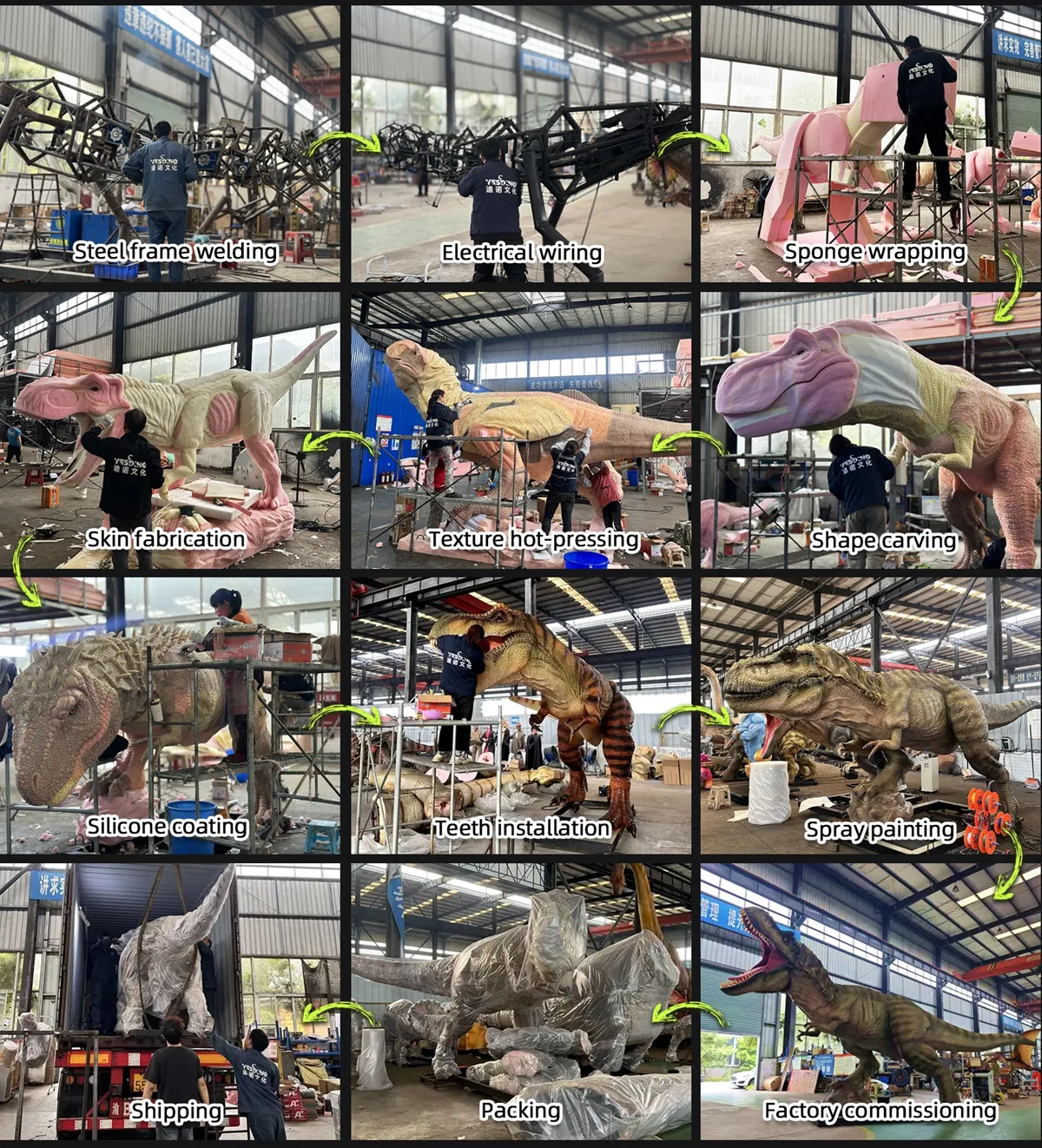
Production Process
The hall opens at nine, the aisle carpet is down, and by half past nine there is a knot of people at the corner of stand 412. Not because of the stand. Because there is a five-metre predator on it, head turned toward the walkway.
This build is 5 m long, 0.65 m wide across the body, 2 m to the top of the skull. It fits a 6 by 3 m stand with room for a counter, and it comes apart into sections one lift door will take.
A booth animal, not a park animal
The two jobs are different. A park animal runs eight hours a day for years, mostly at a distance, and gets serviced from the back. A booth animal runs six hours a day for three days, at arm's length, and has to survive being built and struck inside a single night each time.
So this one is specified for handling: fast section splits, ballasted base, a cabinet that opens from the aisle side. The 5 m length is long enough to stop a person walking past at their usual pace, and short enough not to swallow the stand budget.
Footprint and the line of sight
On a 6 by 3 m stand, set the body along the back wall and let the tail end sit into a corner. The head lands near the aisle corner, which is the only place it can be: a 5 m animal turned across the stand leaves nothing for the counter, and visitors end up queueing in the neighbouring pitch.
Aim the length at the aisle rather than across it. From fifteen or twenty metres down the walkway the horns break the outline of the head, and that silhouette is what pulls someone out of a stream of booths. Standing at the head, visitors get the jaw and the deep skull instead, so both views work for different distances.
Movement in an aisle
Neck, head turn, jaw, blink, tail sway and breathing, with a twitch on the reduced forelimbs. At this range a fast movement shows the mechanism, so the programme is slowed: a head turn takes about two seconds, and the jaw opens and holds before closing.
The trigger matters more than the motion. A proximity sensor on the aisle side at about 2.5 m, with a delay of 1.2 seconds, means the head arrives as people draw level rather than as they approach. Set it to fire instantly and the animal is already looking away before anyone has read the signage.
Skin on a show floor
Q235 steel frame, rust-proofed, foam body, silicone skin 5-7 mm, translucent colour layers. Show floors are harder on a finish than a park path: bags, trolleys, lanyards, and a steady stream of hands on the flank at 0.65 m from the edge of the stand.
A matte topcoat marks less than a gloss one under hall lighting, and a pigment kit goes in the crate so a scuff on day one does not read as damage on day three. Under the 4000 K lamps most exhibition halls use, warm browns drift grey; we test the mixed colour under that temperature before it is sprayed.
One night to build
Four sections plus the base frame, all under 0.8 m wide, through a 1.6 m lift door. Two technicians and a pallet truck: about four hours from crate to running. Vehicles are usually banned from the floor after nine, so the crates come in on the trolley and get broken down at the stand.
Anchors are rarely allowed in a hall, and bolting through carpet into another company's slab is out of the question, so the base is ballasted and the edges tuck under the stand's platform skirt. Cables run in a rubber ramp under the carpet, not across the aisle. The cabinet door faces the back of the stand, not the walkway.
What the venue decides for you
Send the stand dimensions, the aisle width, the power drop position and the rigging height. Hall power is often 220 V at a single point behind the stand, which decides where the cabinet sits; the animal is configured for 110 V or 220 V at build, so this is settled before the crate is packed.
Three cases where I would steer you elsewhere. A 3 by 2 m stand, where 5 m of animal leaves no room to stand back and the head is all anyone sees. A one-day show, where build and strike cost more than the exhibit earns. And a stand with a raised platform, since a 2 m animal on a 400 mm deck puts the head above the sightline of everyone at floor level.
Enquiry
Send the floor plan with the stand and the aisles marked, plus the show dates and the build window you have been given. Tell us who is on the stand during opening hours, since a busy pitch changes where the head goes. Price excludes freight, duty, certificates and installation.
Where to go next
Worth reading before you commit: the wiring concealment notes for how the sizes compare, the park layout and theming strategies for what the ground has to carry, and the cost breakdown with the seven price factors for where the money actually goes.
For ideas on placing it, see exhibit planning walkthrough. The rest of the range is on animatronic dinosaurs, and if this one is the wrong size for the slot, animatronic carnotaurus for theme parks is the closest alternative.
Product Accessories

Packaging and Container Loading



