Why these tenMost of the time, the species list comes from the client, not from us. Someone wants a twenty-metre T-Rex at the gate, someone else wants five small ones scattered through the trees. Only a small share of orders are species we recommended ourselves. So this list is built from two things: the species that keep getting ordered, and the ones visitors stop and photograph at exhibitions, malls and park openings. Where those two agree, the species sits high on the list. Use it as a starting point for a species mix, not as a shopping list. If you want to see the full range first, the animatronic dinosaurs category is the place to start. The star ratings reflect demand, not build quality. Every animal here is made to the same standard — five stars simply means more clients order it and more visitors recognise it. The order also shifts by market. Raptors and Dilophosaurus climb in Europe and North America, where the film influence is strongest, while Brachiosaurus and Triceratops hold steadier in markets where museum and family audiences dominate.
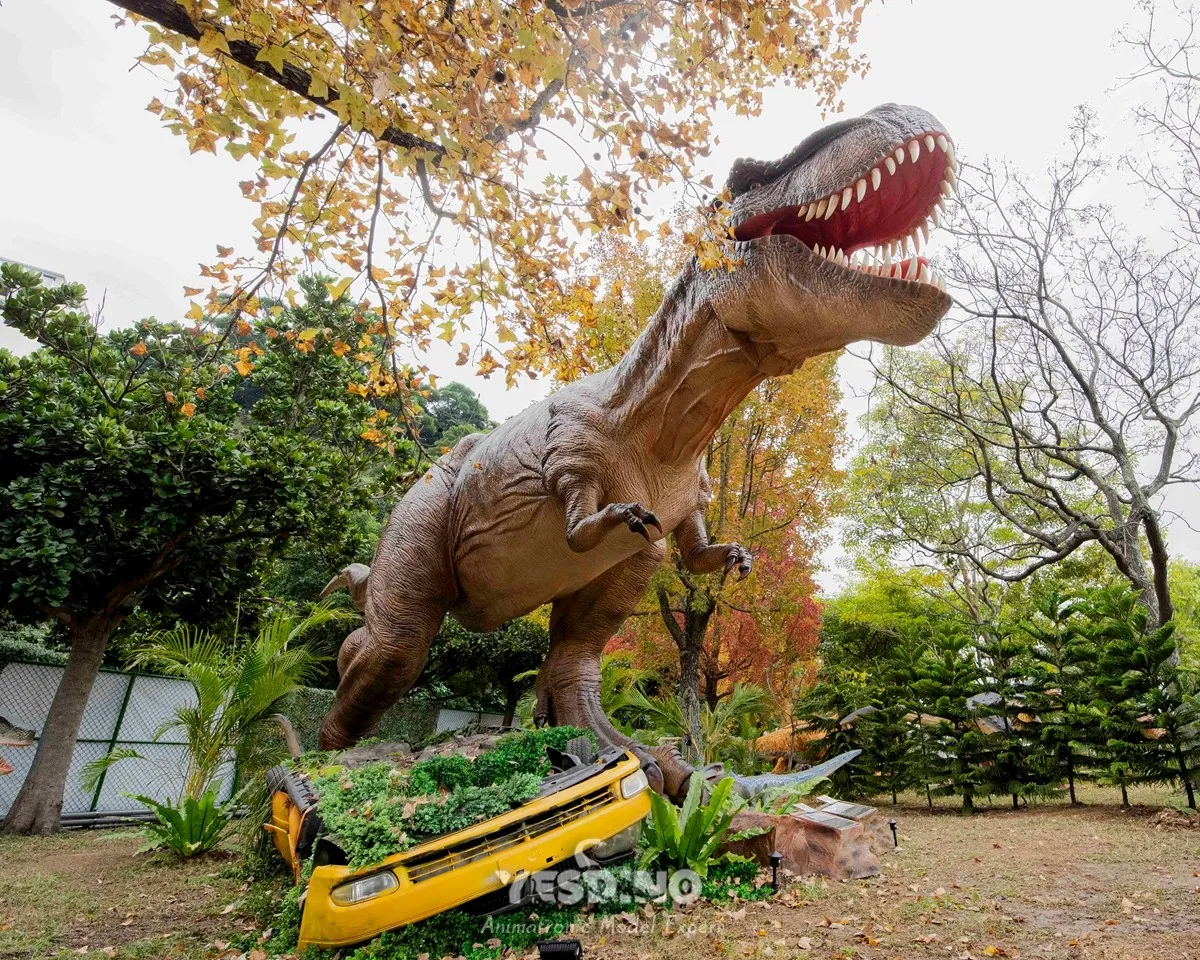
1. Animatronic Tyrannosaurus Rex — ★★★★★The T-Rex is the one species that needs no explanation. Ask a child anywhere in the world to name a dinosaur and this is what comes back. At exhibitions, the T-Rex pen is where the queue forms. From a site-planning angle, a 13 to 20 metre T-Rex at the entrance is the best-value single piece you can buy. The silhouette reads from roughly 500 metres, so people passing on the road know there is a dinosaur park ahead before they see a single sign. That is advertising you do not pay for every month. There are two common ways to use it. One is a standalone animal in a rearing, roaring pose as a visual landmark. The other is a scene — the T-Rex set against Velociraptors or a Spinosaurus in a dispute over a kill, which makes visitors walk a full circle around the group and stay noticeably longer. One thing worth settling early: once a T-Rex is in the ground, moving it is expensive. Fix size, facing direction and base type at the drawing stage. Deciding that later costs far more than deciding it now. If you want the specifications for a single unit, the life-size animatronic Tyrannosaurus page has them.
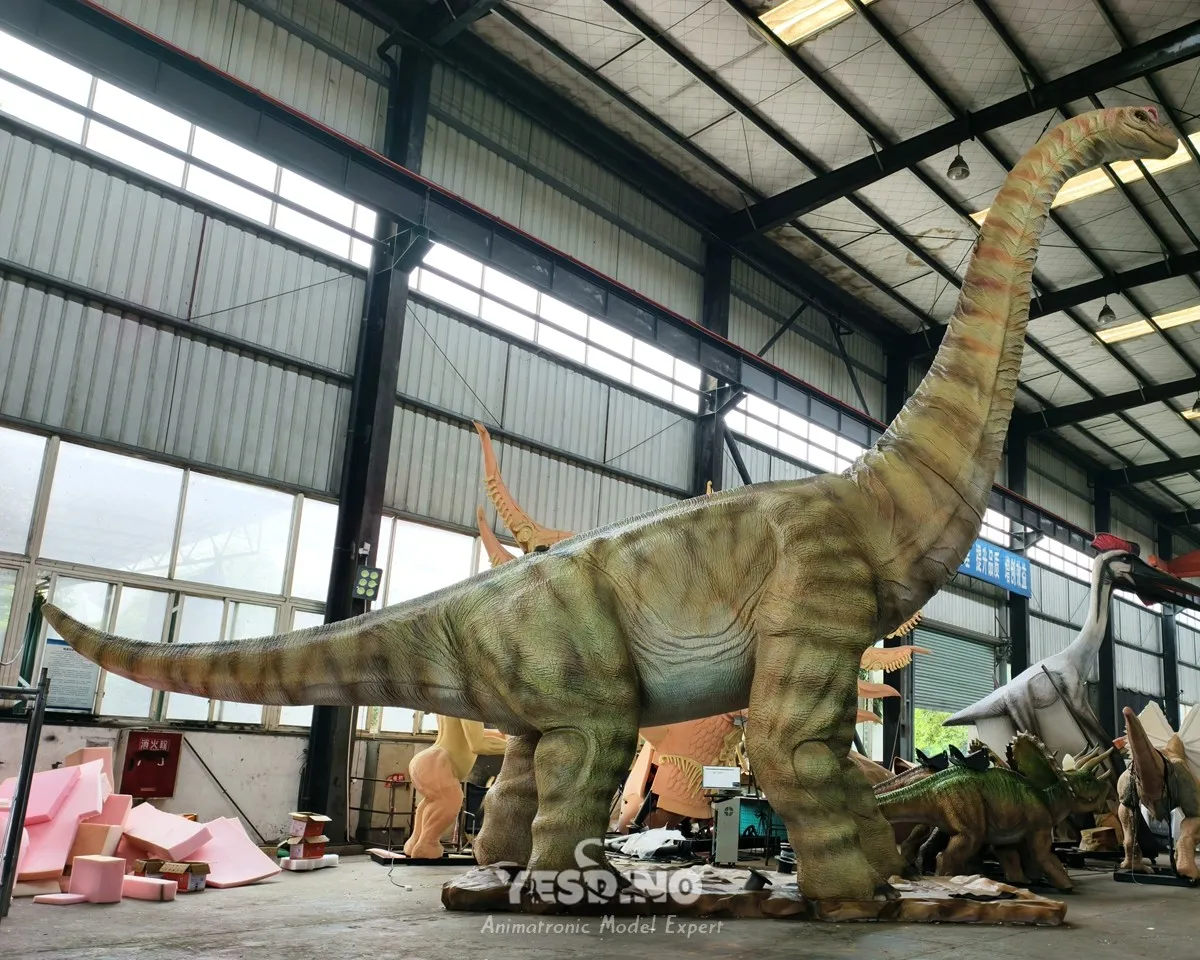
2. Animatronic Brachiosaurus — ★★★★★If the T-Rex handles impact, the Brachiosaurus handles warmth. Big herbivores read as gentle. Long neck, rounded head, no threat posture. A 15 to 25 metre Brachiosaurus also works well at the entrance, and paired with a T-Rex or another carnivore it gives the scene contrast immediately — one aggressive, one calm. The most useful thing about a Brachiosaurus is that it can cross boundaries. The neck goes over a wall, or comes out through the trees. Visitors see a neck before they see the park. On tight sites this matters: the footprint is modest but the visual volume is large. It is also standard stock for travelling exhibitions. Most touring shows treat it as one of the two or three animals they always bring. One build note: the neck is where a Brachiosaurus earns or loses its money. A short, stiff neck reads as a statue, no matter how good the skin is. Ask how many joints the neck has and how far it will turn before you compare quotes — two animals at the same price can look very different once they start moving.
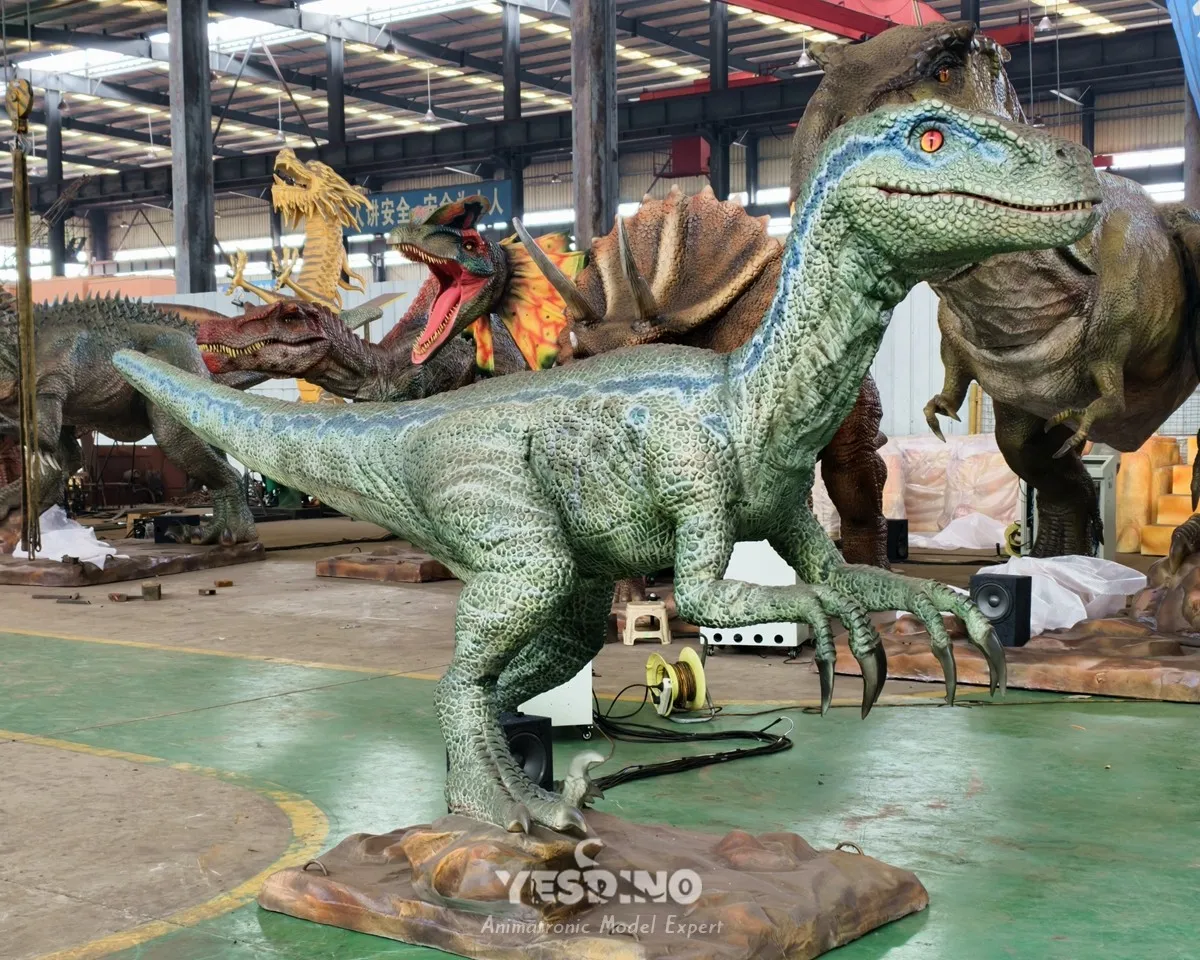
3. Animatronic Velociraptor — ★★★★★Most of the recognition here comes from film. Blue in the Jurassic World series turned the species into a name children know — fast, agile, working in a group, and with a streak of trust toward people. From a product angle the real advantage is that raptors scale in number. At 4 to 5 metres they are not big, so three or five of them in a pack, set in a chase or a hunt, fills a scene without eating much ground. For projects with a limited budget that still need to look busy, this is the best value on the list. A single raptor works, but it reads thin. In the projects we have built, raptors are rarely alone — they are usually the supporting pack around a T-Rex or a Spinosaurus in a fight scene. Because they are small and quick, raptors are also the easiest species to give a varied movement set. Head turns, tail flicks and a lunge forward cost relatively little on a light frame, so a pack can be programmed to fire in sequence rather than all at once. That staggered timing is what makes a group feel alive instead of mechanical.
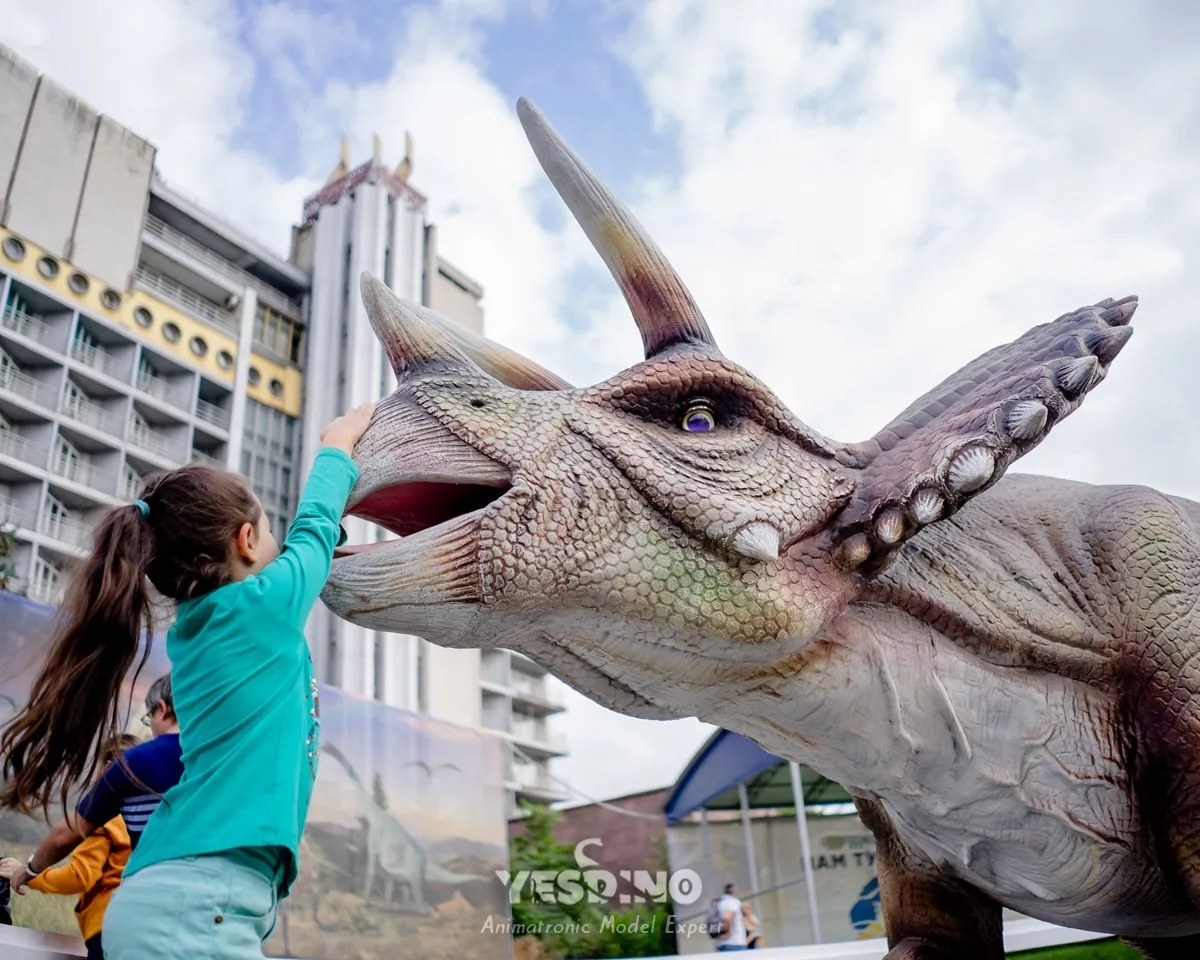
4. Animatronic Triceratops — ★★★★Triceratops is one of the easiest herbivores to identify: three horns, a broad bony frill behind the head, defensive and offensive at the same time. Among herbivores it is about as well equipped as they get. Its appeal is that it is friendly and armoured at once. The rounded beak and heavy body read as approachable; the horns do not. Ask any child to name three dinosaurs and this is almost always one of them. 5 to 8 metres is the size that shows up most often in dinosaur parks. For placement, put it along a walkway or near a fence where visitors can get close. The detail — horn texture, frill pattern, skin folds — only earns its money at close range. Set it far back and you waste the work. Close placement also means contact, so the horns and frill are worth specifying as reinforced. Visitors lean on them, children climb, and a horn that flexes under a hand reads as fake instantly. It is a small line item at build stage and an irritating repair later.
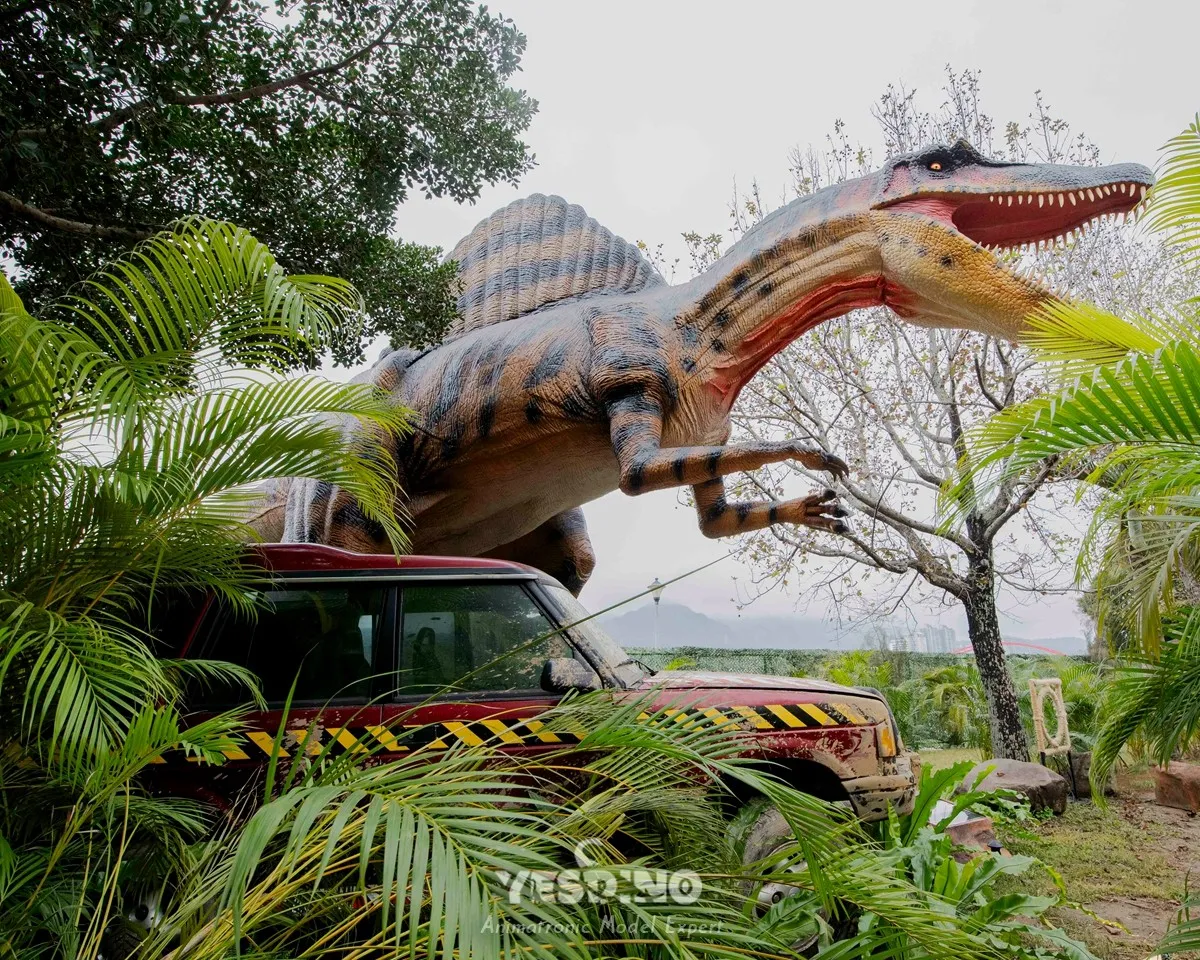
5. Animatronic Spinosaurus — ★★★★Spinosaurus is one of the few species that can stand next to a T-Rex on size alone. Adults run 12 to 15 metres, with a crocodile-like snout, a tall sail along the back and clawed forelimbs. The outline reads as dangerous before you get to any detail. It also had a starring turn in Jurassic Park III, where it beats a T-Rex head to head. That scene is why visitors give it the same respect as the T-Rex rather than treating it as a second-tier carnivore. 12 to 15 metres is what we build most. For placement, set it facing a T-Rex or a Carnotaurus in a standoff, with a visitor path running between them. Two large carnivores facing each other does more than either one alone. A note for scene design: the Indominus rex from the films is a fictional species. Pairing it with Spinosaurus and T-Rex is a common request, and it works visually — just be clear with the client that it is a film creation, not something that ever existed.
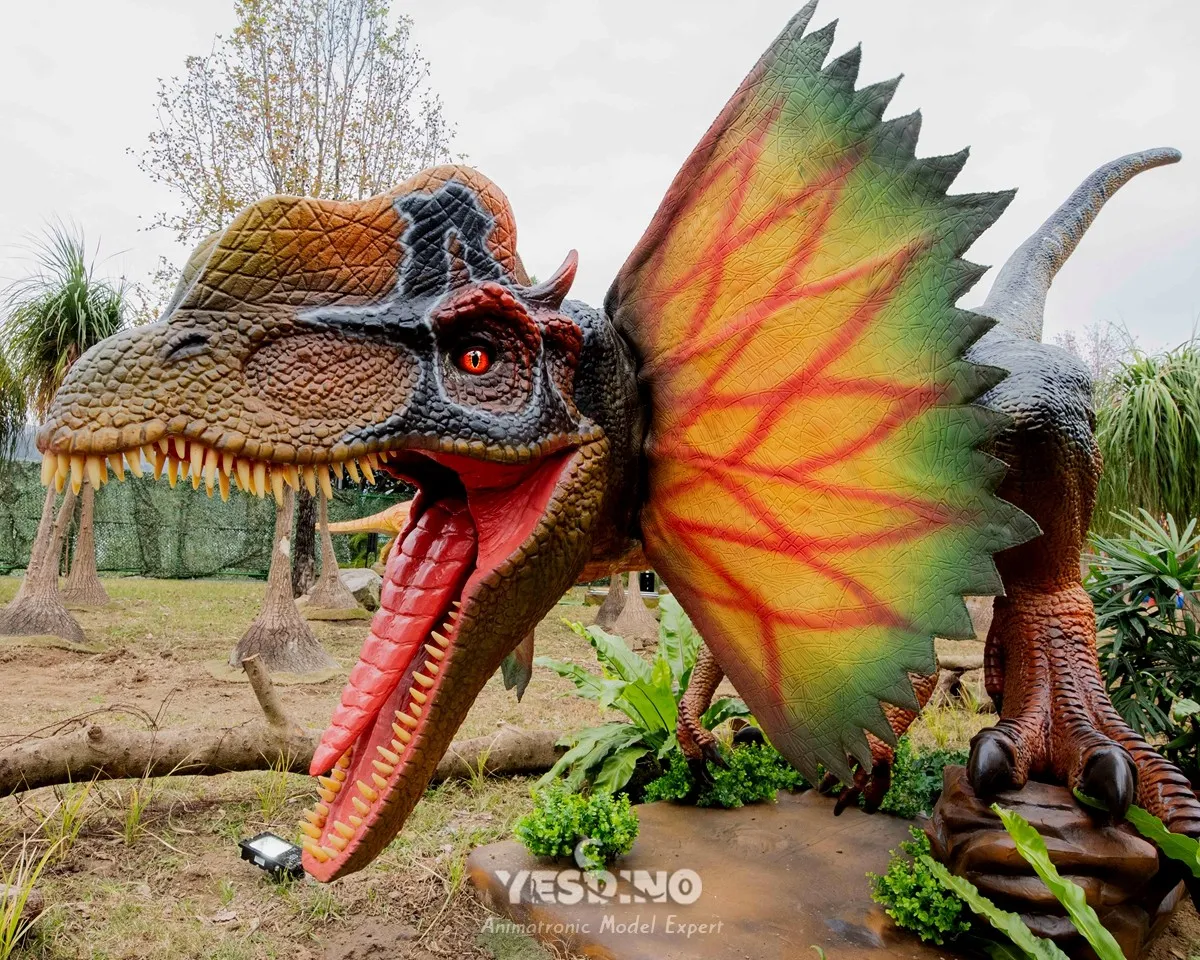
6. Animatronic Dilophosaurus — ★★★★For most people the Dilophosaurus image comes from one scene in Jurassic Park — the neck frills opening, the venom spat at a character. That is a film invention; there is no evidence the real animal had venom. The image stuck anyway. From a product point of view, this is the best interactive animal on the list. The frills on either side of the head take colour well, and the mouth can be fitted with a water or mist spray driven by a sensor, so it reacts when a visitor walks up. That combination works particularly well in mall atriums and travelling shows, because it gives people a reason to stop rather than walk past. 6 to 8 metres is the size we build most. Put it on a main circulation route, not in a corner. An interactive piece only earns its cost where people actually pass. Practical detail on the spray: the sensor range and the refill interval both need setting for the site. Too long a range and it fires at people twenty metres away, which stops being fun after the first hour; too short and nobody triggers it. Ask for both numbers in writing before the unit ships.
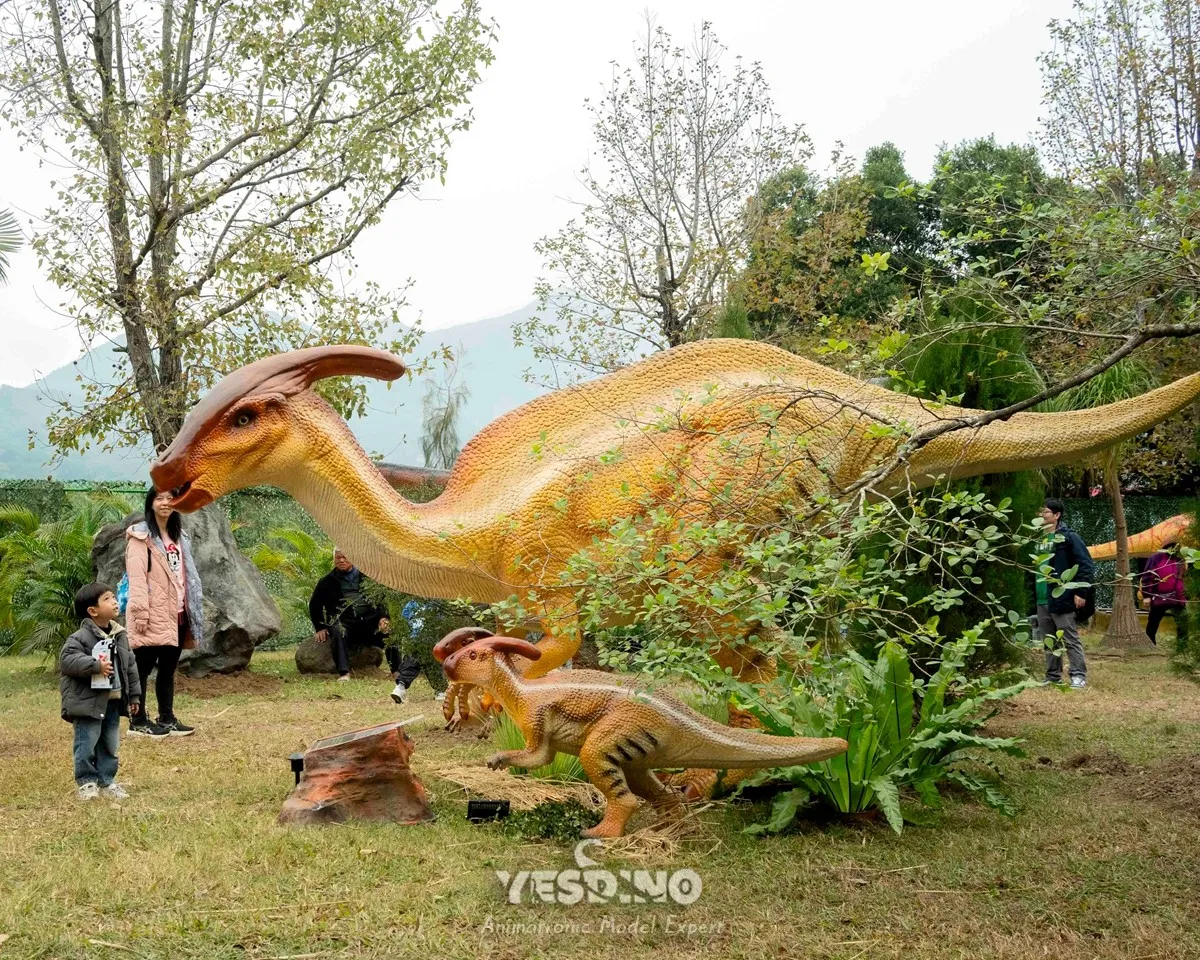
7. Animatronic Parasaurolophus — ★★★The crest is the whole story here — a long tube sweeping back from the head, longer than anything else on the animal. Paleontologists have suggested the hollow structure could have produced a sound something like a horn. That speculation is a big part of why people remember it. It appears several times across the Jurassic World films, so recognition is decent. 5 to 8 metres is our usual build size. Where it really earns its place is family scenes. One larger female with two or three juveniles arranged as a group reads warm and calm, which suits a children's area or a family walkway. Groups like this often get more photographs than a single large carnivore does. The crest is also the one place where colour earns attention. Because it sits above everything else on the animal, a stronger colour there separates it from a green background at a distance. Keep the body tone plain and let the crest carry the colour — the reverse just looks like a painted toy.
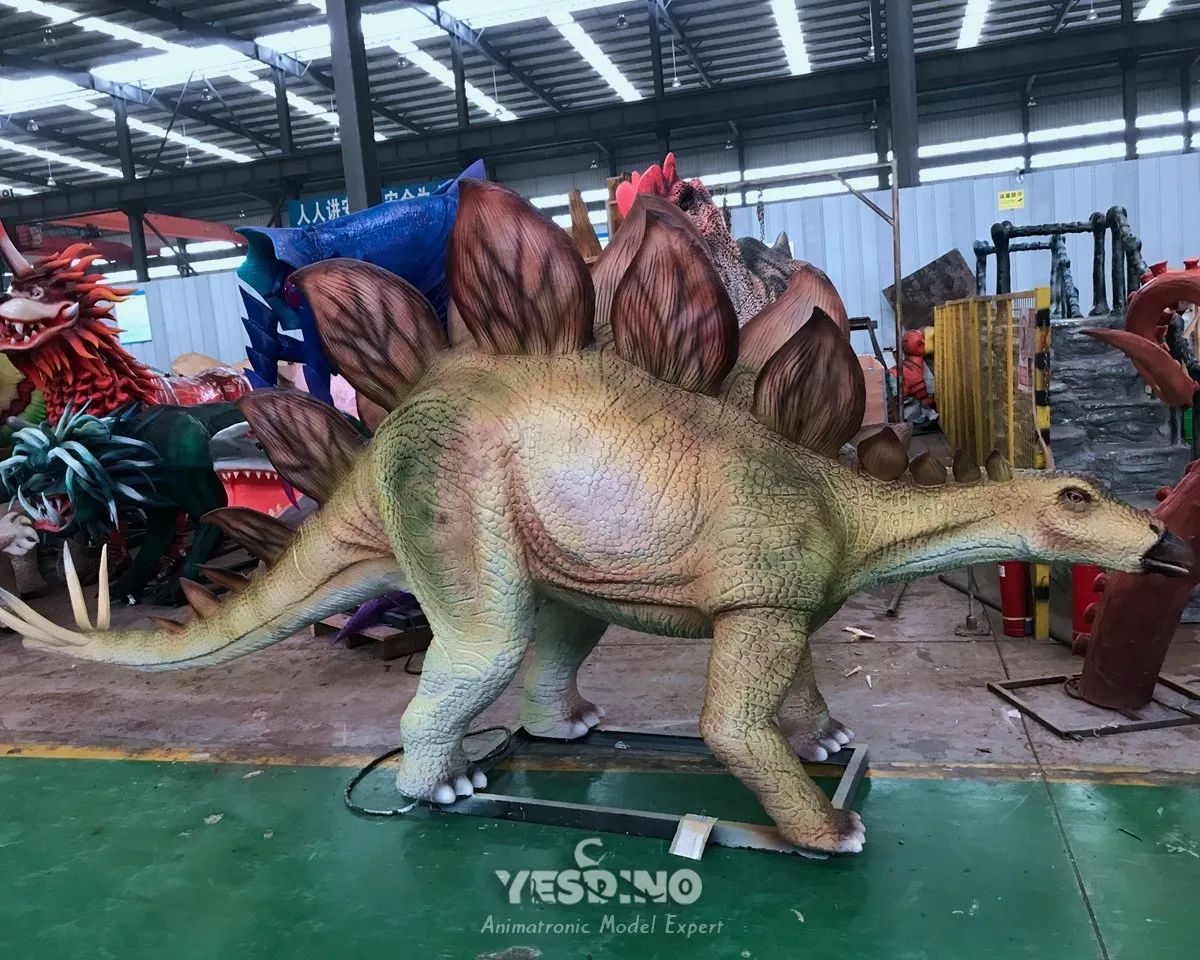
8. Animatronic Stegosaurus — ★★★Stegosaurus works on contrast: a small head, a row of plates standing up along the back like blades, and four spikes at the end of the tail. That combination — small head, big body, built-in hardware — is memorable on sight. Visitors do not need any background to recognise it. It shows up steadily in theme parks. It is the kind of animal that does not need explaining and does not go wrong. 6 to 8 metres is the size visitors respond to most. There is a placement advantage here too. The plate silhouette reads best in side light or against the sun, so it suits a bend in a path or the edge of a water feature. Flat in open ground facing the sun wastes the one thing that makes it distinctive. Those plates are also the part that takes the most handling. They are thin, they catch wind, and they are the first thing a visitor reaches for. On outdoor units the plate mounts are worth checking at the drawing stage — a plate that loosens after a season is visible from a long way off.
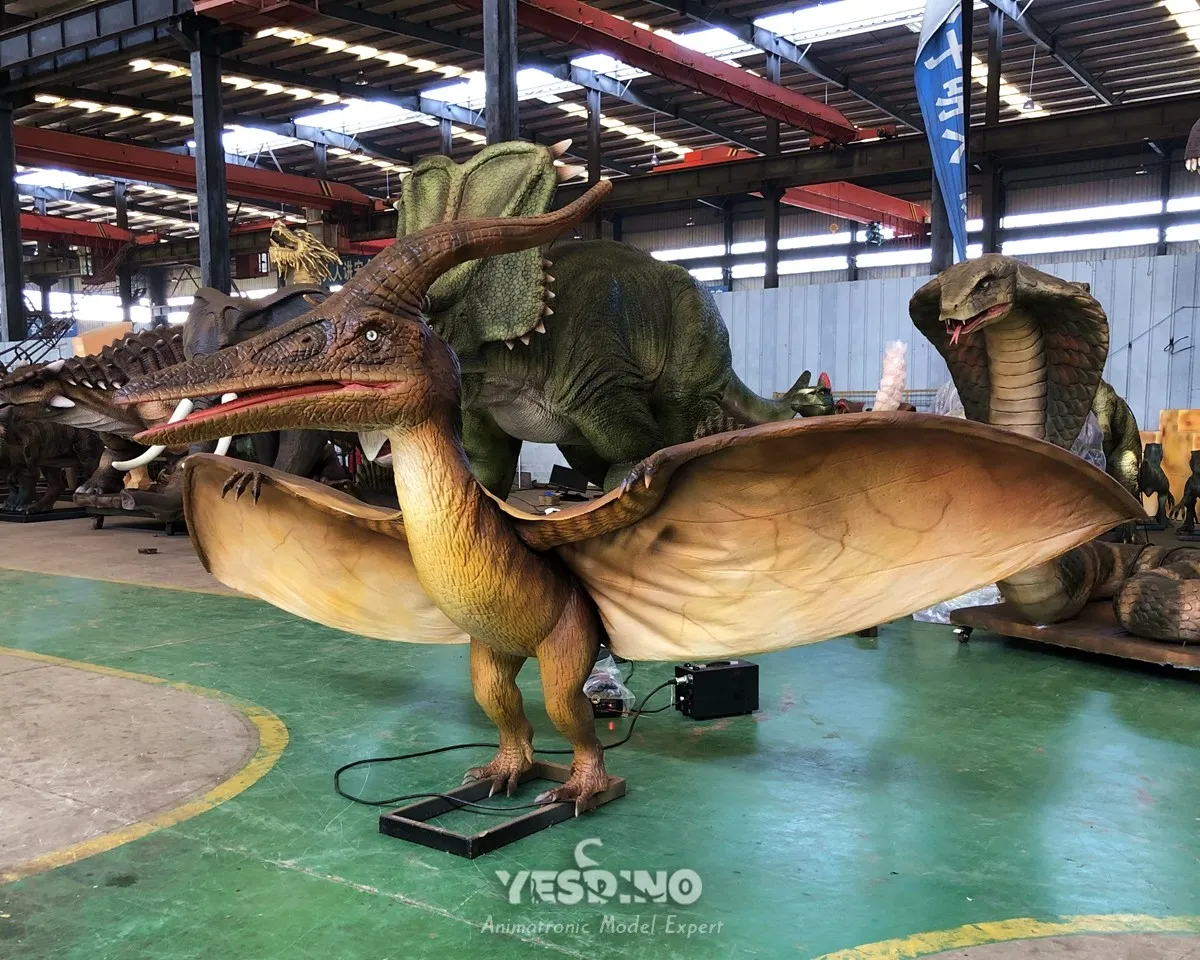
9. Animatronic Pteranodon — ★★★One fact worth getting right: Pteranodon is not a dinosaur. It is a pterosaur, a flying reptile and a close relative. It is worth saying so on the interpretation panel — a fair share of visitors know this, and getting it right earns credit rather than costing anything. Pteranodon is close to standard in dinosaur films. In Jurassic World the giant pterosaurs come in from above, and the membrane wings, long beak and head crest give a stronger visual hit than anything on the ground, because they occupy the air above the visitor rather than eye level. 3 to 5 metre wingspans are what we build most. There are two mounting options: suspended from a ceiling or steel frame, which suits indoor halls and high-roofed exhibits, or a grounded version with folded wings standing on a tree stump for outdoor trails. Recognition is high — children name them without prompting. For the suspended version, the mounting points matter more than the animal itself. The load has to go into structure, not into a suspended ceiling, and the rigging needs to be accessible for maintenance. Settle that with the building engineer before the wingspan is chosen, because a 5 metre unit needs a different anchor pattern from a 3 metre one.
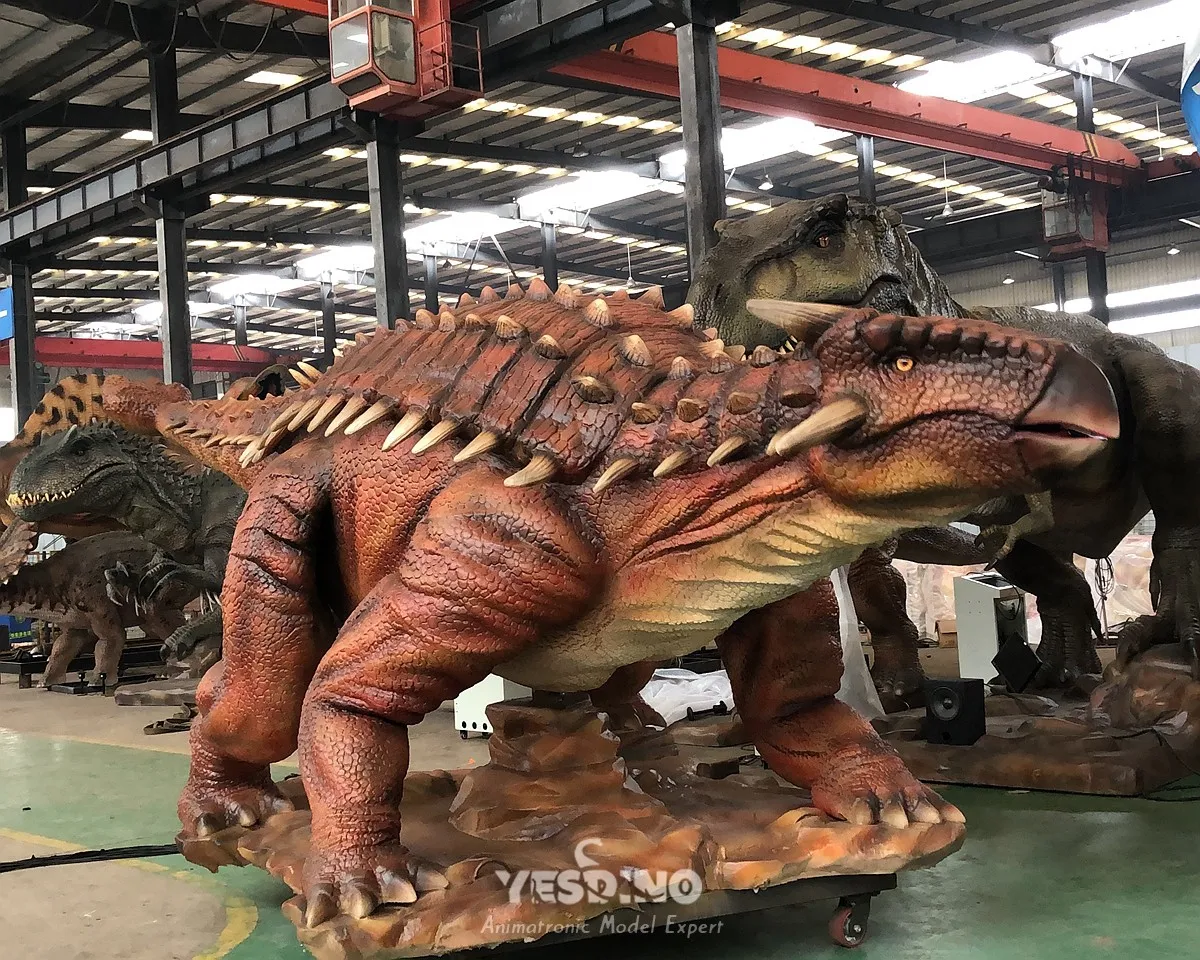
10. Animatronic Ankylosaurus — ★★★Ankylosaurus looks like a tank: armour plating across the back, a heavy club at the end of the tail. That built-in-equipment look is more memorable than a plain-bodied dinosaur, which is why animation, film and children's books keep using it as the defensive archetype. It appears often in exhibitions because it pairs naturally with a T-Rex — one attacking, one hunkered down in defence. The story is already there before you design anything. 5, 6 and 8 metres are the three sizes we build most; 6 and 8 metre units account for most of the orders. Where it earns its keep is low and close. Ankylosaurus sits near the ground, so it reads well at a child's eye level — a tall dinosaur is impressive but it is mostly legs and belly from a metre and a half up. That is why it works in a children's trail or a discovery zone where the animals are meant to be looked at, not just walked past. The tail club is also worth specifying carefully on outdoor units. It is a heavy mass on the end of a lever, and if the tail sweeps near a path, both the swing limit and the clearance need setting at design stage rather than on site.
Layout combinations that workIf you have an empty site and no fixed idea yet, these four combinations come out of real projects. They are meant as a starting point for a budget conversation, not a final plan. Entrance landmark — one 20 m T-Rex, or a 25 m Brachiosaurus with a 15 m T-Rex. Suits a park gate, the end of a main avenue, or a roadside position. Fight scene — T-Rex, Spinosaurus and two Velociraptors in a standoff. Suits a central plaza or anywhere you want people to stop and photograph. Family and gentle — a Parasaurolophus group with juveniles, plus Triceratops, Stegosaurus and Ankylosaurus. Suits a children's area, family trail or indoor hall. Interactive draw — a Dilophosaurus with mist spray, two Velociraptors and a suspended Pteranodon. Small footprint, long dwell time. Good for mall atriums and touring shows. Volume on a budget — eight mid-size animals at 4 to 6 metres spread across a large site, so the park reads as busy rather than sparse. Worth saying plainly: most clients change part of the mix once drawings arrive. That is normal, and it is much cheaper to change a drawing than a finished animal. If cost is the open question, what an animatronic dinosaur costs walks through what moves the number. For outdoor placement and weather, the outdoor animatronic dinosaur guide covers materials and siting. And if you are still shaping the overall concept, planning a dinosaur exhibit and animatronic dinosaurs for theme parks go deeper on layout and visitor flow. Frequently asked questionsOn a limited budget, which should we order first? By recognition per dollar, start with a T-Rex and a Triceratops. Those two have the highest recognition rate with visitors, so they deliver the strongest "this is a dinosaur park" impression for the money. A Brachiosaurus is also worth prioritising if the site has room — its visual volume relative to cost is high. Can the size be changed for our site? Yes. The sizes above are the ones we build most often, not fixed values. The same species can be built smaller or larger. Changing size mainly affects the internal steel frame and the amount of skin material, so the quotation moves with it. Measure site height, walkway width and transport access before the size is locked. Will an outdoor model survive rain and strong sun? Indoor and outdoor versions are built differently. Outdoor units use an anti-rust treated frame, UV-stable silicone skin and sealed motors and electrical parts. Actual service life depends on local climate, sun exposure and how often it is maintained, and the warranty terms are written into the contract. How long from order to delivery? Standard models are usually finished two to four weeks after the deposit and approved drawings. New species and full park projects take longer. Sea freight is on top of that, and the exact schedule is confirmed in writing on the order. Can we see a design before committing? Yes. Once species, size and movement requirements are confirmed, we produce a 3D design drawing for approval at no cost. A live video call from the workshop is also possible if you want to see models mid-production. If you are planning something similar, send over the site conditions and a rough budget and we will come back with a suggested species mix and a quotation. Product catalogue on request. |