|
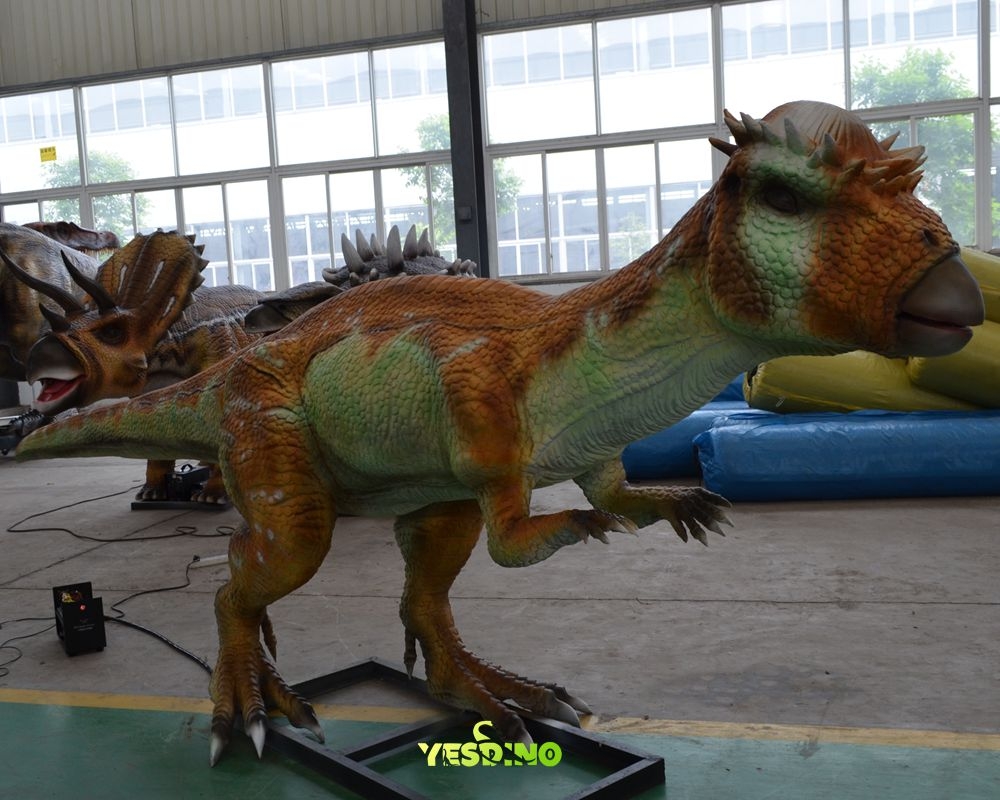
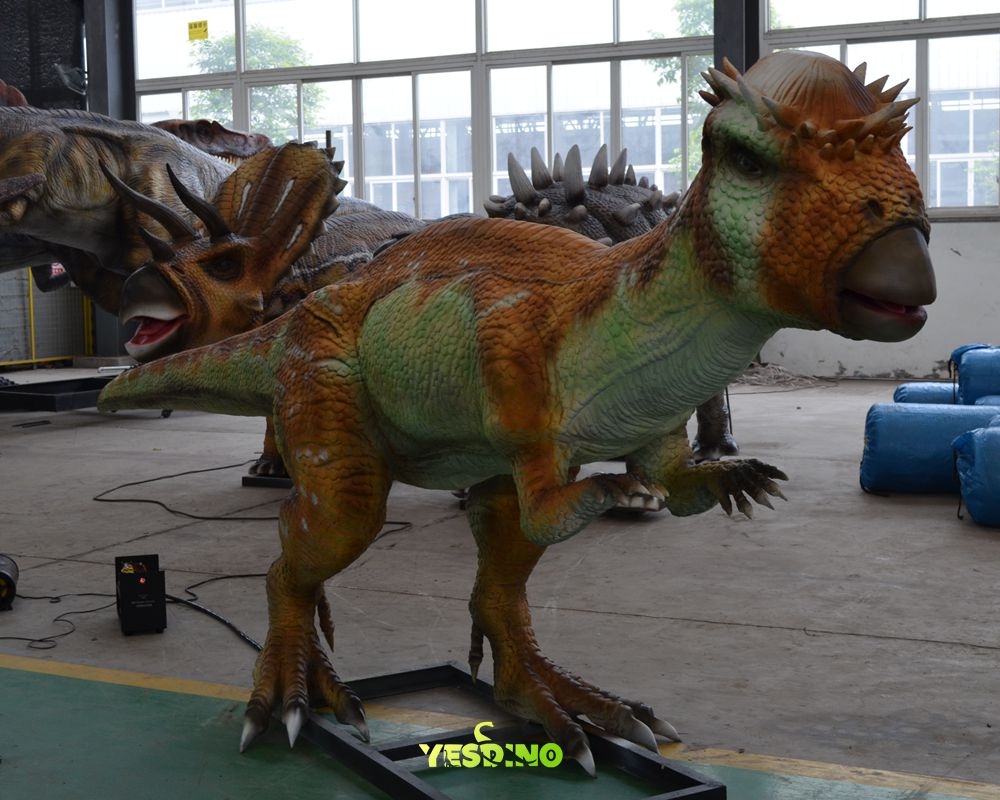
Purchasing large animatronic dinosaurs for theme parks or scenic spots is not just about visual appeal; it is primarily about attracting visitors and boosting revenue. The Pachycephalosaurus is exceptionally popular among tourists due to its unique appearance—specifically, its iconic, large dome-shaped head. Visual ImpactIconic Feature ParametersThe mold workshop uses a 5-axis CNC router to process the 3D skeletal data, keeping the margin of error strictly within 0.2 millimeters. The vertical drop from the highest point of the skull dome to the upper edge of the eye socket is set at 185 millimeters. The dimensional proportions are directly derived from the measurement data of the MOR 295 fossil specimen. The outer shell of the skull dome is cast with modified epoxy resin and fiberglass, with the thickness gradually transitioning from 8 millimeters at the edges to 25 millimeters at the top. The resin is mixed with 15% calcium carbonate powder. Microcellular foaming technology creates random pores with diameters ranging from 0.1 to 0.3 millimeters across the surface. Even when visitors look closely from 30 centimeters away, the surface texture bears a 95% resemblance to natural fossils. The blueprints specify the coordinates for 8 large spikes at the back of the head and 22 small osteoderms around the mouth; the longest spike measures 45 millimeters. To prevent injuries to visitors, all protruding osteoderms are injected with a polyurethane elastomer with a Shore A hardness of 40. Pushing firmly on them depresses the material by 15 millimeters, and it bounces back to its original shape within 0.2 seconds after releasing.
A 35-millimeter-wide band of diamond-shaped overlapping scales is arranged on both sides of the neck to completely conceal the internal movable joints. When the mechanical cervical vertebrae move 60 degrees vertically and 45 degrees horizontally, the scale band provides a 20% deformation compensation along the Z-axis. A 400-mesh nylon fabric is embedded within the silicone skin; after 100,000 continuous bending cycles, the rebound rate remains at 98%. The bionic horny beak at the front of the lower jaw is 140 millimeters long, and the mandible can open up to 35 degrees. The beak material is mixed with 10% PTFE powder, dropping the surface friction coefficient to 0.04 and featuring a smooth reflective band. A 5V miniature atomizer is hidden under the base of the tongue, featuring a 1.5-millimeter nozzle diameter. It sprays water vapor for 1.2 seconds every 45 seconds, with the mist covering a dispersal radius of 0.5 meters. The eye sockets are recessed by 42 millimeters to create a shadowed area for the eyeballs, protecting them from direct intense sunlight. The bottom layer of the iris has an 18-millimeter diameter, covered by a 2-millimeter-thick transparent acrylic convex lens. It houses miniature LED chips with a 2700K color temperature and a 5-lux illuminance to simulate pupil reflection in dim environments.
After the artist finishes applying the water-based acrylic paint, the parts are sent into a 55°C baking room to slow-bake for 12 hours. The polymer pigments seep deep into the silicone micropores, passing the cross-cut adhesion test with zero paint loss, meeting the Grade 0 peeling standard. No matter how heavily the rain washes over it or how much visitors touch it, the color saturation only drops by 2% annually. The reddish-brown patterns on the head are mixed with pearlescent pigments containing 3% mica powder. As the light shifts, the reflection wavelength fluctuates between 620nm and 750nm, giving the surface a subtle metallic texture. The front resin skull dome and the rear steel tube skeleton are rigidly connected by a 10-millimeter-thick aluminum alloy flange. The head weighs less than 18.5 kilograms, with its center of gravity positioned 35 millimeters in front of the first cervical vertebra. The stepper motor controlling the neck's elevation has a rated torque of 40 N·m, typically operating safely within a 65% load limit. The noise of the motor running, measured by a decibel meter 1 meter away, is only 42 decibels. The built-in speakers blast an 85-decibel low-frequency roar, which easily drowns out any mechanical operating sounds. Mechanical Operation Parameters & Sensory TensionThe load-bearing skeleton in the abdominal area utilizes national standard Q235 seamless steel pipes with a substantial wall thickness of 3.5 millimeters. All joints are fully penetrated using double-sided argon arc welding. Before leaving the factory, the steel pipes undergo acid washing and phosphating, followed by two coats of epoxy zinc-rich primer on the outside, achieving a total paint film thickness of 120 microns. To withstand the sheer force of the head smashing down, the first to third cervical vertebrae at the front of the neck are specially reinforced with 15-millimeter-diameter solid stainless steel ribs. For the 18.5-kilogram head to smash down fiercely within 0.8 seconds, it relies on two pneumatic cylinders housed in the chest cavity. The cylinders have a 200-millimeter stroke, with normal air pressure maintained between 0.6 MPa and 0.8 MPa. They are paired with a 3000 rpm brushless DC servo motor that can instantly unleash 65 N·m of torque. The polyurethane timing belt pulling the head is reinforced with internal steel wire; it is 25 millimeters wide and will not snap even under a pulling force of 4500 N. When the infrared sensor detects someone approaching within 3 meters, the machine immediately powers on into standby mode. The instantaneous acceleration of the head plunging downward reaches 2.5G, moving enough air to generate a gust of wind against visitors' faces. Two 60-watt full-range waterproof speakers are welded to the chest, equipped with dedicated crossovers. The speakers emit an 88-decibel low-frequency roar that drops down to 45Hz, causing the entire steel frame to hum with vibration. The cables connecting to the control cabinet are a full 8 meters long, encased in a fire-resistant polyethylene corrugated tube. The control board features a 32-bit microcontroller with an ARM Cortex-M4 architecture, running at a clock frequency of 168 MHz. The time delay between the motor's physical movement and the audio playback is strictly compressed to under 15 milliseconds. The subwoofer's roaring sound perfectly synchronizes with the mouth-opening action; the lower jaw can gape up to a maximum of 42 degrees.
The breathing movement in the belly area is driven by an independent eccentric wheel with an 80-millimeter diameter, rotating 12 to 15 times per minute. The belly skin is pushed and pulled by a mechanical arm, fluctuating up and down by a full 30 millimeters. The tail-swiping motion is controlled by pulling 3 multi-strand wire ropes paired with a miniature stepper motor, allowing it to swing outwardly up to 45 degrees to both the left and right. Having too many moving joints can lead to malfunctions, so all movable parts are equipped with both mechanical and electronic limit switches. If the head encounters over 15 kilograms of resistance while smashing down, the servo motor cuts power within 0.05 seconds to protect the coils from burning out. The most frequently rotated parts of the neck and tail feature lubrication ports; using an Allen wrench, maintenance simply requires squeezing in 5 grams of lithium-based grease every 60 days. The connecting rod that opens the mouth is cut from a 5-millimeter-thick aviation aluminum plate, weighing a mere 65 grams in hand. No matter how fast the jaws snap shut, an 8-millimeter gap is intentionally left between the upper and lower teeth, ensuring fingers won't get pinched. The front claws are suspended 450 millimeters off the ground. Underneath the two large footplates are 400-millimeter-diameter flanges, firmly bolted into the concrete floor with eight M16 expansion anchor bolts. After the machine runs continuously for 5,000 cycles, teardown inspections reveal that the reducer gears wear down by less than 0.02 millimeters. The transmission linkages are entirely fitted with self-lubricating bearings made of copper-based powder metallurgy, resulting in a friction coefficient of only 0.12. Metal-on-metal noise is suppressed below 35 decibels. When a visitor stands right in front of it, their ears are filled with an 88-decibel roar, making the imposing downward plunge feel instantaneous in its 0.8-second execution. The motherboard and all circuits are housed in a 1.5-millimeter-thick stainless steel waterproof box. Rainproof louvers are installed at the bottom of the box, containing two 3500 rpm waterproof exhaust fans. Even on rainy days when humidity spikes to 95%, silicone desiccant boxes absorb all the moisture, ensuring not a single drop of condensation forms on the control board. The 15 external wiring terminals on the motherboard are entirely coated with a layer of insulating, thermally conductive silicone grease. Weather Resistance & Long-Term PerformanceThe outer skin material is infused with 4.5% nano-grade titanium dioxide powder. When UVA and UVB rays from sunlight hit the surface, over 85% of the light is deflected. It was subjected to 18 months of field sun exposure in the Gobi Desert of the Great Northwest. Despite the area's year-round extremely high UV index of UVI 10+, instruments measured a color difference value of less than 3.2. The silicone base is blended with temperature-resistant phenyl silicone oil, achieving the optimal cross-linking density. It was placed into a -25°C cold storage room and frozen solid for a full 72 hours. Upon removal, pulling it forcefully showed the elongation rate remained steady at 280%.
Rainy days in southern regions frequently bring acid rain, so the outermost layer of the skin is sealed with a 1.5-millimeter-thick transparent fluorocarbon protective film. Drenching it continuously for 96 hours with simulated acid rain dropping to a pH of 4.0 causes the surface gloss to decrease by less than 1.5 GU. Silicone abrasion tests are conducted according to automotive interior standards. Scrubbing rough canvas wrapped around a 1,000-gram weight back and forth in the exact same spot 5,000 times wears down the skin texture depth by less than 0.15 millimeters.
Equipment failure is predominantly caused by rusting steel frames. To counter this, the chassis and load-bearing main skeleton are completely subjected to hot-dip galvanizing, providing an outer zinc layer thickness of 85 microns. It was placed into a salt spray chamber and blasted with a 5% sodium chloride solution for 150 hours. Upon careful inspection afterward, not a single spot of red rust appeared at any cuts. Movable joints are covered with 3-millimeter-thick neoprene dust boots. No matter how fierce the sandstorms in the northwest get, PM10 dust particles are entirely kept out of the bearings.
The lifespan of the cylinders and motors relies entirely on the materials selected. The inner wall of the cylinder is plated with a 20-micron-thick layer of hard chrome, dropping the friction coefficient to 0.08. After letting the machine run continuously at full load for 300,000 action cycles, opening it up to measure the wear on the inner wall shows the vernier caliper reading stopping at 0.015 millimeters. The brushless DC motor replaces traditional carbon brushes with Hall sensors, extending its lifespan fourfold. The motherboard inside the waterproof electrical control box is thoroughly coated with a military-grade conformal coating, with the thickness strictly controlled between 30 to 50 microns. Even when seasonal damp weather causes humidity to skyrocket to 98%, the solder joints on the circuit board absolutely will not suffer electrochemical corrosion. The three internal high-frequency filtering capacitors are 105°C temperature-resistant models. After 10,000 hours of continuous powered operation, their capacitance drops by less than 5%.
The abdominal stuffing utilizes high-resilience, flame-retardant sponge with a density of 45 kg/m³. After pressing an 80-kilogram weight on it continuously for a full month, the sponge's rebound rate remains above 95%. If a lit cigarette butt falls onto the skin, the B1-grade flame-retardant material forcibly cuts off the combustion path, leaving nothing more than a scorched black mark on the surface. All exposed screws exclusively use 304 stainless steel anti-loosening nuts equipped with internal nylon locking rings. After the machine vibrates intensely under power for 1,000 hours, testing each one with a torque wrench reveals zero screws loosening by more than 0.5 N·m.
The corrugated tubing for the internal wiring is made from anti-aging PVC material. Bending it by hand when temperatures plummet to -15°C will not cause it to crack, and its lifespan extends up to six years. Before leaving the factory and being loaded for transport, the four fixing flanges at the bottom of the dinosaur's feet are brushed with two coats of anti-corrosion asphalt paint. The concrete base for the expansion bolts must be graded C30 or higher. Eight M16 expansion screws are driven 20 centimeters deep, capable of withstanding 750 kilograms of lateral thrust from a Category 12 typhoon. Even if a massive torrential downpour submerges the chassis in a 30-centimeter-deep puddle for 12 hours, all water is completely blocked from entering the conduits.
Interactive FeaturesRadar Sensing & ResponseHigh-traffic outdoor environments severely test equipment fault tolerance. The Pachycephalosaurus's head conceals a 24GHz millimeter-wave radar equipped with a single-transmit, dual-receive antenna. The radar covers a horizontal range of 120 degrees and a vertical range of 60 degrees. Once powered on, the motherboard emits detection waves outward 10 times per second. These waves can penetrate a 15-millimeter-thick layer of silicone and sponge. The equipment establishes a sensing zone within 3 to 5 meters, with a margin of error not exceeding 0.2 meters. As soon as a visitor approaches, the radar instantly captures the signal. Internal chip algorithms automatically filter out false signals caused by swaying leaves or passing insects. Detection specifications for high-humidity, dusty outdoor environments:
The auditory system utilizes a dual-array omnidirectional microphone. The 2-millimeter sound reception holes are hidden within the crevices of the chin scales. The signal-to-noise ratio reaches 65 decibels, with a distortion rate below 1%. Built-in hardware noise reduction handles ambient background noise. The machine collects ambient background noise in real-time. If a visitor's applause or shout exceeds 64 decibels within 0.5 seconds, the chip triggers a command. The pin voltage surges from 0 volts to a 3.3-volt high level within 2 milliseconds. Upon receiving the command, the 32-bit master control chip instantly ramps up the 12V motor in the chest cavity from 800 rpm to 2400 rpm. The dinosaur's breathing rate shifts from 12 breaths per minute to rapid panting at 35 breaths per minute. The electrical control signal is transmitted to the chin servo. The dinosaur's mouth gapes open to 45 degrees within 0.1 seconds. The 50-watt waterproof speaker in its belly plays an 85-decibel, high-definition, low-frequency roar with zero delay. Action and sound execution parameters:
Relying solely on radar can cause lagging in crowded situations. To eliminate blind spots, bi-directional infrared sensors are installed at the base of the chin. Utilizing a 940-nanometer infrared wavelength, the detection range is locked at 2 meters. Both sets of data undergo dual verification on the motherboard. If a sensor on one side fails, the program automatically switches to single-channel operation. The motherboard is equipped with a 1.6-second watchdog timer. In the event of a system freeze, the microcontroller forces a restart after 1.6 seconds, returning to standby mode. All wiring uses UL2464 standard shielded cables capable of withstanding 200 newtons of pulling force. They are encased in flame-retardant tubing to prevent the cables from snapping due to the dinosaur's continuous head movements and jaw opening. All plug contacts are made of aviation-grade gold-plated materials. The plugs feature IP67-rated water and dust resistance. Neither heavy rain nor washing with a water gun will cause water ingress or short circuits. The entire system has been tested to run flawlessly for 15,000 hours. Amusement parks do not need to hire dedicated low-voltage electricians for daily maintenance patrols. When exposed to the harsh outdoor sun, summer ground temperatures can exceed 60°C. The radar chip features a built-in temperature compensation circuit. It withstands the extreme heat, ensuring the detection distance is maintained at a full 5 meters without shrinking to 2 meters. Standard capacitors fail in -25°C winter conditions. The motherboard is entirely fitted with solid-state capacitors capable of handling a 3000 mA current. The power module supports a wide voltage input range from 18V to 36V, making it immune to erratic mains power fluctuations. Electrical system anti-interference specifications:
During peak nighttime power usage at the amusement park, voltages can become unstable. The voltage regulator chip smooths out the voltage at a 300kHz frequency, outputting clean 5.0V and 3.3V power. Current ripple is suppressed to within 50 millivolts, preventing radar noise that could cause the dinosaur to move erratically. The entire hardware setup accounts for less than 15% of total material costs. The radar sensor handles tens of thousands of visitor triggers daily. Procurement teams can calculate the ROI with absolute clarity: the electricity cost per interaction is merely about 0.003 RMB. API Billing Interface and Central ControlThe motherboard features a standard RJ45 Ethernet port and two RS485 communication ports. The lower layer inherently supports the MODBUS-RTU protocol, with the factory baud rate locked at 9600 bps. On-site installation and wiring of a coin acceptor, QR code scanner, or NFC card reader takes less than 5 minutes. The billing board utilizes optocoupler isolation to completely separate high and low-voltage circuits. The input terminal can withstand instantaneous high voltages of up to 2500V. When a visitor scans a QR code to pay 15 RMB, the external billing box sends a 200-millisecond low-voltage signal to the motherboard, instantly initiating a 180-second interaction. Outdoor placements inevitably encounter network disconnections. A 16MB storage chip is soldered onto the billing board. In offline mode, the machine automatically switches to standalone accounting, storing up to 100,000 transaction records internally. Once network connectivity is restored, the data is encrypted, packaged, and transmitted back to the server within 3 seconds. A single Ethernet cable run to the central control room's server rack fetches real-time data. The API interface uses the universal JSON format. The equipment sends a "heartbeat" ping to the main console twice a second to confirm it is online. This ping includes a 12-byte status code detailing the current power level, machine temperature, and network latency. Operating conditions are visible at a glance on the central control screen. The backend system monitors the real-time operating current of the motors. Normal idling current is 3.2 amps. If a motor jams due to external force or grinds dry from a lack of oil, pushing the current past 4.8 amps, the backend triggers a pop-up alert and sends an SMS to the maintenance technician's phone. Sensor status is monitored via dedicated circuits. The master chip daily calculates the efficiency of the tens of thousands of radar logs. If large debris blocks the sensing zone and pushes the daily false alarm rate above 5%, a red light illuminates next to the equipment icon on the backend, prompting janitorial staff to clear the area.
The communication configuration accommodates single-unit sales or networks spanning hundreds of machines. The MQTT protocol is extremely>Off-the-shelf QR code scanners cost less than 120 RMB. Imagine the machine placed in a mall atrium with a daily foot traffic of 3,000 people. Assuming a conservative 45 paid interactions a day at 20 RMB per use, it yields a daily revenue of 900 RMB. Subtracting the negligible 0.003 RMB electricity cost per interaction, the ROI calculations for procurement are crystal clear. The backend abandons flashy charts in favor of a single Excel export button. After selecting a date, the server generates a startup log accurate down to the second. The spreadsheet clearly outlines the revenue distribution across different time slots between 10:00 AM and 10:00 PM, helping supervisors effectively schedule operators. The motherboard features remote OTA (Over-The-Air) firmware update capabilities. An engineer sitting 500 kilometers away can push a new roar audio package with a few mouse clicks. Update files are compressed to under 2MB, allowing the machine to automatically flash the system update in just 45 seconds before powering down for the night. Fault Tolerance and Mechanical SafetyThe internal main skeleton is exclusively welded from national standard Q235 carbon steel seamless pipes. The primary pipe wall thickness is a solid 5 millimeters, boasting a yield strength of 235 MPa. This thickness is engineered specifically to withstand the sheer force of the dinosaur's head smashing down thousands of times a day. Flanges at movable joints are heavily reinforced to 12 millimeters. All bearings have been upgraded to high-carbon chromium steel. Prior to leaving the factory, they are packed with molybdenum disulfide lithium-based grease, forcing the friction coefficient strictly below 0.05. The servo motor's output shaft is specially equipped with a dynamic torque sensor. The measurement range is set between 0 and 200 N·m, with a blistering sampling frequency of 1,000 times per second. If the machine bumps into a visitor during operation and the mechanical thrust reaches 150 newtons, the relay cuts off the 24V DC power supply within 0.2 seconds. The equipment instantly loses all physical force, going limp and stopping entirely in its current position.
Baking in the harsh summer sun all day pushes the temperature inside the sealed mechanical chest cavity to 85°C. PTC thermistors are pre-embedded within the motor coils, featuring a temperature coefficient of resistance up to 15%/°C. When the motherboard detects an overheating signal, it forcibly cuts the PWM duty cycle in half. The motor speed immediately drops from 2400 rpm to 1200 rpm, relying on low-speed operation to gradually dissipate heat. The control box houses a 1.2A self-resetting fuse. Upon current overload, the fuse severs the circuit within 50 milliseconds; once temperatures drop, power automatically restores in 3 seconds. The trigger current for the leakage protector is factory-locked at 30 milliamps. If moisture enters and causes a short circuit, the 220V mains input is severed within 0.1 seconds. The skin is padded with a full 10 millimeters of high-density sponge, passing the national B1 standard for flame retardancy. Exposing it directly to an open lighter flame for 15 seconds only causes the sponge to blacken and carbonize without catching fire. The exterior is coated with 3 layers of aviation-grade, UV-resistant silicone, with tested tensile strengths reaching 2.5 MPa.
The pneumatic cylinders powering the smashing actions are built tough, featuring 20-millimeter-diameter piston rods and a 150-millimeter stroke. Rated air pressure is set at 0.8 MPa. The air intake comes standard with a pressure regulating valve and an oil-water separator; it filters out impurities with a precision of 5 microns, protecting the inner cylinder walls from scratches. If the pressure gauge detects line pressure exceeding 1.0 MPa, the safety valve automatically pops open to depressurize, venting 200 liters of gas per minute.
All transmission linkages are individually milled from 6061 aluminum alloy. This slashes the weight by 30% compared to pure steel, saving massive amounts of exertion for the motors. All fasteners across the body utilize 304 stainless steel anti-loosening nuts. Before driving the screws tight, they are saturated with industrial threadlocker. After enduring 400 daily low-frequency vibration tests, the nuts do not budge a millimeter. The internal ribbon cables in the belly are tightly bound to the steel pipes every 15 centimeters using 4.8-millimeter-wide nylon zip ties. Routing intentionally steers clear of movable joints by a minimum of 10 centimeters. The ribbon cables twisting back and forth in the neck are encased in a flame-retardant corrugated tube with a 20-millimeter inner diameter. Subjected to destructive testing involving 100,000 head twists before leaving the factory, not a single 0.5-square-millimeter copper core wire suffered from metal fatigue or snapping. A standalone 40-millimeter diameter red mushroom emergency stop button is located on the control panel. Slapping it breaks the normally closed contacts, causing the contactor to sever the 220V high-voltage power within 30 milliseconds. The Pachycephalosaurus loses all power instantly. Any residual air in the cylinders is vented entirely within 1 second via a 5/2-way solenoid valve, causing the machine to slump to the ground like a deflated balloon. The silicone compound is specially mixed with cold-resistant agents. Placed in the freezing -20°C snowy weather of Northeast China, the skin's hardness increases by only 15A; it remains soft to the touch, without becoming brittle or cracking. Thrown into the blistering 50°C heat of the South, the oil precipitating on the surface is less than 0.01 grams per square centimeter, keeping it entirely non-sticky.
Customization for Unique Thematic IntegrationAppearance & Morphological CustomizationA base white model is carved from high-polymer foam with a density of 45 kg/m³ using a 5-axis CNC router according to 1:1 blueprints. Workers manually apply modeling clay to the surface and meticulously press in scale textures using sculpting tools. Every square centimeter of the skin is covered with 12 to 15 hexagonal or diamond-shaped biomimetic scales. The row of dorsal ridge scales running straight down the middle of the back is exceptionally large, reaching up to 18 millimeters in diameter. Moving toward the softer abdominal area, the scales rapidly shrink to 4 millimeters, providing a rough, granular texture to the touch. The large dome on the top of the head is not filled with standard sponge; instead, it is directly cast from 22-millimeter-thick epoxy resin mixed with fiberglass. The radius of curvature for the dome, stretching from the frontal to the parietal bone, is strictly locked at 150 millimeters. To bear the weight, an 8-millimeter-thick Q235 steel plate is pre-embedded inside the skull as a base. Fully assembled, the head component weighs a massive 35 kilograms. Before leaving the factory, it is tested by being struck with a blunt instrument delivering 200 joules of force, and the cranial dome shell exhibits absolutely no deformation or cracking.
The joint between the neck and torso is highly susceptible to physical wear and tear from constant, high-frequency flexing. This area is completely stuffed with high-resilience, flame-retardant sponge that boasts a breaking elongation rate of 120%. The outer skin casing is brushed silicone, with the thickness gradually tapering from 3 millimeters on the body down to a 1.5-millimeter edge at the neck seam. Even when the fully assembled machine runs continuously for 8 hours a day, swinging and extending twice per minute, the outer skin goes a full month without any cracking or delamination. The epidermal muscle lines are layered on by artists using pneumatic airbrushes directly over the textures. The base coat uses industrial-grade acrylic polyurethane paint, with the spray gun pressure steadily set at 0.4 MPa to ensure an even finish. The outermost layer is completely coated with a protective film of liquid transparent silicone mixed with 2% antioxidants. After this skin casing is subjected to 1,500 hours of intense exposure under a UV xenon lamp, instrument-measured color difference values remain strictly under 3.0.
The eyeballs are vacuum-cast using high-transmittance acrylic with a 45-millimeter diameter. A 3D-printed resin decal is precisely inserted into the pupil and coated with amber pigment containing trace amounts of fluorescent powder. A 6000K color temperature SMD LED cold light bulb is embedded right behind the pupil. The internal mouth structure is cast 1:1 directly from ornithischian dinosaur fossils. The upper and lower jaws are planted with a total of 68 leaf-shaped, resin-cast teeth arranged in rows. The exposed length of each tooth outside the gum line ranges from 12 to 18 millimeters, and the tooth edges feature fine, 0.5-millimeter serrations. The tongue and gums are entirely poured from ultra-soft, medical-grade silicone with a Shore hardness of 10A, giving them a soft, elastic feel. The main steel frame enclosed within the body is exclusively welded using CO2 shielded arc welding, with all weld seams strictly required to exceed 4 millimeters in height. Fillet welds on the chassis and joint load-bearing points undergo ultrasonic non-destructive testing to ensure absolutely zero porosity. The anti-rust treatment follows a strict two-basecoat, one-topcoat process. Once dry, the primer is 60 microns thick; after all three layers are sprayed, the total paint film thickness exceeds 120 microns.
The entire tail is designed in a rigid, mid-air suspended posture. The supporting main skeleton is fully welded together using seamless steel pipes with a 32-millimeter diameter and a 2.5-millimeter wall thickness. The outer skin on the rear third of the tail is wrapped with hard, tendon-like protrusions produced by an injection molding machine. The tail's length makes up a solid 45% of the total body length, and the motor-driven swing amplitude is physically restricted to within 30 degrees on either side. Motion Programming & Sensor ControlCommands driving the 7 independent joints across the body are entirely issued from the customized electrical control cabinet at the base of the machine. This IP54-rated cold-rolled steel cabinet houses a 32-bit ARM Cortex-M4 master control chip. When the operator taps the backend panel, motion commands travel down flame-retardant shielded cables to each servo motor with less than 0.2 seconds of latency. Adjacent to the main control board is an industrial-grade relay bank, specifically designed to handle the massive 15-ampere current surges caused by intensive daily start-stop cycles. The wide-ranging swings of the supporting skeleton rely entirely on 5 built-in 24V brushless DC motors. The motor at the base of the neck, responsible for pulling the cranial dome forward into a ramming motion, is cranked up to 400 watts, outputting a massive 60 N·m of torque. A planetary gearbox with a 1:36 reduction ratio is mounted at the rear of the motor, stepping down the high RPM to generate a sluggish, weighty feel suitable for a massive creature in motion. The low-power motor handling the abdominal breathing movements is fitted with external aluminum alloy cooling fins; even after 12 hours of continuous powered operation, its surface temperature is firmly kept below 45°C. The programming written into the motherboard's EEPROM memory is divided into three operational configurations. In standard sleep mode, the mouth opens and closes every 12 seconds with the jaw angle locked at 15 degrees, while the chest skin rises and falls by 8 millimeters at a frequency of 18 times per minute. Switching to patrol code, the neck pans slowly and evenly across a 45-degree area to the left and right at a rate of 10 degrees per second. The tail's eccentric wheel mechanism runs in tandem, driving the tip of the tail to trace a horizontal figure-eight path with a span of roughly 25 centimeters. The component that brings this iron-and-steel skeleton to life is a dual-channel sensor network hidden within the artificial rockery. Two NPN normally-open photoelectric switches are buried in the grass out front, with their infrared emitters cross-covering a 3-meter-wide pedestrian walkway. A 2.4GHz millimeter-wave radar is embedded directly inside the warning sign facing the visitors, transmitting detection waves outward in a 120-degree fan shape. The RF signals can penetrate 2-centimeter-thick plywood and plant foliage, firmly locking onto continuously moving human heat sources within an 8-meter forward radius. Once the radar detects an object the size of an adult human crossing the 5-meter boundary, the master chip interrupts the sleep loop code. The LED cold light sources in the eye sockets instantly ramp up from 30% brightness to a full 100% with zero delay, mimicking a startled pupillary response. Two stepper motors attached to the forelimbs receive pulse signals, commanding the short arms to wave up and down at 45 times per minute. The built-in speakers seamlessly queue up the third-track audio file, blasting short, low roars at 85 decibels to ramp up the atmosphere. As the crowd's footsteps draw closer and cross the frontline 2.5-meter infrared trigger wire, the machine enters its highest-stress ramming deterrence mode. The hindlimb hydraulic push rods pitch the massive body's center of gravity forward by 15 degrees, while the thick neck rapidly retracts and plunges down 20 centimeters in 1.2 seconds. At the exact moment the sound system unleashes a 110-decibel ultra-low-frequency roar, the 35-kilogram cranial dome thrusts violently forward. This extreme action sequence takes 2.8 seconds. Afterwards, the machine is forced into a 40-second hydraulic unloading period to prevent the immensely heavy linkage parts from suffering fatigue failure. Below is a detailed breakdown of the factory-set electromechanical motion parameters for easy inspection and verification:
The intensive mechanical operations on site are ultimately safeguarded by the hardwired protection protocol embedded in the chip's base code. A three-phase current transformer is wired in series behind the control cabinet, monitoring the power consumption values of every active motor at the millisecond level. If the machine's thrusting motion is obstructed by a stroller or hard object, the thermal current surges past 1.5 times the calibrated value within half a second. The synchronization error between the body skeleton's pulling motions and the roaring sound from the speakers is kept strictly under 50 milliseconds. A maintenance technician can simply plug a laptop into the machine's external RS485 communication port and tweak a few lines of code to dial down the radar's sensitivity parameters right on the spot. Before the park shuts down and cuts the main power for the night, the microcontroller forces a 15-second "return-to-zero" reset sequence. All 7 independent movable joints of the machine drop back to their natural resting positions where mechanical stress is minimal, completely relieving the tension on the springs and wire ropes. Acoustic & Engineering Installation StandardsThe acoustic units are fully enclosed within a customized rainproof chamber beneath the belly. Embedded inside are two waterproof coaxial speakers with a peak power of 150W, with impedance parameters locked tightly at 4 ohms. The speakers are shielded by a 304 stainless steel protective mesh, perforated with insect-proof holes as fine as 1.2 millimeters in diameter. Audio transmission utilizes pure oxygen-free copper cables wrapped in a thick, double-layer PVC insulation. Even running the wire a full 15 meters to the control cabinet introduces absolutely no background noise or static. The audio chip soldered to the motherboard is capable of running 16-bit WAV lossless original audio at a 44.1kHz sampling rate. A paleontological team spliced crocodile grunts and ostrich pants to synthesize 5 original audio tracks, all stored on a 16GB memory card with industrial-grade SLC NAND flash. A sound technician stepping back 3 meters with a decibel meter verifies that, in standby mode, the breathing sound rests steadily at 65 decibels.
Supporting this multi-hundred-kilogram iron skeleton is a solid chassis consisting of a single 2.5-meter long, 1.2-meter wide piece of Q235 national standard hot-rolled steel plate. The plate is a full 20 millimeters thick, with four 80-centimeter-long load-bearing columns welded securely to the corners. Before shipping, the entire base is submerged in a zinc bath for hot-dip galvanizing; scanning it with an instrument shows the zinc layer thickness uniformly exceeds 85 microns.
Raw iron frames rust very easily when exposed to the elements. Painters wield high-pressure spray guns to coat every steel pipe on the body with two layers of epoxy zinc-rich primer. Once the paint film air-dries completely, a thickness gauge confirms that even the thinnest edges measure 120 microns. The outermost layer is then sealed with a highly expensive fluorocarbon topcoat. Even if left baking on a highly saline beach for 5 years, the paint flaking rate is forcefully kept below 0.5%.
All terminals carrying 220V high-voltage power have been upgraded to IP67-rated die-cast aluminum waterproof junction boxes. The edges of the metal cover tightly compress a silicone sealing strip with a 5-millimeter cross-sectional diameter, locked down by 4 tightened M6 stainless steel hex socket screws. A maintenance worker can blast a high-pressure water hose just half a meter away from the cover for 3 continuous minutes, and the binding posts won't catch a single drop. The tripping current for the entire machine's leakage protection module is set at 30 milliamps, configured to cut power within 0.1 seconds upon encountering water. To guard against typhoons in coastal areas, the diameter of the primary load-bearing steel pipes inside the machine's belly is increased entirely to 48 millimeters, with a wall thickness of 3.5 millimeters. Three additional diagonal cross-bracing ribs are firmly welded into the lateral abdominal cavity, which bears the largest wind-facing surface area. Running extreme tests with wind tunnel simulation software shows the skeleton can endure a Category 12 typhoon at 32.6 meters per second without sustaining any physical deformation. Between the chassis's dead weight and 800 kilograms of counterweights, the entire machine is firmly anchored to the ground.
Right before leaving the factory and being packed onto the truck, a quality control inspector uses an infrared thermometer to spot-check the machine after 12 hours of continuous operation. The motherboard's aluminum heat sink rests at 42°C, and the casing of the high-power neck motor is only 48°C. Two 2-ton forklifts support the bottom corners of the chassis from the front and back, steadily hoisting it and slowly easing it into a 17.5-meter semi-trailer. It is wrapped inside and out with a full 5 layers of bubble wrap, and the exterior is fitted with 50-millimeter-thick EPE foam collision guards on the corners. |