|
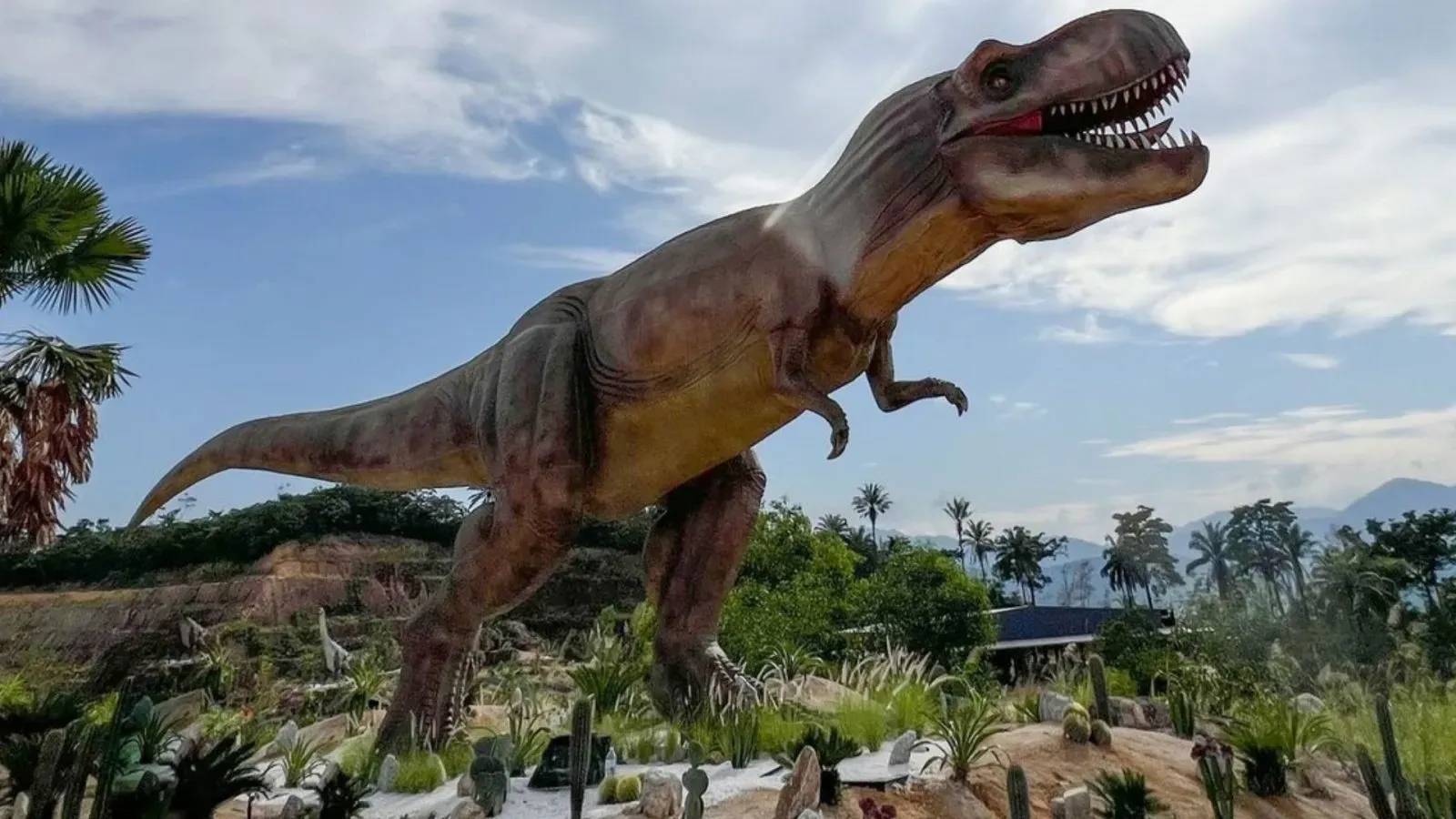
One of the most important things at a theme park entrance is making visitors think, at first glance, “Wow, that’s amazing.” An animatronic dinosaur—a realistic dinosaur model that can move and roar—is one of the most common choices, and also one of the most effective. Animatronic TyrannosaurusMechanical Structure & SpecificationsFor a lifelike Tyrannosaurus measuring 12.2 meters in overall length, the material selection of the load-bearing frame directly determines its outdoor wind resistance rating. The base frame is welded from Q235B standard square steel tubing, with each main side beam measuring 150 mm in width and 4.5 mm in wall thickness, allowing it to withstand a wind pressure of 7.5 kN/m². The moving pivot pins are machined from 45# quenched-and-tempered steel, paired with 65 mm diameter oil-impregnated powder metallurgy bushings, ensuring that the head can rotate through 170 degrees without producing metallic friction noise. The surface of the frame is coated with three layers of epoxy micaceous iron primer, reaching a total dry film thickness of 120 microns, enabling it to withstand acid-rain environments with humidity levels above 80%. The internal transmission rods use rectangular-section steel with a wall thickness of no less than 3.5 mm, preventing fatigue fracture under a working frequency of 15 cycles per minute. All welded joints undergo magnetic particle inspection, with crack detection rates controlled below 0.1%.
The flexibility of the mechanical joints is maintained by 15 internal brushless DC power modules. The 24V industrial gear motors deliver a rated torque of 200 Nm, with a response time controlled within 30 milliseconds. Combined with Hall-effect positioning, motion repeatability is kept within 0.5 degrees. The neck uses a heavy-duty electric actuator with a 400 mm stroke and 300 kg of thrust, sufficient to support a head module weighing 60 kg. The electrical layout avoids metal edges and is protected with flame-retardant PVC conduit. The main control box is equipped with a 16-channel PLC logic module with an instruction scan cycle of 1.2 microseconds, responsible for synchronizing audio playback with the jaw movement. The power distributor includes an overload protector, keeping peak current for the entire unit at 15 amps, while standby power consumption remains around 55 watts. The outer skin is built on a base layer of 50D polyurethane high-resilience foam. With an open-cell ratio of 70% to 80%, this material allows air circulation and helps prevent condensation corrosion on the internal steel frame caused by temperature differences. The surface is covered with a 400 g/m² high-tensile fiber mesh with a tear resistance of 600 N, ensuring that no fatigue creases form even when the torso expands and contracts by 10 cm to simulate breathing. The surface is coated with a polydimethylsiloxane (PDMS) blended compound at a thickness of 3 mm to 5 mm. The compound contains UV-resistant additives, and after 4,000 hours of xenon lamp aging tests, the fading rate remains below 5%. The hardness is adjusted to Shore A15, giving it a texture close to biological elasticity, with a rebound speed of 0.8 seconds after compression. The scale texture is kept at a depth of 2 mm to 4 mm, allowing rainwater to drain naturally without dirt accumulation.
The coloring process eliminates ordinary paint and instead uses an acrylic resin pigment blended with liquid silicone. This coating penetrates the skin substrate at a molecular level, giving it a peeling strength greater than 2.5 kN/m. The darker texture zones are airbrushed in three layers, with the base color, transition tone, and highlight tone proportioned at 5:3:2, creating visible muscular depth under 5,000 lux of natural light. The audio system measures a sound pressure level of 105 dB at a point 2 meters from the dinosaur’s mouth. The dual-channel stereo amplifier is rated at 2 × 60 W, and the audio files use a sampling rate of no less than 48 kHz with 16-bit depth, reproducing the vibration of low-frequency roars. The speaker cones are made from polypropylene and rated IPX6 waterproof, preventing rain-season moisture intrusion and audio distortion. A 24 GHz microwave sensing radar is concealed in the nose, with a 120-degree detection fan and an 8-meter radius. The control logic is configured for trigger-based wake-up, with each operating cycle lasting 120 seconds to reduce motor heat buildup. The emergency stop button is located at the rear side of the base, cutting off the power circuit in less than 0.1 seconds. The internal cooling fan runs at 3,500 rpm with an airflow of 50 CFM, keeping the internal temperature rise below 15°C.
The installation site requires excavation of a 1,500 mm deep foundation pit, with a 200 mm thick crushed stone bedding layer spread across the bottom. During the second concrete pour, levelness deviation must be controlled within 2 mm per meter, preventing center-of-gravity shift and eccentric wear. Every 6 months, the neck and abdomen access panels should be opened to apply molybdenum disulfide grease and inspect the vulcanization integrity of the silicone skin joints. Motion Performance & NodesThe head carries more than 60% of the entire unit’s motion logic, and the jaw bite angle is fixed at 170 degrees. The biting movement is driven by a high-torque eccentric wheel mechanism, taking 1.2 seconds to move from fully open to fully closed. The upper jaw is fitted with 13 pairs of simulated teeth, each measuring 15 cm in length. Steel pins are embedded in the base of every tooth to prevent loosening or detachment at a bite frequency of 30 times per hour. Inside the mouth, the tongue has an independent swinging node, formed from soft silicone wrapped around 2 movable pivot points. The tip of the tongue has an up-and-down travel of 8 cm, synchronized with the roar sound at the millisecond level. A red LED fill light is installed deep in the throat, controlled at 300 lumens, creating visible depth in dim evening light while simultaneously emitting 35°C room-temperature mist at a frequency of 4 times per minute. The eyeballs use 120 mm diameter high-transparency polycarbonate spheres, with iris details painted by hand and pupil proportions modeled after crocodilian eye structure. The eyelids are driven by miniature servos, with each blink lasting a random 200 to 400 milliseconds. Every 5 minutes, the system automatically triggers a rapid series of blinks to simulate a living creature clearing dust from its cornea.
The neck has movement in three dimensions. The vertical pitch range extends from -20 degrees to +35 degrees. Left and right yaw reach 45 degrees each, while lateral tilt reaches 15 degrees, allowing for lifelike head-cocking behavior. These compound movements are supported by a 250 mm diameter slewing bearing at the base, carrying a dynamic head load of nearly 80 kg, while operating noise is kept below 50 dB.
On both sides of the torso, a breathing module simulates rib movement, cycling 12 to 18 times per minute. The motion is driven by an internal crank-and-connecting-rod mechanism, with the actuator stroke set to 10 cm and thrust reaching 50 kg. Even in static display mode, this subtle physical expansion allows visitors within 3 meters to sense signs of life rather than seeing a rigid mechanical model. The tail serves as a balancing counterweight and is divided into three independently loaded segments, driven by flexible steel cables. The swing radius at the tail end reaches 1.5 meters, and the movement follows an S-shaped curve, with maximum speed controlled at 0.5 m/s. To protect the internal structure, the joints are fitted with polyurethane damping pads, which absorb inertial shock during directional changes and prevent long-term weld cracking. The control system performs a position check on all motors every 16 milliseconds. Head rotation is synchronized with the peak of the roar waveform in the audio system, with an error controlled within 0.02 seconds. When the 24 GHz radar in the nose detects a visitor moving within 5 meters, the system switches from standby low-frequency sway to full-speed attack mode within 0.5 seconds, and instantaneous output power rises from 60 W to 1,200 W.
The forelimbs have 2 active joints. The clawing action has an amplitude of about 15 cm, operating at a scratching frequency of 6 times per minute. At the ankles, the base uses 16 mm thick manganese steel plates, secured to the concrete foundation with 32 M20 high-strength bolts, ensuring that the body sway remains under 5 mm even during full-speed twisting. This stability comes from a computer-calculated center of gravity, with deviation controlled within 10% of the geometric center. A three-stage surge protector is added at the power input to prevent high-voltage breakdown of the control circuit during summer lightning storms. The main power cable uses a 3-core, 2.5 mm² national-standard rubber cable, with a maximum current-carrying capacity of 25 amps. To handle emergencies in outdoor display conditions, an emergency stop button is placed at the rear side of the base, physically cutting off the 24V power circuit in no more than 0.1 seconds. The surface coloring process replaces conventional paint with liquid silicone blended with acrylic resin pigments. The pigment forms a molecular-level bond with the skin substrate, delivering a coating peel strength greater than 2.5 kN/m. The darker texture zones are applied in three airbrushed layers, with base, transition, and highlight tones in a 5:3:2 ratio, creating muscular relief under 5,000 lux of natural light with a visual depth of 30 mm. Skin Material & ProcessThe Tyrannosaurus’ muscle base is formed from 50D high-density polyurethane foam, with an open-cell ratio maintained at around 75%. The internal pore structure of the foam allows the steel frame to avoid condensation buildup even when ambient temperature reaches 40°C, reducing the likelihood of corrosion in mechanical components. Technicians use a heated cutting blade to sculpt muscle textures of varying depth into the foam surface, with a maximum relief difference of 150 mm, simulating the expansion of a predator’s body under strain. Covering the foam is a double-layer high-tensile fiber mesh with a basis weight of 400 g/m². The material’s tear resistance is fixed at 600 N, so even when the internal actuator expands outward at a speed of 10 cm/s, the skin will not crack due to uneven force distribution. The fiber mesh is bonded to the foam substrate using a specialized chloroprene adhesive, with a measured peel strength of no less than 2 kN/m.
The weather resistance of the simulated skin depends on the silicone formulation. During mixing, adding 3% thinner and 1.5% curing agent locks the Shore hardness precisely at A15. Skin thickness is maintained at 3 mm to 5 mm, allowing it to withstand strong wind while adding no more than 15 kg of extra load to the neck drive motor. The surface silicone is blended with 5% UV-resistant additive during casting. Xenon lamp aging tests of 4,000 hours show a fading rate below 5%. The coating reaches IP65 waterproof performance. When rainwater contacts the surface, it forms droplets about 3 mm in diameter and quickly rolls off. Even in regions with annual rainfall exceeding 1,500 mm, the internal foam layer remains dry, and the added self-weight does not exceed 2% of the original body weight. Thickness distribution is not uniform across the entire body. The skin on the head is increased to 8 mm to withstand frequent jaw friction. In areas with more folds, such as the limbs and abdomen, the skin is reduced to 2.5 mm, and lubricating talc is used to lower friction resistance where skin layers overlap. This differential-thickness design allows the neck skin to stretch to 300% of its original length during a 170-degree wide-open jaw movement without whitening or cracking.
The coloring process uses liquid silicone blended with acrylic resin pigments. The pigment penetrates 0.2 mm into the skin surface, forming a molecular bond with a coating peel strength greater than 2.5 kN/m. Under direct natural light at 5,000 lux, the matte finish on the skin absorbs 70% of reflected light, preventing the glossy plastic-like appearance. The color layout follows biological logic: the transition zone between the dark brown back and the pale yellow abdomen is set at 20 cm in width. Technicians use a spray gun with a 0.5 mm nozzle to apply three layers of color, with the base color accounting for 50%, the transition tone 30%, and the highlight texture 20%. Paint usage is controlled to 450 g per square meter of skin, producing a visual depth of 30 mm from 5 meters away, with no visible signs of artificial application. Fine-detail treatment includes special finishing for the cornea, gums, and nostrils. The gum area is coated with an additional layer of high-gloss transparent silicone oil, 0.5 mm thick, to simulate the moist reflectivity of living mucosa. The transparent material has a refractive index close to 1.45, creating realistic physiological reflections under nighttime lighting and increasing credibility for close-up viewing.
To address scratches caused by long-term outdoor operation, the surface skin has room-temperature vulcanizing repair capability. Using a patch adhesive made from the same material, preliminary curing can be completed within 2 hours at 25°C, restoring strength to 90% of the original skin. The flatness deviation at the repaired area remains below 1 mm, and seamless restoration can be achieved with later repainting, extending the service life of the entire unit to 8–10 years.
Animatronic Eotyrannus DinosaurHardware & Structural DataThe body proportions of Eotyrannus are particularly distinctive in paleontological records. It measures 4.6 meters in overall length, with a hip height of 1.7 meters and forelimbs reaching 0.82 meters. This long-arm structure gives it three sharp-clawed fingers, and the ratio of forelimb length to hindlimb length is approximately 1:1.25, far greater than that of later tyrannosaurids. The internal support frame is built from #304 stainless steel square tubing, uniformly sized at 40 mm × 40 mm with a wall thickness of 3.5 mm. Welding is carried out using TIG (tungsten inert gas welding), with the current controlled at 150 A to ensure weld penetration reaches more than 80% of the steel thickness. This steel structure can stably support a 450 kg dynamic load, and in simulated rainforest conditions with 95% humidity, its oxidation-resistant service life exceeds 10 years. The frame surface is coated with two layers of epoxy zinc-rich primer, each with a dry film thickness of no less than 50 microns, to isolate acidic substances in the air.
The power system eliminates aging-prone belt drives and instead uses an all-metal planetary gearbox with a reduction ratio of 1:80. With the gain of the reducer, the 24V / 150W brushless DC motor delivers up to 50 Nm of output torque at the joints. This configuration allows the mouth to open and close fully within 0.5 seconds, with no physical rebound when it stops. The gear set is filled with compound lithium-based grease with a dropping point above 180°C, so it will not run or drip even when ground temperatures reach 50°C in summer. The head is fitted with two acrylic eyeballs, each 32 mm in diameter, with hand-painted iris details. The eyelids are driven by miniature electromagnetic actuators, simulating irregular blinking 3 to 5 times per minute.
During skin production, dimethyl silicone oil is added as a long-lasting softening agent to prevent fatigue cracking in the silicone rubber under long-term stretching. In high-frequency folding areas such as the armpits and neck, the skin thickness is increased to 1.5 mm and reinforced with an internal tear-resistant grid fabric. The surface texture is based on the scale distribution of the Komodo dragon, with hand-carved depth ranging from 0.5 mm to 1.5 mm. The paint scheme uses a dark gray-green base with dark red dorsal stripes, a camouflage pattern that increases concealment in vegetation. The sensing system uses a 24 GHz microwave radar module, capable of penetrating fiberglass artificial rock or decorative structures up to 10 cm thick. The detection range is adjustable from 2.5 to 5 meters, effectively avoiding false triggers caused by falling leaves, strong light, and other environmental interference. The audio unit is equipped with two 40W full-range waterproof speakers, producing a sound pressure level of 105 dB at 1 meter. The audio source uses a 48 kHz / 24-bit sample format, blending low growls from lions and tigers with the breathing sounds of a modern alligator. A miniature smoke system is integrated into the nasal cavity, using heated food-grade vegetable glycerin to generate white vapor. This design simulates the visible breath of a warm-blooded animal on a cool morning. A single 100 ml fill of smoke fluid supports more than 500 activations.
The mounting base is a Q235 steel plate measuring 2.5 m × 1.2 m with a thickness of 15 mm. Around the base are 8 reinforced holes with a diameter of 18 mm, ensuring the unit will not tip or shift under Level 10 gust conditions. The control box is rated IP67 and fitted with an internal 10W ceramic heating element. When the humidity sensor detects internal humidity above 85%, the system automatically activates dehumidification mode to protect electronic components from electrochemical corrosion. Before leaving the factory, every Eotyrannus must pass a 72-hour load aging test. A data logger monitors current fluctuations in every joint motor in real time, and those fluctuations are strictly limited to ±5% of the initial value. Dynamic Performance & Sensing MetricsThe neck contains three-axis rotational joints, allowing the head to tilt up and down by 45 degrees and turn left or right by up to 60 degrees. Each joint is driven by a 24V AC servo motor combined with a 1:80 reduction gearbox, producing up to 55 Nm of torque. This is enough to whip a 15 kg dinosaur head upward in 0.4 seconds, with a stopping position deviation of less than 0.5 mm. The rotational bearings are supplied by HRB, packed with polyurea grease that will not drip even when heated to 260°C. Even if outdoor surface temperatures reach 60°C in summer, this joint system can operate continuously for 2,000 hours without issue. A 0.5 mm nylon mesh is bonded to the inner neck skin to prevent the outer silicone skin from tearing during large-angle twisting.
The tail is connected by four sections of steel universal joints, and the tip can swing at speeds up to 1.5 m/s. To make the tail move with lifelike inertia, the control program uses S-curve acceleration and deceleration control. This system checks motor data 1,000 times per second, suppressing mechanical vibration to below 2 Hz, so the movement does not snap back with a stiff, machine-like feel. The forelimb clawing motion is powered by a miniature electric actuator capable of delivering 800 N of thrust. The actuator has a 100 mm stroke, and its surface is hard-chrome plated, making it several times harder than ordinary steel. The three claws are made from reinforced resin and can withstand 65 MPa of pulling force, so they are not easily broken even if a mischievous child tugs on them. Instead of sunlight-sensitive infrared sensors, the system uses a 24 GHz microwave radar module. The radar scans across a 120-degree fan angle and can detect approaching visitors at 5 meters. The radar can also pass through 15 mm of artificial rock or foliage, allowing it to detect people even when hidden behind landscaping.
The sensing program uses three layers of logic. When a visitor is 5 meters away, the dinosaur simply breathes 14 times per minute, as if asleep. At 3 meters, it begins to turn its head slowly and watch the person. Once the visitor crosses the 1.5-meter line, the dinosaur immediately opens its mouth, lets out a 105 dB roar, and lunges forward. The sound system uses a 48 kHz high-sample-rate format, with near-CD-quality playback stored on an industrial-grade SD card. Inside the throat are two 40W waterproof speakers covering a frequency range of 65 Hz to 18 kHz. The low frequencies deliberately use resonance from the throat cavity, producing the chesty rumble of a large predator. The eyes blink 6 to 10 times per minute, with each blink occurring at irregular intervals for a more lifelike effect. The left and right eyelids are driven by two independent micro motors, and they can close in just 0.08 seconds. The eyeball surfaces are coated with fluorescent paint, so at night their glowing gaze remains visible across a 120-degree range.
The abdominal breathing motion is driven by an eccentric wheel mechanism, simulating the expansion and contraction of lungs. The connecting rod is made from 6061 aluminum alloy, a lightweight and wear-resistant material that allows the breathing motor to run continuously for 5,000 hours. The rise-and-fall motion is synchronized with the breathing audio to within 30 milliseconds, making it feel like genuine respiration. To handle winter temperatures as low as -15°C in northern regions, the circuit board is equipped with a PID automatic heating system. When low temperatures are detected, the heating element keeps the electronics above 10°C. This prevents shrinkage-related gear sticking and ensures the dinosaur moves as smoothly in winter as it does in summer. The lower Q235 steel plate is treated with anti-rust coating and shows no corrosion after 500 hours of salt spray testing. The plate includes 8 large anchor holes and must be fixed into concrete to a depth of 150 mm. This fixing method can withstand 2,500 N of force, ensuring that even a dinosaur weighing several hundred kilograms will not be blown off center in Level 10 winds. Maintenance Cycle & DurabilityThe Eotyrannus frame is welded from #304 stainless steel tubing with a wall thickness of 3.5 mm, capable of resisting tensile strength above 515 MPa. During welding, the AC argon arc welder must be set to 150 A, and every weld point must penetrate more than 80% of the steel thickness. The frame surface is coated with two layers of 50-micron epoxy zinc-rich anti-rust primer, allowing it to withstand 95% humidity for 10 years without rust spotting. The muscle layer outside the frame uses high-resilience foam with a density of 40 kg/m³, which rebounds immediately after compression. The outside of the foam is wrapped with a 0.5 mm nylon fiber mesh capable of withstanding 120 N of tensile force per square centimeter. Once the support structure is secured, the internal rotating joints must also meet specific performance standards:
When greasing, a high-pressure grease gun must be pressed firmly into the bearing housing lubrication port until the old grease being expelled turns visibly clean. The skin is built up by hand in layers of silicone rubber, with thickness controlled between 1.5 mm and 2.0 mm. To prevent cracking under strong sunlight, the formula includes 2% dimethyl silicone oil as a softening agent. Across temperature differences from -20°C to 50°C, the skin hardness remains around Shore 15, giving it a texture close to real flesh. The outermost color layer uses an acrylic thinner combined with oxidation-resistant pigment, with color fastness reaching Grade 4 under ISO 105-B02. In sun-intense southern theme parks, the color can remain stable for 3 years without noticeable fading. If the skin is cut by branches or other objects, the included 500 ml repair adhesive can be applied, and it will cure in 30 minutes. The internal power core is a 24V / 150W brushless DC servo motor paired with a 1:80 planetary gearbox.
Every six months, the motor cover should be removed and the gearbox checked for clicking noises. If the sound level exceeds 65 dB, the assembly should be disassembled for inspection. The sensing system uses a 24 GHz microwave radar module with a 120-degree scan angle, capable of detecting moving people as far as 6 meters away. Because the radar can pass through 10 cm of artificial rock, the sensor can be hidden behind landscaping elements. The mainboard uses an ARM Cortex-M4 core with 256 MB of storage, holding 16 different action sets. When a person approaches within 1.5 meters, the controller sends a signal to the driver, and the dinosaur can raise its head within 0.1 seconds. In standby mode, it consumes only 12 W, roughly equivalent to a light bulb, while full-speed operation peaks at around 1,500 W. The mounting base plate is a Q235 steel plate measuring 2.5 meters long, 1.2 meters wide, and 15 mm thick. It has 8 holes, each 18 mm in diameter, and must be fixed into concrete with M16 stainless steel expansion bolts embedded to a depth of 120 mm. This mounting method can withstand 2,500 N of force, so even in Level 10 winds at 28.4 m/s, the Eotyrannus will remain upright. After the bolts are installed, structural construction adhesive should be applied around each hole to prevent rainwater from entering through the gaps and corroding the anchors. The white vapor effect from the nose is produced by a 100 ml miniature smoke generator. The smoke fluid is made from food-grade vegetable glycerin, and one full fill allows more than 500 sprays. The smoke tube is made from PTFE, with heat resistance up to 260°C. Every 30 days, the pipe should be cleaned with a 1:1 vinegar-water solution to prevent mineral buildup from clogging the line. The speakers are installed behind the throat and consist of two 40W waterproof drivers protected by fine stainless steel mesh. The sound level measures 105 dB at 1 meter, roughly comparable to a train whistle. The sound files are stored in 48 kHz high-fidelity format, and the SD card should be removed and reformatted every six months to avoid playback errors.
Before shipment, the dinosaur must run continuously in the test field for 168 hours without interruption. The monitoring computer tracks the current of every motor. If any current suddenly rises by 20%, it indicates a joint may be binding. Only when the current curves remain stable, with fluctuations controlled within ±5%, is the unit considered qualified for delivery.
Animatronic OuranosaurusMechanical & Interactive ParametersThe internal load-bearing frame of the Ouranosaurus model is built from Q235 square steel compliant with Chinese national standards, typically in 40 mm × 40 mm sections with a precisely maintained 3.5 mm wall thickness. The frame is joined by CO₂ gas-shielded welding, with weld penetration exceeding 95% of the metal cross-section, making it highly resistant to metal fatigue caused by frequent outdoor vibration. At the junction between the neck and torso, a 6061 aerospace-grade aluminum bearing housing is paired with a 25 mm diameter solid rotating shaft, providing stable support for a dinosaur head weighing up to 35 kg. Technicians hand-cut high-resilience polyether foam with a density of 30 kg/m³. Even after 50% compression, this material quickly returns to its original shape. The foam is wrapped in a specially engineered high-elasticity fiber mesh with a 400% elongation at break, preventing the internal filling from shifting or bunching into wrinkles when the dinosaur performs large downward neck movements.
The outer skin is made from industrial-grade silicone rubber, mixed with a thixotropic agent at a 10:1 ratio and vacuum-degassed during preparation. Hardness is maintained at Shore A 25. This material retains its physical toughness in environments ranging from -20°C to 55°C, without surface cracking. Before the silicone cures, technicians use hand-made molds to emboss simulated scales with depths of 2 mm to 5 mm, with texture density strictly based on paleontological reconstruction references. For skin coloring, a special silicone pigment paste is blended with 120# solvent, achieving a pigment penetration depth of 0.5 mm. This coloring system reaches a UV resistance grade of 7. After 1,000 hours of xenon lamp accelerated aging in the lab, the color fading rate remains below 15%. Even after three years of full outdoor exposure at a theme park entrance, there is no obvious fading or coating peel visible to the naked eye.
The central control unit is developed on an ARM Cortex-M4 architecture, supporting multi-channel PWM output to control multiple groups of brushless motors. Two 50 W full-range waterproof speakers are embedded inside the chest cavity, delivering a measured sound pressure level of 110 dB at 1 meter. The audio processing chip includes a digital low-pass filter that removes artificial noise above 200 Hz, reproducing the deep, heavy low-frequency roar associated with prehistoric creatures. The electrical system is fitted with a leakage protection breaker with a 30 mA trip current, and a trip response time under 0.1 seconds, ensuring visitor safety on contact. All connectors use IP67 aviation-grade waterproof plugs, with fluororubber sealing rings to protect internal circuit contacts from acid rain corrosion. The machine’s center of gravity is tuned through a 12 mm thick steel base plate, and the unit is secured to concrete with M16 chemical anchor bolts, allowing it to withstand Level 10 winds. The mechanical joints are periodically lubricated with lithium-based grease with a dropping point of 190°C. This grease does not thin out or leak under heavy operation, eliminating sharp noise caused by metal friction. Randomization is built into the motion program logic, so each blink or head-turn occurs at intervals varying from 4 to 8 seconds, breaking the sense of mechanical repetition and giving the entrance welcome sequence a more lifelike presence.
Environmental Adaptability & DurabilityA 7-meter-long Ouranosaurus model placed outside a park entrance is exposed to the elements 365 days a year. Its entire internal structural frame is treated with hot-dip galvanizing, with the steel submerged in molten zinc at 450°C. The galvanized layer is strictly controlled at no less than 85 microns, forming a dense metallic barrier that blocks 99% of airborne moisture. The outer frame is then coated with two layers of epoxy zinc-rich primer, followed by an 80-micron fluorocarbon topcoat, creating a dual protective shell. Test samples are placed in a high-concentration salt spray chamber and continuously exposed for 1,500 hours. Even under magnification, no blistering or rusting can be found on the metal surface. The tall sail on the back of the Ouranosaurus presents a much larger wind-catching surface than that of ordinary dinosaur models. Meteorological testing data shows that under Level 8 gale-force winds, a 2.5-meter-high sail can be subjected to as much as 450 kg of lateral force. Such wind pressure can easily overturn a conventional frame. To solve this, the internal structure of the sail abandons rigid steel tubing in favor of solid fiberglass rods with a diameter of 15 mm. In strong winds, these rods can flex by as much as 12 degrees, quietly relieving wind pressure and protecting the main shaft at the base. At the lowest point of the sail base, hidden 8 mm drainage holes are installed every 30 cm. Rainwater flows smoothly through pre-embedded PVC flexible hoses with a 20 mm inner diameter and is discharged through the abdomen. The inner walls of the hoses are coated with an anti-algae coating, preventing moss buildup and blockage even under long-term water flow.
In summer, the surface temperature of the silicone skin under direct sunlight often rises to 65°C. To counter this, 4% nano-scale UV-resistant powder is pre-mixed into the compound. Under a microscope, these UV-resistant particles show a flake-like structure that reflects destructive solar radiation away. This formula delays the onset of natural outdoor cracking and shrinkage by a full 48 months. In northern regions, winter temperatures in parks can approach -20°C, causing conventional hydraulic oil and grease to thicken into paste-like sludge. The motor gearbox is therefore filled with aerospace-grade low-temperature grease. Its kinematic viscosity remains at 25 cSt even in extreme cold, ensuring smooth head movement with no sticking. Its dropping point reaches 190°C, so even under heavy motor load and high heat, the grease does not liquefy and run out. A tear-resistance test is mandatory during factory quality inspection. Buried firmly inside the 5 mm silicone layer is a 1000D nylon ballistic mesh. Even when several adults pull hard on the dinosaur’s tail, its 18 MPa tensile strength allows it to withstand destructive force exceeding 50 kg.
Children often like to touch the dinosaur’s mouth. The Ouranosaurus teeth are cast from high-strength polyurethane resin with a hardness of Shore 75D. Even when scraped hard with a metal key, the surface does not show obvious white marks. Antioxidants are added to the resin, so after five years of outdoor exposure, the white teeth do not yellow or become brittle. The silicone material is also blended with automotive-grade outdoor oil-based pigments, allowing the color to penetrate 2 mm below the skin surface. After three years of wind and rain exposure, instrument testing shows a pigment fading rate of no more than 10%. The pair of custom 80 mm diameter glass eyes is coated with an ultra-thin scratch-resistant nano film. Even when cleaning staff wash away bird droppings and dust daily with a 30 psi hose, the glass remains clear and bright. The tallest neural spines on the back undergo slight physical vibration during routine breathing movements. At the base of each fiberglass rod, a polyurethane shock-absorbing pad with a hardness of Shore 60 is installed. This reduces the metal fatigue caused by high-frequency micro-vibration to the lowest possible level. Technicians use medical-grade RTV silicone adhesive for a second manual edge sealing process. The seam achieves a tensile tear strength of 25 kN/m, so the neck will not delaminate even after tens of thousands of twisting movements. The circuit boards on the main control board are fully coated with conformal coating. This evenly applied insulating layer seals the copper traces and surface-mounted components completely. In seaside amusement parks, where the air is full of salt, the control board has operated continuously for 5,000 hours without a single micro short circuit. When a 1.2-ton machine stands in place, the anchoring quality of the base is a matter of safety. The concrete foundation is secured with eight M20 chemical anchor bolts. Each anchor reaches a depth of 30 cm, gripping C30-grade concrete firmly. In Level 10 typhoon conditions, the base can achieve an overturning resistance moment of 15,000 N·m. Visitor Psychological FeedbackWhen a 7-meter-long mechanical dinosaur stands at the ticket entrance, most children between 3 and 6 years old instinctively shrink back. A Tyrannosaurus with 60 sharp teeth up to 15 cm long can easily make young children cry. By contrast, the Ouranosaurus has a broad, flat, duck-bill-like beak about 40 cm wide at the front of its head, with no exposed sharp teeth. Its rounded, flattened facial features naturally project a gentle and harmless biological character. Test recordings provide exact figures from a sample of 1,200 people. When facing a roaring carnivorous dinosaur with its mouth open, around 65% of preschool children clutch their parents’ clothes tightly. When replaced by the herbivorous Ouranosaurus, the proportion of children who voluntarily approached the protective barrier within 1 meter rose to 82%. Its large size combined with a non-aggressive appearance increased the average dwell time of each family group outside the barrier to 4.5 minutes.
The production team equipped the Ouranosaurus with custom caramel-colored acrylic pupils, edged with a soft orange glow at a color temperature of about 2800K. Built-in servo motors control the eyes so they drift slowly within a range of ±15 degrees at a very slow speed of 0.2 radians per second. As visitors approach the barrier, the giant eyes align almost perfectly at eye level with children around 1.2 meters tall. Out of 500 entrance survey responses, 410 mothers, accounting for 82%, selected the option “My child feels the big dinosaur can understand speech.” The cold, mechanical impression of a giant machine is completely softened by this gentle eye contact. The average favorability score on the rating sheet reached 9.2 points. The subtle rise and fall of the abdomen deeply influences the subconscious. A machine that only stiffly shakes its head and tail quickly feels dull. To solve this, craftsmen installed two electric actuators inside the chest cavity, each with a 60 mm stroke and 150 kg of thrust. With every inhalation, the silicone abdomen expands outward by about 0.5 cubic meters.
Control over the audio frequency range plays a major role in shaping visitor emotion. Amusement parks often use sharp roars above 85 dB to attract attention. When harsh, piercing sounds enter the ear, visitors’ systolic blood pressure can rise by 5 to 8 mmHg within 0.5 seconds. The Ouranosaurus audio generator intentionally removes high, sharp frequency components above 400 Hz. What comes through the dual 60 W bass speakers is a low, resonant moan in the 150 Hz to 250 Hz range. Zoologists often place the chewing and low vocalizations of cattle within this band. The deep, full-bodied sound carries through three layers of queued visitors and can spread clearly across an open plaza for 50 meters. As visitors move from the parking lot toward the ticket plaza and hear this deep, resonant echo, their average walking speed instinctively drops to 0.8 meters per second. The anxious mood of people waiting in line is noticeably soothed. Entrance surveillance footage shows that the average daily complaint rate involving pushing or jostling in the ticket line dropped by about 19%, from around 15 incidents per day. The tall sail rising from the back also becomes an excellent photo backdrop. The 2.5-meter-long sail, spanning four mechanical vertebrae, is painted with three gradient layers of peacock green and bright yellow.
Visitors naturally form orderly short pauses at the entrance. The massive body of the Ouranosaurus inherently helps divide and guide the flow of people. During the morning peak, the redistribution effect of photo-taking visitors reduces queue density from 4.5 people per square meter to 3.2 people per square meter, easing localized crowding pressure by roughly one quarter.
|