|
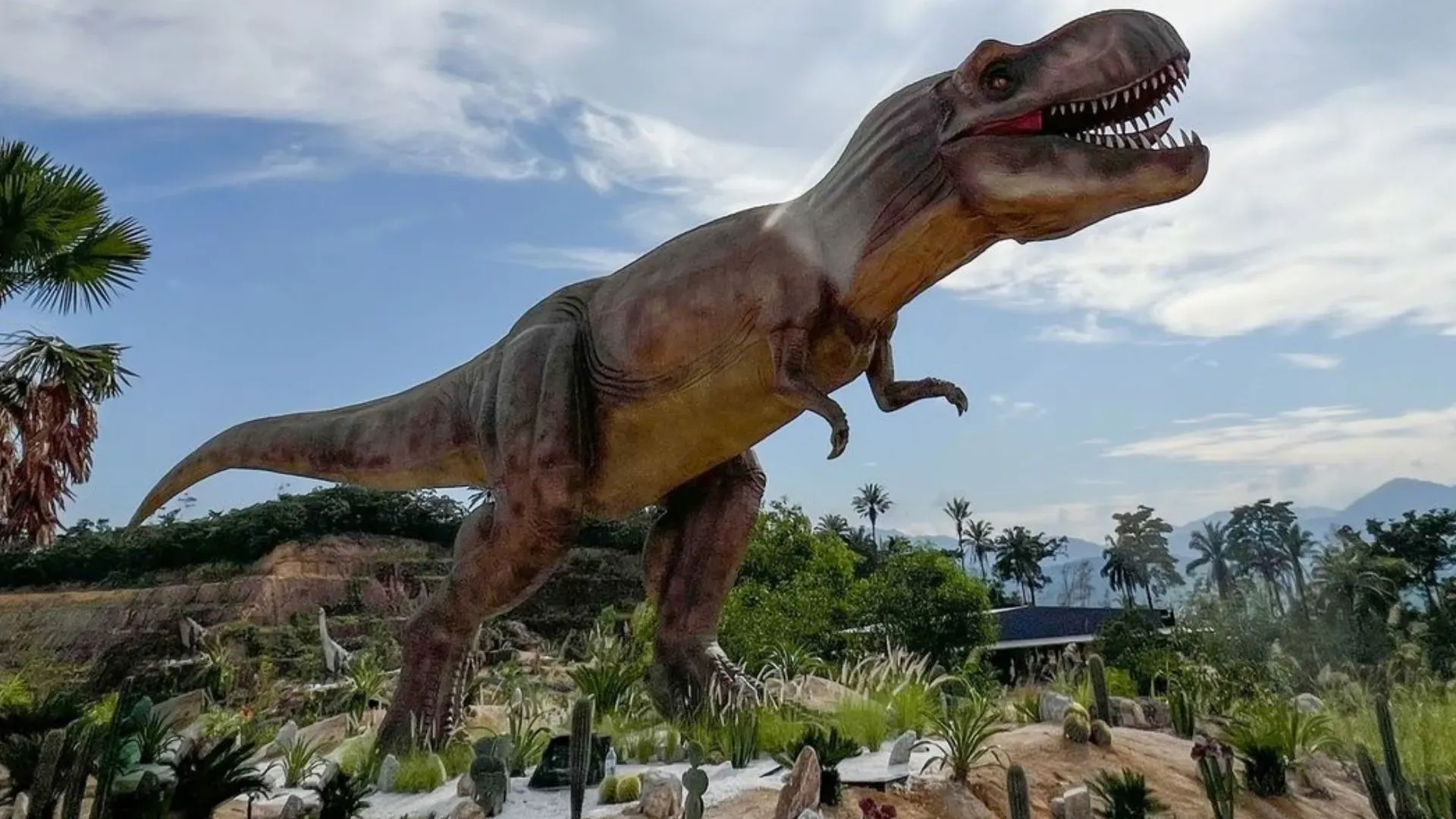
12-meter Tyrannosaurus Rex with 110 dB sensor-triggered sound for a commanding, high-impact presence; 4-meter Pachycephalosaurus designed for agile, interactive engagement; 8-meter Triceratops paired with low-lying fog effects for immersive scene-building. Animatronic T-RexFor a night-show version of an animatronic T-Rex, the body length is typically set at 12 to 15 meters, with a height of 4.5 to 5 meters. The unit is built with 25 to 30 independent servo motors, controlling full-body movement from jaw opening and closing to neck rotation and tail sweeping. The outer skin is made from a cast combination of three layers of high-density flame-retardant foam and weather-resistant silicone, while the internal frame is welded from CE-compliant galvanized steel tubing. Total weight is kept within 1.8 to 2.2 tons. It is equipped with two 1000W waterproof directional speakers and programmable RGB eye lighting, with a rated power of 4500W and support for both 110V and 220V wide-voltage input. Frame & Control SpecificationsFor a 15-meter animatronic T-Rex, stability is the first priority. Construction teams at theme parks in California typically begin with a high-density concrete foundation. The base is assembled from heavy-duty H-section steel, with the main load-bearing steel plates reaching a thickness of 15 mm. Workers drill 16 deep holes into the ground, each 24 mm in diameter, and secure the base using chemical anchor bolts. Even when this 2-ton structure twists violently at 1.5 meters per second, the base remains completely stable. The main load-bearing steel tubes inside the body have a wall thickness of 4.5 mm. In Orlando, where nighttime gusts often reach 80 km/h, frame deflection remains below 0.2%. All welding is done using argon arc welding, with weld depth tightly controlled at 3 mm. Even after 10 hours of continuous night performance and more than 10,000 neck movements, the steel joints do not develop even hairline cracks. Once the frame is fully welded, it is dipped in a hot-dip galvanizing bath, forming an 80-micron zinc layer on the surface. In Florida’s year-round humidity of up to 95%, this protective metal coating prevents the steel tubes from corroding even after years of outdoor exposure. All joint bearings are upgraded to SKF self-aligning models, capable of handling 450,000 newtons of force. The neck and tail contain 32 brushless motors. The motor controlling the neck alone can deliver 120 N·m of torque. A 1:64 planetary gearbox is installed throughout the drive system, allowing the 150 kg lower jaw to snap shut in 0.4 seconds. The internal gear engagement is extremely smooth, eliminating the jerky, outdated motion often seen in older amusement-park dinosaurs. All wiring is protected by flame-retardant polymer conduit. More than 150 meters of heavy copper cable runs through the body, and the outer insulation remains intact even after millions of bending cycles. Even with a 1000W strobe light flashing nearby, the control signal remains completely stable and free from interference.
Movement commands are transmitted via the DMX512 stage protocol, with the control board providing access to 512 channels. A 12-meter tail sweep can be synchronized perfectly with a DJ beat at 120 BPM, with an error margin of less than 15 milliseconds. At the edge of the venue, Omron sensors are mounted at a height of 2 meters. When someone enters the sensing zone at 8.5 meters, 7 internal motors activate together within 0.15 seconds, driving the T-Rex head sharply downward by 65 degrees. The waterproof control box inside the body is made from cast aluminum. System refresh speed is extremely fast, at just 1 millisecond. The mainboard and all joint assemblies cross-check positioning 1000 times per second, ensuring that movement trajectories never drift off target. Facial micro-expressions are controlled pneumatically. A silent air pump pushes 200 liters of high-pressure air per minute through the tubing. The eyelids can blink in just 0.08 seconds, and the eyes can rotate 15 degrees per second. Between the steel frame and outer skin sits 5 cm of flame-retardant foam. When the internal steel tubing rotates at 20 degrees per second, the foam absorbs the hard vibration before it reaches the outer surface. The silicone skin can stretch to three times its original length. Even when the jaw opens to 65 degrees, the corners of the mouth do not crack. Engineers can plug in a computer and view the waveforms of all 32 motors clearly on screen. By dragging the timeline in the control software, the entire creature can reproduce a signature 2.4-second Hollywood-style roar with precise timing. The base contains 800 kg of solid cast iron ballast, locking the center of gravity at 1.2 meters above ground level. Even when the body swings violently from side to side at 45 degrees, the entire machine remains stable without visible sway. It continues roaring normally at temperatures up to 55°C. The system supports both 110V and 220V power supplies. Under normal operation, daily power consumption is about 18 kWh, and a 10 mm² copper cable is sufficient for power connection. At startup, the current peaks at 45A, and full-speed operating power reaches 4500W. With a 32A waterproof connector, multiple dinosaurs can run in the same venue without tripping the circuit. For transport, the 15-meter body is divided into three sections. The neck, body, and tail are connected with aviation plugs that can be disconnected in 3 seconds. Once delivered to a venue in Miami, four workers can fully reassemble the unit and tighten more than 30 bolts within 6 hours. A 40 cm square zippered maintenance opening is left beneath the belly. A technician can reach inside and access the main control board directly. All internal wiring is bundled with nylon ties at 10 cm intervals, making cable routing clear and easy to service. The 60 teeth inside the T-Rex mouth are cast from high-strength resin, each measuring 12 cm in length. Every tooth base is locked to the jaw steel plate with two heavy screws, and each tooth can withstand a direct pulling force of 20 kg. External Protection & Climate AdaptabilityPlace a 15-meter, 2-ton animatronic dinosaur outdoors under the intense sun in Dubai, where ground temperatures can reach 55°C at midday, and the outer skin must be built from genuinely durable materials. Otherwise, it would deform within days. Before shipping, workers hand-brush a 4 mm layer of RTV-2 room-temperature-vulcanizing silicone over the outer surface. This material is commonly used on heavy industrial equipment, and even under the extreme sun of the Middle East, it resists softening and deformation. Directly beneath the silicone skin is a layer of flame-retardant polyurethane foam with a density of 40 kg/m³. Between the foam and the outer skin, a layer of high-elasticity nylon mesh fabric is permanently bonded in place. During performances, the dinosaur may whip its head violently and open its jaws to 60 degrees. The nylon mesh distributes that intense pulling force throughout the structure, preventing the outer silicone skin from developing any visible tears or stretch lines. Color finishing is also highly specialized. The sprayed acrylic paint includes UV-resistant additives. In Orlando, where the summer UV index frequently exceeds 11, the outer finish can remain under direct sun for 8000 hours and still show no more than 15% color fading.
If the dinosaur is installed in London, where light rain is frequent year-round, the body design helps shed water efficiently. The entire spine is shaped with a built-in drainage slope. Rain striking the back runs along the 12-meter dorsal line and flows off cleanly at the tail. No standing water remains in the coarse folds under the neck or belly. The electrical control box and all cable connections hidden deep inside the body are manufactured to IP65 waterproof standard. Even during a downpour of 50 mm per hour, water cannot penetrate the circuit boards. The rear cooling fans are fitted with custom weatherproof louver covers that block wind-driven moisture as well. At the lowest points under the jaw and belly, drainage holes with a diameter of 8 mm are drilled into the soft skin before delivery. In Florida, summer nights often bring a 10-degree temperature swing. Any condensation forming inside the foam layer drains out through these holes and drops to the ground. The galvanized steel frame inside remains dry, leaving no opportunity for rust to develop. If installed in places like Calgary, where nighttime winter temperatures can fall to -20°C, ordinary rubber materials would become brittle. The specially formulated cold-resistant silicone skin used here still maintains 250% elongation even in those conditions. A 12-meter tail can keep sweeping through the snow without the outer skin stiffening or cracking.
The structure stands nearly 5 meters tall, with a very large wind-exposed surface area. The silicone skin and steel frame are fully bonded together using high-strength polyurethane structural adhesive. When side gusts of 80 km/h strike the body at night, the skin remains close to the rib structure and does not balloon outward like an overinflated surface. The mouth contains 60 large teeth, exposed outdoors year-round. These are made from dental-grade fiberglass resin, and the root section alone extends 15 cm into the jaw. Each tooth is finished in a high-temperature kiln with an anti-yellowing gloss coating. Even after three years of outdoor exposure, strong stage lighting still makes the teeth appear bright white and reflective. The eyeballs are machined from highly transparent acrylic resin. In Miami’s extremely humid night air, a 5V micro-heating wire is installed behind the acrylic lenses. Once powered, the heating wire keeps the lens surface about 3°C above ambient temperature, preventing condensation from forming and ensuring the eyes never fog over.
For maintenance crews, access is easy. A discreet 10 x 10 cm Velcro access flap is hidden on the inner thigh. Once opened, a worker can shine a flashlight inside and inspect the frame welds directly for rust. If a bird pecks through the scalp at night, or a fallen branch tears a 5 cm slit into the thigh, the repair is simple. Workers can apply matching RTV-2 silicone directly into the damaged area with a trowel. At room temperature of 25°C, the repair fully cures in 15 minutes. Once finished, the surface feels smooth, with no raised seam or visible repair line. Because the neck and knees bend tens of thousands of times every night, the skin in those areas is designed with accordion-style layered folds. During a 4-hour night performance, the neck can twist 30 degrees per minute. That repeated pulling force is spread across seven to eight large folds, preventing any single section of skin from taking the full strain. Inside the chest cavity, the two 1000W speakers are protected by a 2 mm Gore-Tex membrane. The 110 dB roar passes easily through the membrane, while stage fog and artificial mist are completely blocked from reaching the speaker voice coils. Sound & Lighting EffectsAt night, in a dark amusement park setting, body movement alone is not enough to create impact. Mounted deep inside the chest frame are two 1000W marine-grade waterproof speakers, with a full frequency response range of 40 Hz to 18 kHz and especially strong low-frequency output. The mainboard is loaded with lossless audio combining lion roars and crocodile hissing. When the jaw-opening mechanical command is triggered, the control board activates the MP3 decoder within 15 milliseconds.
The speaker housings are covered with a 2 mm PTFE breathable membrane, blocking the moisture produced by stage mist machines from reaching the speaker diaphragm. The internal copper coils can carry an instantaneous current of 12A, allowing the system to roar continuously for 4 hours without overheating. Movement and sound alone are not enough. In low-light night-show conditions, the eyes are the first thing visitors notice. The eye sockets contain a pair of high-transparency acrylic eyeballs, each hollowed out and fitted with a full ring of 5050 RGB LED strips. The wiring uses 24V DC low-voltage cable connected directly to the venue’s DMX512 lighting console. With access to 512 independent channels, lighting designers at festivals in Las Vegas can sync the eye color changes perfectly with the venue’s strobe lighting.
When that red light flashes into a visitor’s eyes, it creates a momentary visual blind spot lasting about 2 seconds. To heighten the effect, the T-Rex opens its mouth to 60 degrees and emits white smoke from deep in the throat. Three high-pressure PTFE air hoses with an internal diameter of 15 mm are mounted along the steel tubing deep inside the neck. These hoses run down through the leg area and connect to a 1500W high-output fog machine hidden in the base below the set. The tank is filled with water-based amusement-grade fog fluid, consuming about 2.5 liters per night.
The fog machine outputs 20 cubic meters of smoke per minute. The smoke pushes outward through the gaps between the 60 resin teeth, projecting as far as 2 meters from the mouth. Hidden inside the upper jaw are two 30W cool-tone LED spotlights. When smoke is released, these lights switch on and illuminate the dense white vapor, creating the effect of an animal exhaling icy breath into -5°C night air. For Halloween night shows in Orlando, operators sometimes swap these mouth lights for bright orange-red units. Combined with the high-pressure white fog, the effect looks like a blazing burst of fire.
The entire sound-and-light system connects to the venue control room through a 100-meter multi-core shielded cable. The PLC inside the control cabinet keeps the time difference between sound, lighting, and fog effects within 20 milliseconds. Troubleshooting is simple for maintenance staff. The control panel contains three independent circuit breakers, separately assigned to the speakers, eye lights, and fog machine. If any one system fails, workers can unplug the aviation connector, check resistance with a multimeter, and replace the fuse within 3 minutes. The high-voltage power lines at the base are kept 15 cm away from the main audio lines. Even when the two 1000W speakers are roaring at 110 dB, the heavy current field does not interfere with the fog-machine control signal at all. To handle extremely humid night conditions in places like Chicago, all harness connectors are coated with insulating silicone grease. Even when condensation forms across the surface of the control box, the entire coordinated system continues to run with complete stability, with timing error kept to within a single frame.
Animatronic PachycephalosaurusThis lifelike Pachycephalosaurus measures 4.5 meters long and 2.2 meters high, and features a reinforced dome skull structure with a thickness of 25 mm. Inside, a brushless motor works together with a pneumatic system to deliver a head-butting frequency of 1.5 impacts per second. The outer skin is made from high-density, UV-resistant silicone. After an Orlando dinosaur night park introduced two combat-style Pachycephalosaurus units, average visitor dwell time increased by 25 minutes, and night ticket sales rose by 18%. Mechanical Structure & ImpactThe two 420 kg Pachycephalosaurus units at Universal Studios Orlando do not rely on thin sheet metal framing. The manufacturer built the internal structure with 4.5 mm-thick seamless steel tubing, reinforced with X-shaped cross beams beneath the abdomen. During lateral pull testing, the frame withstood 1.2 tons of force without deformation. The large cranial dome could never survive repeated impact if it were made from fiberglass. A prop factory in Florida instead used polyurethane foam to create a separate oversized head shell with a thickness of 80 mm, then coated the exterior with a 3 mm-thick polyurea layer. When the two dinosaurs collided head-to-head at 3 meters per second, this outer shell absorbed 90% of the vibration. The neck is not a rigid metal bar. It is built from 12 articulated universal joints made of high-carbon steel, assembled with tolerances under 0.05 mm. The gaps between the joints are filled with industrial silicone pads rated at Shore A 40 hardness. Once powered on, the neck can bend 45 degrees to either side with ease.
A rotating motor alone cannot generate that kind of explosive striking force. The outsourced engineering team installed a double-acting pneumatic cylinder inside the dinosaur’s chest cavity. The piston measures 63 mm in diameter and can extend forward by 150 mm. It is connected to an industrial air compressor supplying 0.8 MPa of continuous high-pressure air. Within 0.1 seconds of the exhaust valve opening, the cylinder drives the neck forward in a powerful strike. Instrument testing recorded an instantaneous thrust of 1200 N. To prevent the cylinder from retracting too violently and tearing the skin, two 1.5 kW servo motors apply braking force from the rear. A machine weighing several hundred kilograms and colliding like this every day would tip over if the base were unstable. The 2.8-meter base is factory-filled with 400 kg of cast pure lead, then anchored on-site into the ground using eight 20 mm expansion bolts. No matter how violently the upper body moves, base displacement stays within 2 mm.
How do the two dinosaurs align so precisely at night? Each nostril conceals a miniature infrared sensor. The moment the two noses come within 15 cm, the sensor sends an electrical signal to the main control board. From signal reception to cylinder discharge, the delay is locked within 15 milliseconds. The control program intentionally makes the left unit travel 2 cm less. As the two artificial skulls collide, this creates a convincingly real sense of offset friction. At the Natural History Museum in Munich, Germany, one display pair operated continuously for 90 days and completed 65,000 impacts. Ultrasound scanning of the skull surface showed microcracks of less than 0.2 mm. When a head weighing tens of kilograms lunges forward, the rear would naturally lift. To counter this, a 15 kg solid iron counterweight is suspended inside the tail. As the head thrusts forward, the motor pulls a steel cable to lift the tail by 30 degrees, instantly rebalancing the mass distribution.
If a branch or other obstruction jams the neck, the high-power clutch plate on the main board automatically slips and disengages, preventing the steel tubing from bending. Inside the abdomen, 22 electrical wires and 4 pneumatic hoses are all sleeved in German-made nylon corrugated conduit. They are fixed at non-moving points with stainless steel clamps, so even under constant vibration, the outer sheath does not wear through. Nighttime Sound and Lighting ControlLast year, a night adventure park in Austin, Texas installed two fully equipped Pachycephalosaurus units. Engineers fitted two 150 W outdoor all-weather subwoofers inside the rib-frame structure of each dinosaur’s chest cavity. The bass reflex ports were directed toward the ground beneath. Sound level tests taken from 3 meters away recorded a peak volume of 115 dB when the two dinosaurs roared at each other. The decoding board inside the belly uses a 64 GB industrial-grade SD card, loaded with lossless WAV roar files at 48 kHz. A control-board motherboard with SMPTE timecode sends instructions and synchronizes the sound files exactly with cylinder motion. The audio begins playing 12 milliseconds before the cylinder exhaust valve opens. What visitors hear during impact is a blended effect of the external audio system and the physical collision of the internal frame. To suppress motor noise, the inside of the chest tubing is lined with 50 mm-thick flame-retardant acoustic foam, which absorbs about 80% of the sharp gear-friction noise generated during operation.
Lighting cables account for the other half of the wiring bandwidth. Hidden beneath the silicone skin of the left rear leg is a 5-core waterproof XLR signal cable, which runs through the ground to the park’s central lighting console. Beneath the translucent polyurethane dome skull is a custom ring-shaped PCB. This green PCB is densely populated with 40 RGBW full-color LED beads. At full brightness, they emit 800 lumens of light through the thick resin skull. The lighting programmer created a breathing fade effect: when the dinosaur lowers its head to build momentum, the flashing frequency gradually rises from 20 pulses per minute to 120 pulses per minute. The light color follows a preset heartbeat rhythm. At first, the dome glows a cool green at 520 nm. Half a second before collision, it switches sharply to a blood-red 620 nm. Two 12 V acrylic artificial eyeballs are connected to the same circuit. Red backlighting shines through the 3 mm-wide pupils, illuminating the UV fluorescent paint on the skin.
All surrounding environmental lighting comes from equipment installed in the bushes around the set. Mounted on an aluminum truss 2 meters above ground are four 400 W waterproof beam lights. Their strong beams hit the rough scales on the dinosaurs’ backs, casting sharp, high-contrast shadows on the ground. A 1500 W heavy-duty fog machine is hidden in the nearby shrubs. When the infrared system on the main board detects that the dinosaurs’ noses are within 50 cm, the fog machine relay activates instantly and releases 3 seconds of low-lying cold fog across the ground. The red light from the dinosaurs’ heads cuts through the white mist and stains roughly 15 square meters of surrounding ground in deep red. Reduced visibility makes the 2 cm physical misalignment in the metal collision look strikingly real. All underground low-voltage cabling is routed through HDPE conduit. The 30-meter IP68-rated waterproof cable can sit in wet soil for two years without leakage or embrittlement. The equipment room is located 500 meters away in a tower. Trigger signals are transmitted through a fiber converter to the receiver inside the dinosaur’s body, and instrument testing showed zero signal attenuation.
The power distribution box runs on 220 V AC, with a dedicated 16 A circuit installed by an electrician. The residual-current breaker is the highest-sensitivity type available. Florida’s summer storms are frequent, so if rainwater leaks into the control box through the neck seam, the breaker can cut off the high-voltage supply completely within 0.03 seconds. Before leaving the factory, all green circuit boards are fully coated in acrylic conformal coating. They then undergo extreme-environment testing inside a constant temperature and humidity chamber. After 72 hours at 40°C and 95% relative humidity, none of the hundreds of solder joints showed any trace of green corrosion. Night-shift electricians simply scan the power cabinet once with a thermal imaging camera. Two 5 mm drainage holes are built into the bottom of the enclosure to discharge condensation. Water runs down the insulated outer jacket and drains into the soil below. Two ball-bearing cooling fans mounted on the side of the control box run continuously, extracting 45 CFM of hot air and keeping the main board temperature below 45°C at all times.
A UK outdoor amusement equipment rental company calculated the full energy usage. A complete sound-and-light system plus all internal mechanical components consumes less than 8 kWh over a 4-hour evening run. Wiring and software commissioning require only two skilled technicians with multimeters for roughly half a day. Previously, all wire ends were permanently soldered in place. They have now been replaced with locking aviation connectors. The control board is designed as an independent plug-in module, so if one board burns out, technicians can unplug the harness, insert a replacement board, reset the DMX address code, and return the system to service. Troubleshooting downtime has been reduced to under 10 minutes. Cost & Equipment MaintenanceThe finance team at a prehistoric park in Colorado calculated the operating costs in detail. Two Pachycephalosaurus units with pneumatic impact functions, plus the adjacent fog machine, draw only 3.2 kW at full load. The night show runs continuously from 6:00 PM to 10:00 PM. The park uses a standard 110 V commercial power supply. The total electricity bill for one evening is barely enough to buy two Starbucks Americanos from a corner store. Compared with hiring two stunt performers in creature suits to simulate head collisions, the operating cost is almost negligible. The park’s 2024 accounts showed clearly that one pneumatic Pachycephalosaurus running at full schedule for a month incurred an electricity cost of just USD 18.5, not even a significant fraction of equipment depreciation. The real maintenance effort goes into consumable parts. When the two artificial skulls collide every night at 3 meters per second, the outer 3 mm polyurea coating inevitably wears down. After about three months of repeated impacts, the outer shell loses roughly 0.8 mm of material. Technicians do not need to remove and replace the entire oversized head shell. A special-effects factory in Florida supplies a dedicated two-part repair adhesive for quick resurfacing.
The 12 high-carbon steel universal joints inside the neck are one of the biggest maintenance priorities. Under repeated forward thrust at 1200 N, the factory lubricant burns off quickly. Every 200 operating hours, maintenance staff must inject extreme-pressure lithium grease through the lubrication ports. If this is neglected, the Shore A 40 silicone pads between the joints will be shredded. Replacing the full joint set costs USD 850, plus two skilled technicians working for four full hours.
The double-acting cylinder that provides impact power is also sensitive. The industrial air compressor continuously feeds it with 0.8 MPa of compressed air. If moisture condenses inside the metal tank, the inner walls of the air lines can rust within two months. For that reason, an oil-water separator is permanently installed on the equipment-room wall. Night security staff simply need to twist open the solid brass drain valve during patrol. This one small step extends pneumatic hose life by three times.
The heavy silicone skin is most vulnerable to sun exposure and acid rain. At an open-air amusement park in London, cleaners wash the dinosaur down once a month using a pressure washer. The pressure is limited to 1.5 MPa or below so the skin is not damaged. After mud is removed, they use a sponge and a UV-protective silicone oil to carefully wipe and polish the scales. One 250 mL bottle is just enough for a full maintenance treatment on one 4.5-meter Pachycephalosaurus. This routine extends the onset of cracking and peeling in the silicone skin by four years. Electrical troubleshooting has now been simplified almost completely. The PLC board inside the cabinet has 12 LED fault indicators. If the infrared sensor is blocked by leaves or mud at night, the corresponding No. 3 yellow indicator flashes continuously. The electrician does not even need a multimeter. Wipe the dinosaur’s nostril clean with a cloth, and the yellow light immediately turns green. If either of the two 45 CFM exhaust fans mounted on the side of the enclosure drops below 1200 rpm, the alarm sounds a 60 dB buzzer immediately.
The row of 3 cm resin teeth inside the dinosaur’s mouth is fixed to the gumline with industrial AB adhesive. Visitors at night parks often poke the mouth with water bottles, and a few teeth occasionally get knocked loose. Administrators keep a tube of quick-dry glue and a pair of tweezers on hand at all times. Just pick the fallen tooth up from the ground, clean it, add two drops of glue, and press it back onto the silicone gum. Teeth are pure consumables, but repairs require almost no technical skill.
The 50 mm acrylic eye sockets on the head also collect dust easily. After closing time, cleaning staff wipe them with an alcohol-treated microfiber cloth, restoring light transmission to above 95%. The silicone skin around the eye socket is attached with hook-and-loop fastener. Peel back the eyelid, remove two 2 mm screws with a Phillips screwdriver, and the burned-out light board can be pulled out and discarded. The 400 kg pure lead ballast in the base usually requires no attention, even when left outdoors in mud. But the eight M20 expansion bolts do need regular inspection. In Chicago, winter temperatures can fall below -20°C, and frost heave can loosen them. When the snow melts in spring, technicians use a torque wrench to retighten each nut to 150 N·m. The control room keeps a full year’s worth of wear parts in stock, and the total value comes to under USD 1200. Routine upkeep for these two large units is surprisingly inexpensive.
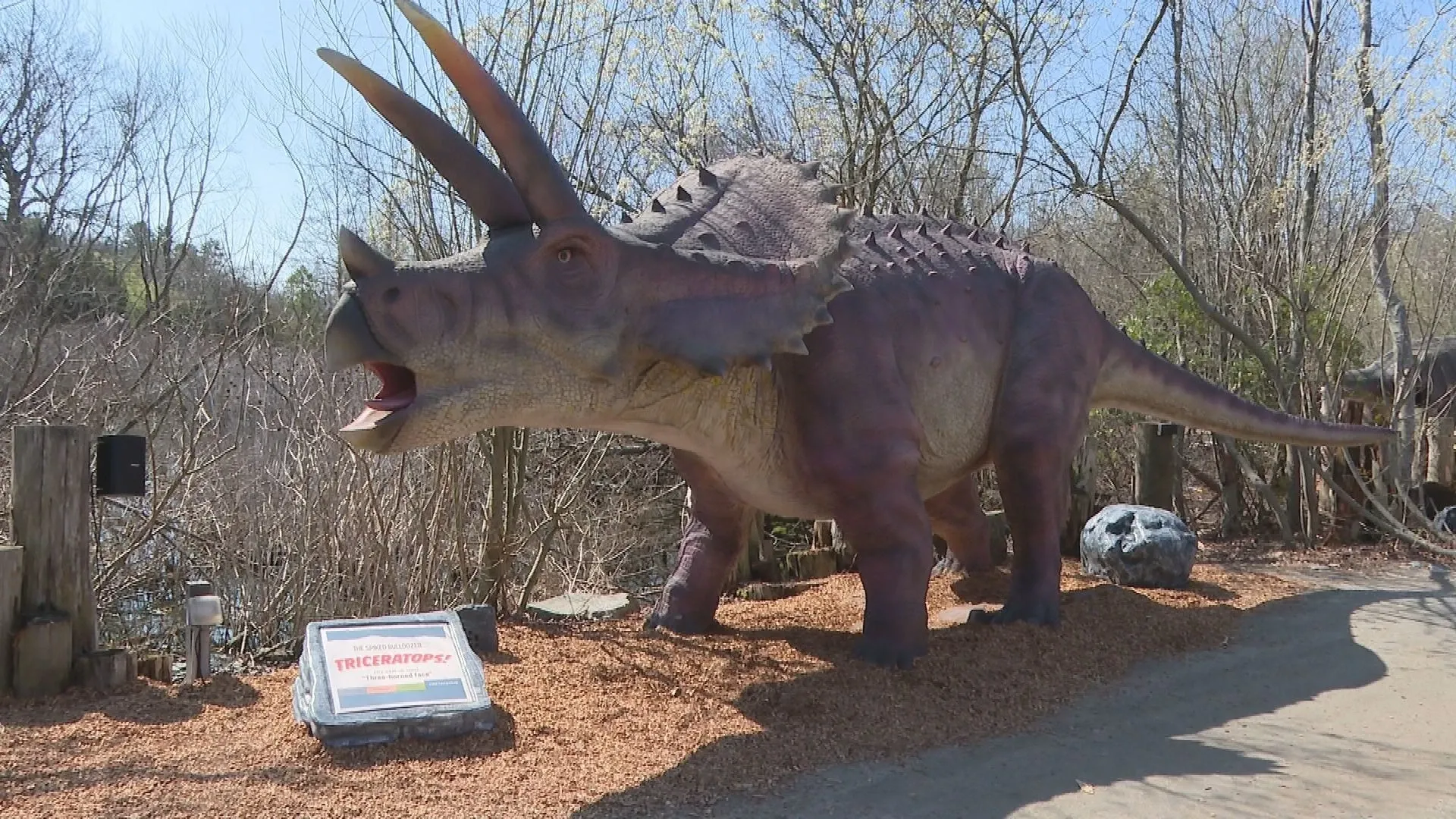
Animatronic TriceratopsA standard Animatronic Triceratops typically measures 6 to 8 meters in length and 2.5 to 3 meters in height. Its broad neck frill covers up to 1.5 square meters, while the textured silicone skin helps diffuse ambient light effectively. Night tour records from Leu Gardens in Orlando show that this installation increased the average dwell time of family visitors with children aged 3 to 8 to 4.2 minutes. Its built-in brushless servo motors keep operating noise below 40 dB, so even when placed just 1.5 meters from the walkway behind a close barrier, the mechanical motion does not interfere with the surrounding soundscape. Projection Panel & Lighting EffectsThe fan-shaped frill behind the Triceratops’s neck spans a full 1.5 square meters. Technicians apply a specially formulated matte coating over the dark gray silicone surface. Light meter readings show that the skin’s reflectance remains consistently between 0.15 and 0.22. Under illumination, it never looks harsh or glossy, but instead resembles rough, natural hide. Set crews typically position two 300 W LED profile lights about 2.5 meters from the dinosaur. The edge falloff is calibrated to decrease by 15% per 10 centimeters, allowing the beam to stay precisely within the edge of the frill. No excess light spills onto the dark foliage behind it. To fully illuminate the frill, a single fixture output of 3200 lumens is ideal. The beam angle is locked at 24 degrees by the control console. The surface is textured with biomimetic grooves and recesses about 5 mm deep, so angled lighting immediately brings out strong dimensional shadows. Lighting consoles usually use amber light in the 580 to 595 nm range to illuminate the skin. At night outdoors, this color temperature can achieve a CRI of 95. Warm-toned light clearly reveals the dark brown markings along the edges of the keratin-like texture. When the color temperature switches to 2800 K within one second, the massive, heavy-bodied presence of the dinosaur becomes even more pronounced. The alternation frequency between warm and cool lighting is set to 0.2 Hz, matching the dinosaur’s 4-second breathing cycle. Lighting designers often project a GOBO leaf pattern across the frill to simulate mottled shadows from overhead branches. The heat-resistant glass pattern disc is only 1.1 mm thick, yet it can withstand temperatures of 450°C near the lamp. A small motor rotating at 0.5 rpm is mounted in front of the lamp. It keeps the projected leaf-shadow blur radius between 8 and 12 cm, allowing the shadows to drift slowly across the frill and creating a convincing illusion of wind moving through trees. When planning the surrounding lighting for this Triceratops, the physical layout is tightly controlled:
The low-lying fog machine on the ground can output 4000 cubic feet of white fog per minute. The water-based fog fluid produces extremely fine particles measuring just 1 to 2 microns in diameter. On still nights, dense white fog can remain low over the grass for up to 45 seconds before dispersing. Beneath the fog are often several 120-degree wide-angle LED wall washers, creating a 15 cm-thick blanket of blue-violet light at ground level. To make this visual effect stand out, the base lighting around the visitor pathway is kept very dim, with measured illumination under 5 lux. Inside the eye sockets are two custom 4 cm-diameter acrylic eyeballs. A small recess is carved behind each eye to hold a 0.5 W warm-white LED. The brightness is intentionally limited to under 15 nits. The effect is faint and natural, closely matching the low-light physiology of nocturnal animal pupils. When strong outdoor lighting interacts with the silicone skin, several measurable physical characteristics remain consistent:
Control signals sent from the DMX512 console are hardware-limited to a delay of under 20 milliseconds. As soon as the speaker inside the dinosaur emits an 80 Hz low-frequency rumble, the four strobe lights mounted in the surrounding trees flash at 3 times per second. Each flash lasts 1.2 seconds and emits red light at 620 nm. The floodlights hidden in the grass are housed in high-density die-cast aluminum enclosures. The heat-dissipation fins on the back are precision-machined with 4 mm spacing. The internal waterproof seals can withstand water impact at 12.5 liters per minute. The copper contacts inside the connectors are plated with 3 microns of real gold, and even after six months of outdoor rain exposure, the electrical resistance changes by less than 0.1 ohm. Visitors usually observe from outside a safety rope about 2.5 meters away. The 1.2-meter horn on the dinosaur’s nose is often highlighted by a dedicated 20 cm-wide spotlight beam. The contrast between the bright spine and the shadow beneath the belly reaches 1:8, visually separating this 8-meter-long giant from the dark forest background. Laboratory testing with infrared thermal imaging shows that after a 300 W fixture runs continuously for 4 hours, the metal housing remains below 55°C. Even if a child accidentally touches the housing while passing by, it will not cause burns. The frontal lighting that falls on visitors’ faces provides approximately 150 lux of vertical illuminance. This gives smartphone cameras enough light to capture clear, noise-free facial photos at night while standing in front of the dinosaur. Motion Programming & Mechanical ParametersSupporting this 8-meter-long creature is an extremely robust galvanized steel frame. The square tubing used in the load-bearing legs has a wall thickness of 3 mm. After fabrication, the frame is submerged in a 450°C molten zinc bath for full galvanization. Even when this 800 kg machine is placed outdoors for years in rainy cities like Seattle, the frame shows no visible rust. Inside the frame are 7 brushless servo motors handling the major mechanical functions. All are powered by a 24 V low-voltage supply. Even with the full body in motion, sound meter readings remain at 40 dB, so families standing just 1.5 meters away behind the safety rope hear no noticeable metal gear noise. The breathing motion relies on an 8 cm aluminum push rod inside the abdomen. Both ends are padded with thick foam, pressing gently against the outer silicone skin. Every 4 seconds, the belly rises and falls by 4 to 6 cm. A Florida amusement park subjected this mechanism to stress testing, and the rod completed 150,000 continuous reciprocating cycles without failure. The Triceratops supports a 1.5-square-meter frill on its neck. Inside are two heavy-duty dual-axis motors capable of outputting 50 N·m of torque. The grazing motion is programmatically limited to a 10 to 15-degree downward tilt. A full lowering-and-raising cycle takes 6 seconds. The jaw movement is tightly synchronized with the low-frequency rumble from the speaker system. Once the audio board sends the signal, the hardware keeps the delay below 20 milliseconds. The jaw opening is controlled precisely at 15 cm, and built-in limit switches prevent the lower jaw from opening too far and damaging the outer skin. The blinking frequency is fixed at 8 to 10 times per minute. Miniature pull-wire motors hidden inside the eyelids complete a full blink in just 0.8 seconds. The 4 cm-wide eyelid edges are lined with 0.5 mm black flocking, which absorbs the sound of the metal eyelids closing together. The tail is programmed to sweep left and right through a 20 to 30-degree arc. It is 2.5 meters long and contains 5 universal joints in the internal frame. Driven by a motor pulling a steel cable, the tail takes a slow 8 seconds to travel from one side to the other. Installation crews mark out a 2-meter-wide exclusion zone behind it to prevent accidental contact. The control board assigns the following power specifications to each moving part:
All motor wiring uses 16 AWG solid copper cable, enclosed in corrugated flame-retardant conduit. The connectors are IP65-rated waterproof aviation plugs manufactured by Weidmuller, Germany. Even during heavy rain of 40 mm per hour, no water enters the threaded metal sockets. The main control box is concealed inside an artificial rock beside the front leg. Inside the enclosure, a 3000 rpm cooling fan continuously pulls hot air outward. Even under 35°C outdoor heat in California, after 12 hours of continuous operation, the internal board temperature remains below 45°C. The four legs stay anchored to the ground through a clearly defined set of physical specifications:
Two eccentric vibration motors are mounted on the steel frame along the inside of the thighs. Their speed is set to 800 rpm. Every time the dinosaur roars through its speaker system, the motors vibrate intensely for 2 seconds. Through the thick silicone skin, visitors can actually see a realistic trembling effect in the thigh muscles before the roar. All motion programs are stored on a standard 8 GB SD card. Technicians simply insert the card and switch a few small toggles on the main board to change the behavior sequence. During quiet daytime hours, the unit can be set to an energy-saving mode that activates once every 10 minutes. At night, when visitor traffic increases, the program forces all motors into full-duty continuous operation. Before leaving the factory, all bearing points are packed with lithium-based grease. This lubricant remains stable from -20°C to 120°C. According to maintenance guidelines from the American theme entertainment industry, outdoor equipment only needs relubrication every 1500 operating hours. Site Planning & Trigger MechanismBefore installing this 8-meter machine on a lawn, the construction team first excavates a shallow pit measuring 9 meters long by 4 meters wide. The base is filled with 15 cm of crushed stone for drainage. During Orlando’s rainy season, when rainfall can reach 40 mm in one hour, this gravel bed can drain standing water within 3 minutes. Even after multiple days of heavy rain, the 800 kg unit does not sink by even 1 mm. Along the edge of the pit, carpenters build a 2.5-meter-wide semicircular viewing deck using pressure-treated lumber. The wooden railing leaves exactly 1.5 meters of clearance from the Triceratops’s nose horn. Around the pathway runs a 1.2-meter-high rope barrier, positioned roughly at adult waist height. Children aged four or five can lean against it with an unobstructed view, yet cannot reach the machine even with fully extended arms. Once the perimeter is complete, technicians install the trigger mechanisms for visitor interaction. Infrared motion sensors are hidden in nearby artificial foliage. Their detection range is limited by the manufacturer to a 120-degree fan-shaped field, with a maximum reach of 5 meters.
When a visitor steps into the 3-meter activation zone, the sensor sends a low-current signal to the control box in under 0.5 seconds. The resting Triceratops immediately begins a 45-second greeting sequence. It spends 6 seconds slowly raising its heavy head, while the two 100 W waterproof speakers hidden in the belly begin playing sound. The 60 to 150 Hz low-frequency rumble measures just 75 dB at 3 meters, based on sound meter testing. Some theme parks consider infrared triggering insufficiently precise and instead replace it with industrial through-beam laser sensors. Two palm-sized black transmitters are fixed to tree trunks on either side of the deck:
Technicians also adjust a cooldown knob on the main board to prevent the dinosaur from triggering repeatedly without pause. After one visitor group activates the sequence, the unit is forced into a 120-second sleep cycle. This two-minute rest period can reduce the surface temperature of the motor housing by at least 5°C before the next activation. The artificial rocks that house the speakers are built to a very high standard. Their shells are molded from fiberglass with a thickness of 8 mm, making them solid and impact-resistant. The surface is coated with three layers of waterproof resin paint, while the inside is packed with dense acoustic insulation to suppress unwanted rear speaker noise. The bass reflex port faces downward at a 15-degree angle, so rainwater drains away naturally. Rules for site cabling are non-negotiable. All power cables must run through PVC rigid conduit with a 32 mm outer diameter. The conduit is buried 20 cm underground, covered with a red warning strip, and then backfilled. Even when groundskeepers drive heavy lawn mowers repeatedly across the grass, the blades cannot reach the 2.5 mm² solid copper conductors inside the pipe. At one night safari park in the UK, pressure sensors were installed beneath the boards of the viewing deck. From the surface, each one looks like an ordinary timber plank. When a load of more than 15 kg is applied, the internal spring compresses by 2 mm, immediately closing a micro-switch. The Triceratops’s eyes snap open within 0.8 seconds. Daily site planning must also leave working space for future maintenance. Exactly 2 meters behind the dinosaur, workers intentionally plant a cluster of real ferns over 1 meter high.
Large outdoor machines must also be protected against strong nighttime winds. Park electricians mount a compact three-blade anemometer at the top of a 10-meter lamppost nearby. If wind speed exceeds 17.1 m/s, the anemometer triggers the main AC contactor and cuts power automatically. The several-hundred-kilogram machine becomes a fully static mass of steel on the ground, ensuring it cannot tip over in severe wind. |